
[7]
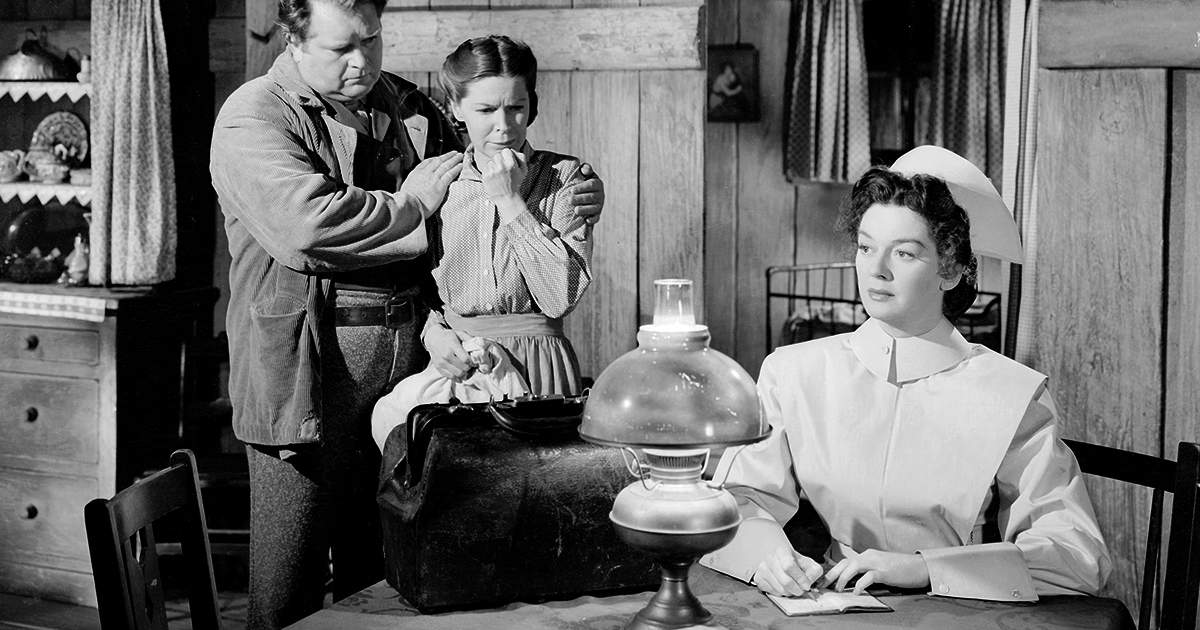
Rosalind Russell (His Girl Friday, Auntie Mame) stars as a rural Australian nurse who discovers an effective treatment for polio-related paralysis, saving countless children from becoming invalids. But rather than embracing her discovery, the medical establishment punishes her — branding her a ‘quack’ and closing down her clinics, only because she dared to challenge the traditional methods. (And, let’s face it: because she’s a woman, too.)
Based on the true story of Elizabeth Kenny, Sister Kenny is a film about determination and perseverance. It takes place over many decades, juggling both Kenny’s personal and professional lives. While the main plot focuses on her life-long battle with dismissive governments and medical institutions, there’s a subplot involving her relationship with a man played by Dean Jagger. That relationship gets put on hold over and over again while Kenny is continually pulled into the field to help ailing children. She ultimately sacrifices marriage and any kind of normal life, devoting herself to treating polio in Australia, England, and finally, in America.
I’m sure this film is fictionalized to some degree, but it’s maddening to think this woman’s proven, life-altering treatments went ignored for so long, just to preserve tradition (or patriarchy). I was expecting a much happier ending to this movie, but I guess Elizabeth Kenny’s ultimate vindication was a painfully slow and gradual one. When Kenny sold the rights to her story to RKO pictures, it was stipulated in her contract that only Russell could play her. Rosalind Russell is reliably terrific in the lead role, for which she received her second of four Oscar nominations. The project was especially meaningful for her, because she had a nephew who was successfully treated with the ‘Kenny method’.
Directed by Dudley Nichols. With Alexander Knox as Kenny’s most trusted medical colleague, Philip Merivale as her most vocal critic, and Beulah Bondi as Kenny’s mother.
Oscar Nomination: Best Actress (Rosalind Russell)