
[7]
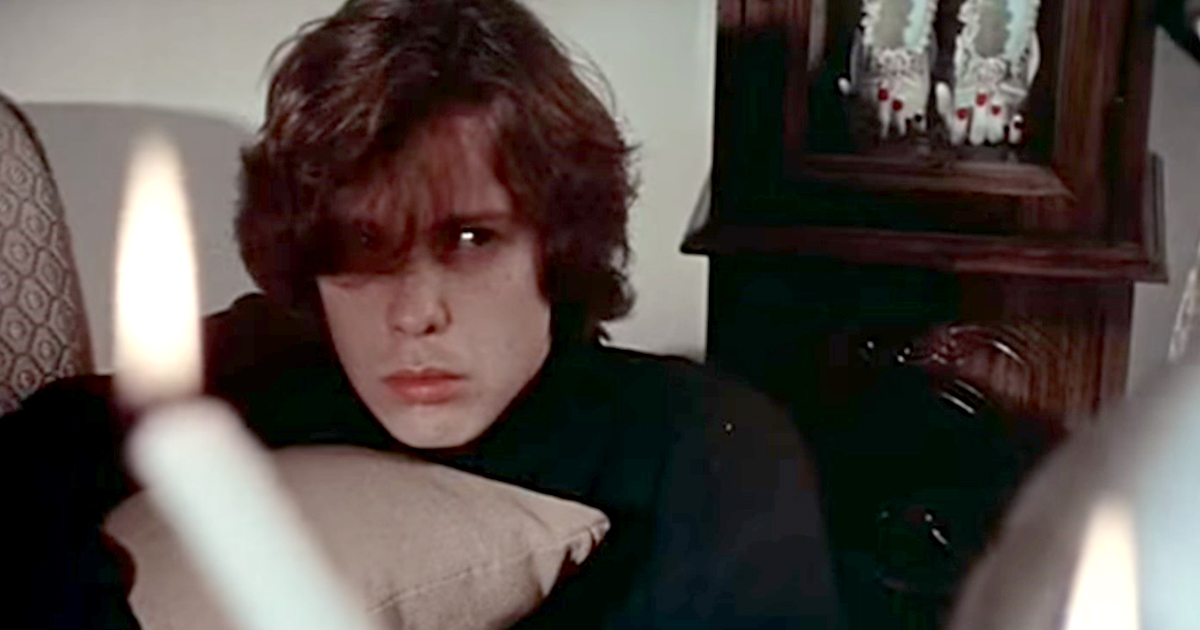
Director George Romero (Night of the Living Dead) often said Martin was his favorite among his films. John Amplas stars as Martin, a painfully shy and sullen young man who looks to be twenty years old, but claims to be an eighty-year-old vampire. The film opens with Martin taking a train to come and live with his uncle in Pittsburgh. During the trip, Martin sedates a young woman, makes love to her unconscious body, and then drinks her blood. At the train station he’s picked up by Tata Cuda, his Romanian uncle (Lincoln Maazel) who repeatedly calls him “Nosferatu” and promises to save his soul — or destroy him if he kills anyone from the neighborhood. The only person who doesn’t think Martin is a vampire is his uncle’s granddaughter (Christine Forrest), who shares the house with them and quarrels with Tata Cuda as much as Martin does.
Martin may not be as exciting or viscerally thrilling as Romero’s more famous Living Dead films, but it’s an interesting and sensitive character study. Romero, who also wrote the film, never fully discloses whether or not Martin is really a vampire, or if he might be suffering from mental illness. The plotting is loose, struggling with focus in its final half-hour, but remarkable in the way it keeps us engaged with its title character. Even though Martin kills people, he seems conflicted about having to do so. He uses the hypodermic needles to put his victims to sleep, apologizing to them profusely while they struggle in his arms. He admits to a call-in radio show host that he’d like one day to ‘do the sexy stuff without the blood’, inviting an intriguing layer of psychosexuality to the movie.
Amplas’s performance is what brings Martin together. He’s quiet and soft-spoken, pulling us into several lengthy scenes without even saying a word. He conveys a lot with his eyes and body language. He makes it possible for the audience to step inside Martin’s uncomfortable skin for a while. We sympathize with his social awkwardness and his desire to be intimate with people, even if his methods are condemnable. At one point, Martin confesses to the radio show host that it’s hard “to get people to do what you want them to do”. Can’t we all relate with this sentiment? Martin makes me wonder if perhaps the only difference between heroes and monsters is our ability to disguise our primal, selfish aims through convincing social etiquette.
With Tom Savini and Elyane Nadeau.