
[8]
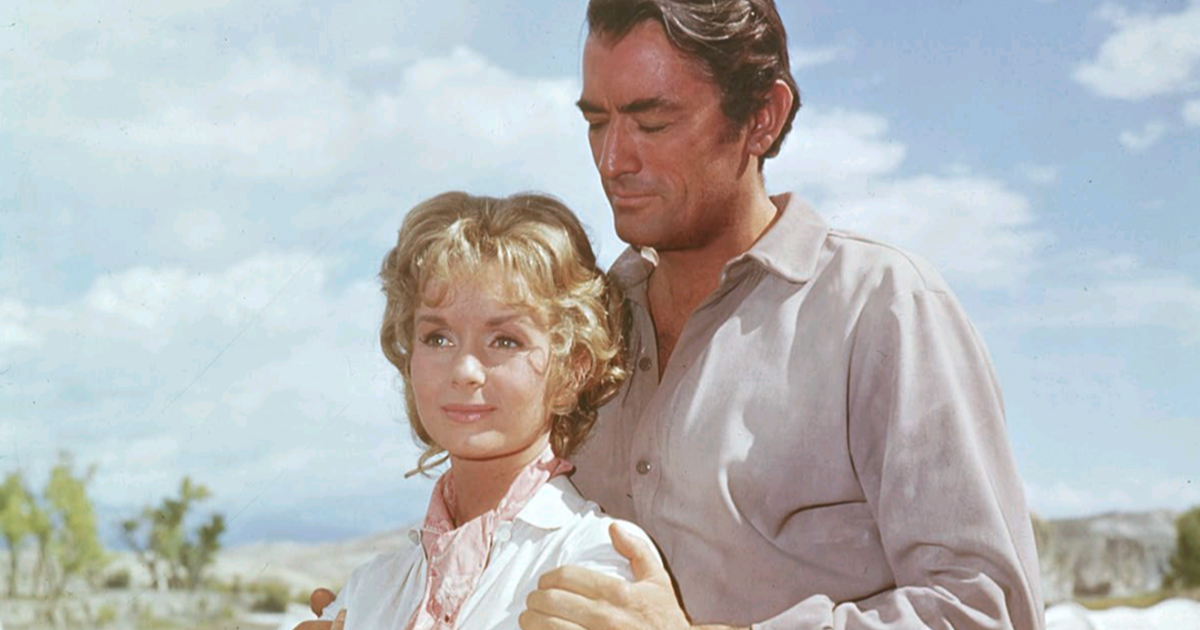
Debbie Reynolds and George Peppard get the lion’s share of screen time in the all-star epic western How the West Was Won. The film chronicles the Prescott family as they charge west in the 1830s, encountering river pirates, deadly rapids, Civil War combat, incursions with Native Americans, and villainous outlaws. The Oscar-winning script is divided into five interlocking stories, with Reynolds featuring in three of them. Her character, Lilly Prescott, loses her parents on the family’s westward trek and winds up in a love triangle with Gregory Peck and Robert Preston before striking it rich in San Francisco. Meanwhile, her sister Eve (Carroll Baker) builds a farm at the site of their parents’ death and shacks up with a mountain man played by Jimmy Stewart. The Civil War claims Stewart’s life and sends their son Zeb (Peppard) into adventures with the transcontinental railroad and a gang of outlaws led by Eli Wallach. The final story takes place in the 1880s, reuniting an aged Reynolds and Peppard — aunt and nephew.
How the West Was Won was one of few films shot in the expensive Cinerama process, which involved three cameras rolling side-by-side during filming and projection to create the widest image in film history (nearly three times as wide as it is tall). The process gives it a distinct look and feel, with ultra-wide vistas and deep focus throughout the film. The cameras are often placed to simulate first-person perspective, placing the audience right in the middle of some thrilling action sequences including the white-water rapids scene, a buffalo stampede, and a climactic train crash.
The film’s impressive cast also includes Henry Fonda as a mountain man who helps Peppard negotiate with the Indians on behalf of the railroad company, Karl Malden as Lilly and Eve’s father, and John Wayne in a relatively brief role as Union general William Tecumseh Sherman. The film is narrated by Spencer Tracy, who underlines the American spirit of adventure and progress between story segments.
At nearly three hours long, some viewers may find the film a little disjointed in its storytelling, but for an anthology tale, I found all the different segments equally engaging. Each is anchored by warm sentiment and moments of spectacle. Not every actor gets a chance to shine, but it’s still impressive to see so many well-known actors appearing in the same film. It’s not as well-regarded as classic, single-story Westerns like The Searchers, Stagecoach, or Rio Bravo, but How the West Was Won nevertheless succeeds in inviting the audience to feel that they are a part of the story and in capturing the multi-faceted essence of the American Western. For maximum effect, this is a film that needs to be seen in surround sound on the largest screen possible.
Elevating the viewing experience to often euphoric levels is the sumptuous score by the legendary Alfred Newman with extensive choral work by Ken Darby. The electrifying main title track practically gallops off the screen, beautifully capturing the bold courage and moral fortitude of all those who laid the groundwork for westward expansion. Newman and Darby also give us an achingly romantic song performed by Debbie Reynolds titled “Home in the Meadow”. Darby contributes so many richly-arranged folk songs and hymns, you could almost consider the film a musical — one where every song happens to be a highlight, and where the choral work is so stunning, the film almost starts to feel like a religious experience.
Directed by Henry Hathaway, John Ford, and George Marshall. With Carolyn Jones (The Addams Family), Lee J. Cobb, Richard Widmark, Walter Brennan, Agnes Moorehead, Harry Morgan, Thelma Ritter, and Russ Tamblyn (Twin Peaks).
Academy Awards: Best Original Screenplay, Film Editing, Sound
Oscar Nominations: Best Picture, Color Cinematography, Color Art Direction, Color Costume Design, Score