
[4]
Christopher Nolan is not one of my favorite directors. Occasionally he’ll make a movie that emotionally grips me, like Inception or Interstellar, but I more often than not find his work cold and hollow — like Oppenheimer or Dunkirk. Even when the films are intrinsically emotional in their core concepts, Nolan somehow finds a way to make them feel too austere or sterile for me. This is the case for his interpretation of Homer’s foundational epic, The Odyssey. While the filmmaking is on a grand, old-fashioned scale that I’d normally appreciate, I found the film uneven and messy in its overall impact.
The plot points are largely faithful to a story so old, it literally predates The Bible. Matt Damon plays Odysseus, a Greek king trying to lead his soldiers back home to the Greek island of Ithaca after winning the Trojan War. The journey takes twenty years, as Odysseus and his crew become lost at sea, plagued by a string of setbacks and deadly encounters. Meanwhile, back in Ithaca, his queen Penelope (Anne Hathaway) fends off dozens of suitors, clinging to the hope that Odysseus is still alive and will one day return. As a suitor named Antinous (Robert Pattinson) schemes to win the throne, Odysseus’ and Penelope’s son, Telemachus (Tom Holland), leaves the safety of the palace to learn what he can of his father’s whereabouts.
Nolan’s Odyssey is a full three hours long, and I wish I could say that it didn’t feel that long. The first half of the film is a bit of a slog. It’s told in unrelenting flashbacks, jumping back and forth through time in a choppy fashion that induces discombobulating whiplash. It feels like Nolan is grabbing us by the collar, shoving us into a corner, and force-feeding us all the stuff we need to know for a quiz on Homer’s tale. There’s no grace in the storytelling for that first half — it’s clunky and off-putting.
The middle third of the film will be a lot of people’s favorite — it was mine. This is the episodic portion, where Odysseus and his men encounter the fearsome Cyclops, the monstrous Scylla and Charybdis, the dark sorceress Circe (Samantha Morton), the deadly sirens, and more. The Cyclops and Circe sequences are the most thrilling standout moments in the film, as is Odysseus’ visit to the Underworld where he learns from the dead how to find the path home. As good as this middle part of the film is, it’s somewhat undercut by Nolan’s determination to tell a very earth-bound version of The Odyssey. He downplays all supernatural elements of the story as much as possible. The famous Greek gods do not appear in this movie as they do throughout Homer’s story (with Athena being one ambiguous exception). This decision makes it jarring whenever something supernatural does occur. The Cyclops, Circe, and other creatures all feel out of place in their own mythic story because Nolan has placed the anchor of realism around their necks.
Then we arrive at the third act, which is sure to be the most divisive. Some will enjoy the revenge-laded climax in which Odysseus single-handedly slaughters dozens — a scene I found jarringly out of place, like something from a Quentin Tarantino movie. Purists will object to Nolan’s attempts to turn classic literature into a very modern-day, anti-war parable. He deconstructs the character of Odysseus, replacing his raw unfettered heroism with post-traumatic stress and war-crimes guilt. The choice gives Matt Damon something to play, reminding me a lot of Frodo in The Lord of the Rings. Both characters experience things that rob them of their innocence to such a profound degree, that in a sense, they can never go home again.
I might have liked this added, dramatic depth, except that it only succeeds in making Nolan’s Odyssey more grim and depressing. There is a disconcerting lack of joy and beauty in this film — nothing to counterbalance the pervasive gloom and doom. We never once see Odysseus happy with his wife or son, and the world around them is only ever portrayed as cold and brutal. The love between a husband and wife, a father and son, should have been the dramatic engine that drove this movie, but as with many Nolan films, the human element is severely repressed. For me, the film needs more emotion and a more traditionally romantic tone to give Odysseus and his crew more reason to live and see their home again.
The casting is serviceable overall. Damon isn’t flashy, giving the kind of performance I might appreciate more on repeat viewings. The only standout, award-worthy performance is Anne Hathaway’s. Her Penelope is a mightily conflicted character, buckling under pressure while clinging to her convictions, secretly dying to lash out at a world that dares place her in such a position. Nolan’s contemporary take on her character is his best addition to the story. Robert Pattinson plays a good villain, while John Leguizamo is memorable (and almost unrecognizable) as a close family friend to Odysseus and Telemachus.
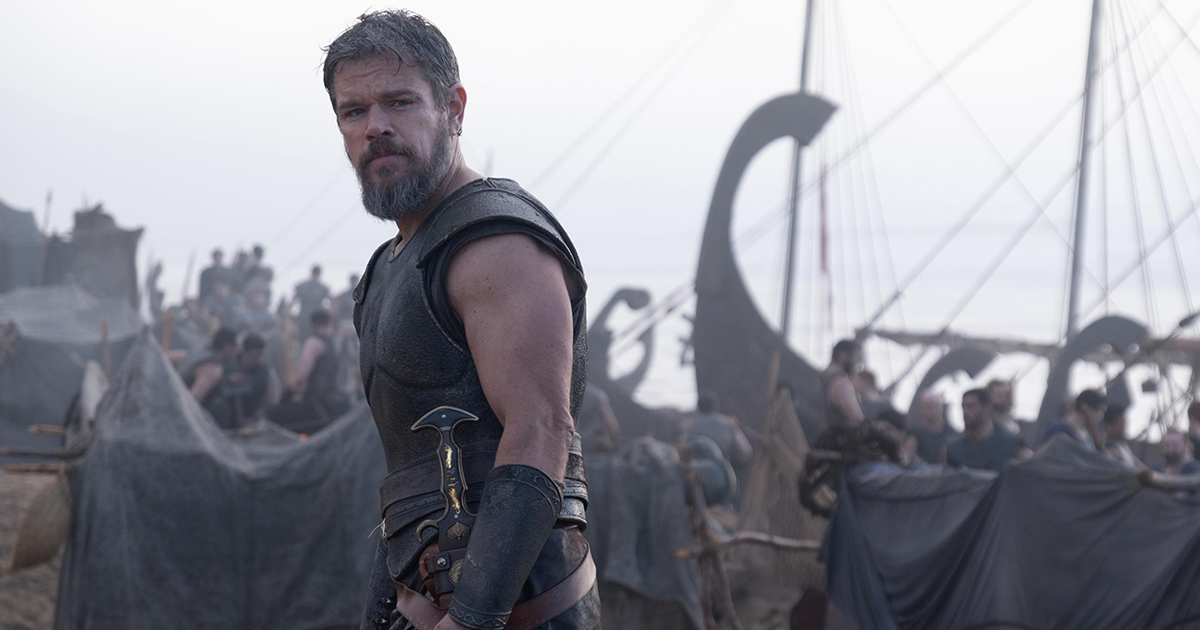
Here’s a hot take I’m sure I’ll catch flack for: Nolan’s Odyssey is a profoundly ugly movie. And aesthetics matter more to me than most people, which might explain why this movie leaves me feeling pretty indifferent. Nolan went to the trouble and expense to shoot this film in 70mm IMAX — the first film ever to be shot entirely in the format. But then he refuses to put any color into it. The photography is so desaturated, and the lighting is so flat-to-dim, why bother with such a deluxe treatment? On top of that, the sets, costumes, and overall production design are all so simple and unadorned, I couldn’t find anything to appreciate on a stylistic level. The film looks as boring as it possibly could.
And it sounds worse, with an annoying ‘score’ (if you can call it that) by Oscar-winner Ludwig Goransson. Even though little else of The Odyssey is ‘historically accurate’, Nolan insists on a period-accurate score without any strings or traditional instrumentation. The result is Ludwig Goransson banging on drums while a wordless choir moans incessantly throughout the whole movie. This approach could have worked in isolated instances, but the score is a big miss in this movie. A traditional orchestra, with much-needed strings, could have easily restored a lot of the story’s missing emotion. When you try to imagine Star Wars without John Williams’ music, I imagine it feeling a lot like Christopher Nolan’s The Odyssey.
While I liked a few parts of this movie — the Cyclops, Circei, Anne Hathaway, the Underworld sequence, and a certain dog character (who gets the film’s sole emotional moment) — it just didn’t work for me overall. The earthbound approach to the story robs it of magic and romance to the point where the best parts of the film don’t feel like they belong in it. I’m also tired of Hollywood’s stubborn, recent trend of deconstructing classic tropes and narratives. I prefer a more unabashedly heroic Odysseus, not one who feels bad about doing his duty. I also prefer my epic myths be directed with more humanity, emotion, and beauty than Christopher Nolan is inclined to deliver.
With Charlize Theron, Zendaya, Jon Bernthal, Elliot Page, Travis Scott, Mia Goth, and Lupita Nyong’o.