
[9]
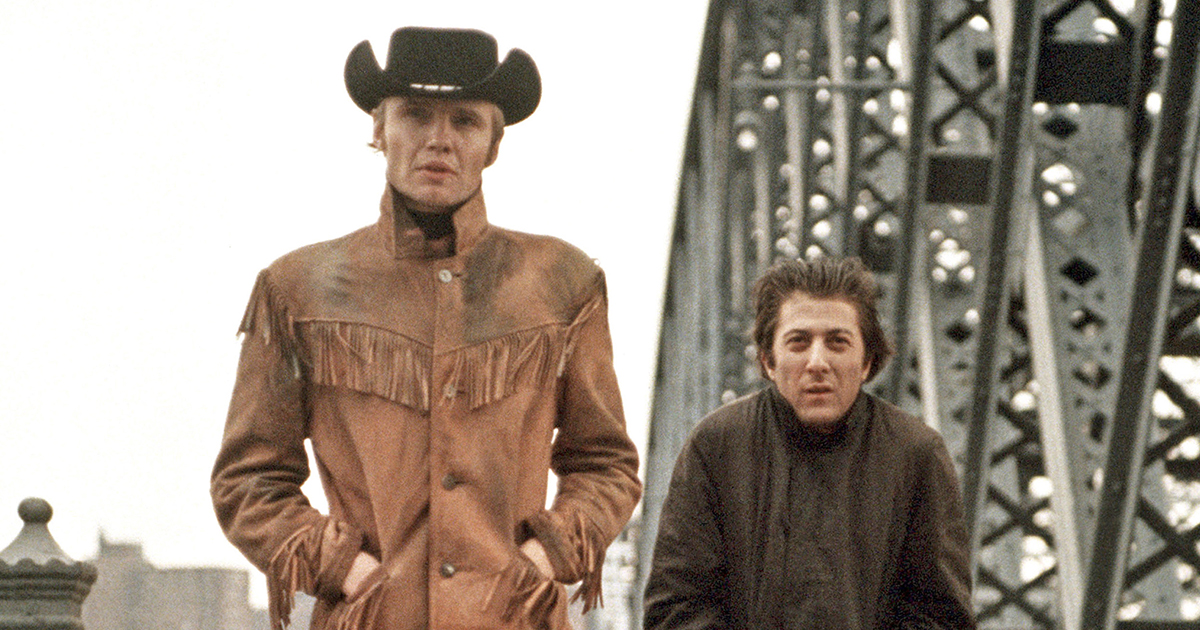
Director John Schlesinger (Sunday Bloody Sunday, Marathon Man) turns James Leo Herlihy’s novel about a Texas hick trying to make it as a gigolo in New York City into a touching and marvelously well-made film. Jon Voight stars as Joe Buck, a naive young man who thinks his only gift is his ability to please women in bed. So he hits the Big Apple decked out in cowboy attire — since that’s the kind of man his grandma always liked. He finds it exceedingly difficult to turn a profit, though. He eventually finds himself evicted and penniless, but it’s in the gutter where he finds a new, unlikely best friend — ‘Ratso’ Rizzo (Dustin Hoffman). Rizzo walks with a limp and lives in a condemned building, but he teaches Buck how to survive — and never to give up on his dreams.
The relationship between Buck and Rizzo has to be one of the most unusual and touching ones in all of film history. These are the kinds of people who go largely ignored by the general public — the homeless and ‘eccentric’. But Schlesinger, Herlihy, and screenwriter Waldo Salt open up their world to the audience. While these characters do their fair share of bickering and blaming, they also have an innate kindness about them that makes them endearing. That kindness, combined with their determination to make a better life for themselves, makes Midnight Cowboy — strangely enough — a lot like many war films. It’s a love story between straight men who prop each other up through the worst of times.
The cinematography is suitably gritty and unadorned, while the film editing is frequently stylized to provocative effect. A lot of backstory and character psychology are conveyed through dream-like montages that combine memories of the past with dreams of the future. These sequences work almost subliminally, giving us an impression of Buck’s past and his current motivations. The experimental style isn’t at all pretentious, though — it underscores and enhances the story’s emotion in ways that sidestep any potential sentimentality.
The performances are outstanding up and down the cast roster. Jon Voight became a star with his charming but vulnerable performance. Dustin Hoffman, hot off The Graduate, transforms strange little Rizzo from a caricature into a fully-fleshed out, fearful and sympathetic human being. Every single supporting performer is excellent in their limited screen time, including Brenda Vaccaro (Supergirl) as one of Buck’s few successful hookups, Sylvia Miles as an emotionally distraught ‘customer’ who ends up costing Buck money instead of paying him any, and Barnard Hughes (The Lost Boys) as a wealthy man who propositions Buck, only to waffle between his desires for Buck to pleasure or punish him.
This film was originally rated ‘X’, but after it won the Best Picture Oscar, the Academy reassessed that decision and re-branded it with an ‘R’. Other than a few fleeting shots of bare breasts, it’s not an explicit film. I can only assume the Academy took issue with the film’s content, which includes some frank, casual depictions of prostitution, drug use, and same-sex desire (Buck is straight, but he entertains a few male customers when he’s in dire need.) But these aspects play out only in the periphery of the film’s main storyline, which centers squarely on Buck and Rizzo’s camaraderie. So if you’ve never seen Midnight Cowboy, don’t let the old ‘X’ rating or anything you may have heard sway you from giving it a chance. It’s not a lascivious or dirty film. It’s a surprisingly warm, tender and uplifting one about human connection.
With Bob Balaban, John McGiver, and sparse but memorable scoring by the great John Barry.
Academy Awards: Best Picture, Director, Adapted Screenplay (Waldo Salt)
Oscar Nominations: Best Actor (Jon Voight), Actor (Dustin Hoffman), Supporting Actress (Sylvia Miles), Film Editing (Hugh A. Robertson)