
[3]
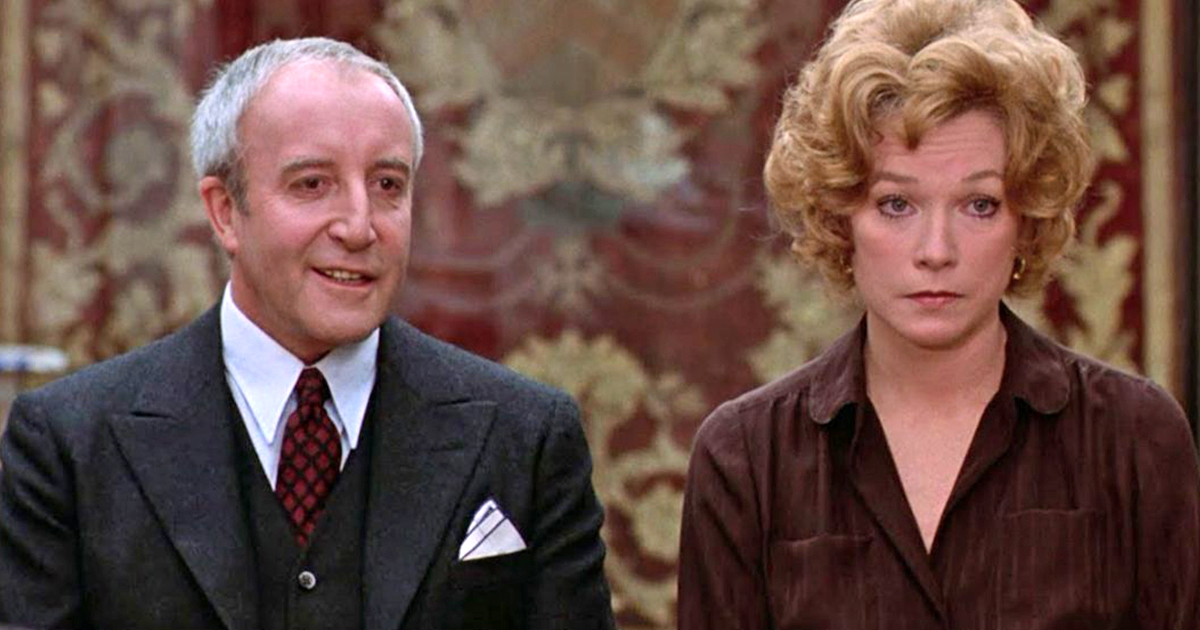
Pre-dating Forrest Gump by fifteen years is Being There, another movie about a simple-minded idiot who lucks his way into the good graces of society. Peter Sellers stars as Chauncey Gardiner, a gardener and avid TV watcher who is certainly on one far side of the autism spectrum. When his employer dies, Chauncey is forced to leave the only home he’s ever known. But he doesn’t wander the streets long before Shirley MacLaine’s limo driver accidentally runs him over.
MacLaine takes him to her sprawling mansion to recuperate, where he meets her uber-wealthy tycoon husband Benjamin Rand (Melvyn Douglas), who enjoys simple, down-to-earth conversations with Chauncey as he slowly dies from a rare blood disease. Before long, Rand introduces Chauncey to the President of the United States (Jack Warden), who quotes Chauncey on live television. Chauncey then becomes an overnight national treasure, sought by the press and the government as MacLaine’s character begins to fall madly in love with him. But what will happen if they ever find out he’s just a dim-witted fool whose statements have been taken far too seriously?
Being There‘s droll, sardonic humor might have been a breath of fresh air in the late ’70s, but I find the satire very one-dimensional. Jerzy Kosinski’s script seems to have no purpose other than to mock a world that would mistake an imbecile for a messiah. The joke gets old quickly, and there is nothing else in the narrative to latch onto. I don’t like Chauncey and I don’t think Sellers’ performance is anything special. He has no discernable character arc and delivers everything in a pleasant monotone. MacLaine’s character is just grist for the plot mill, turned into a laughingstock through her misinterpretations of Chauncey’s cryptic behavior. She ends up masturbating in front of him because he tells her, “I like to watch.” He means television, of course.
While the film as a whole doesn’t work for me, I’m a fan of Caleb Deschanel’s cinematography. I also found a few of the supporting performances far more engaging than the main characters. Douglas is compelling as the dying tycoon. You almost want the illusion of Chauncey’s brilliance to be maintained, if only for Douglas’s sake. My favorite character, though, is Douglas’s personal doctor, played by Richard Dysart (The Thing). He’s the only major character who comes to see Chauncey for the simpleton he really is. With that insight, he progresses to a point in the story no one else ever gets to: a moral crossroads. Does Dysart tell MacLaine, Douglas, and Warden’s President the truth about Chauncey? Or does he let the lie continue to grow? What harm, if any, is Chauncey doing to the other characters or the world at large? Dysart makes the most of these ideas with very little screen time. It’s too bad his character and performance have more substance to them than the rest of the movie.
Directed by Hal Ashby (Harold and Maude, The Last Detail).
Academy Award: Best Supporting Actor (Melvyn Douglas)
Oscar Nomination: Best Actor (Peter Sellers)