
[7]
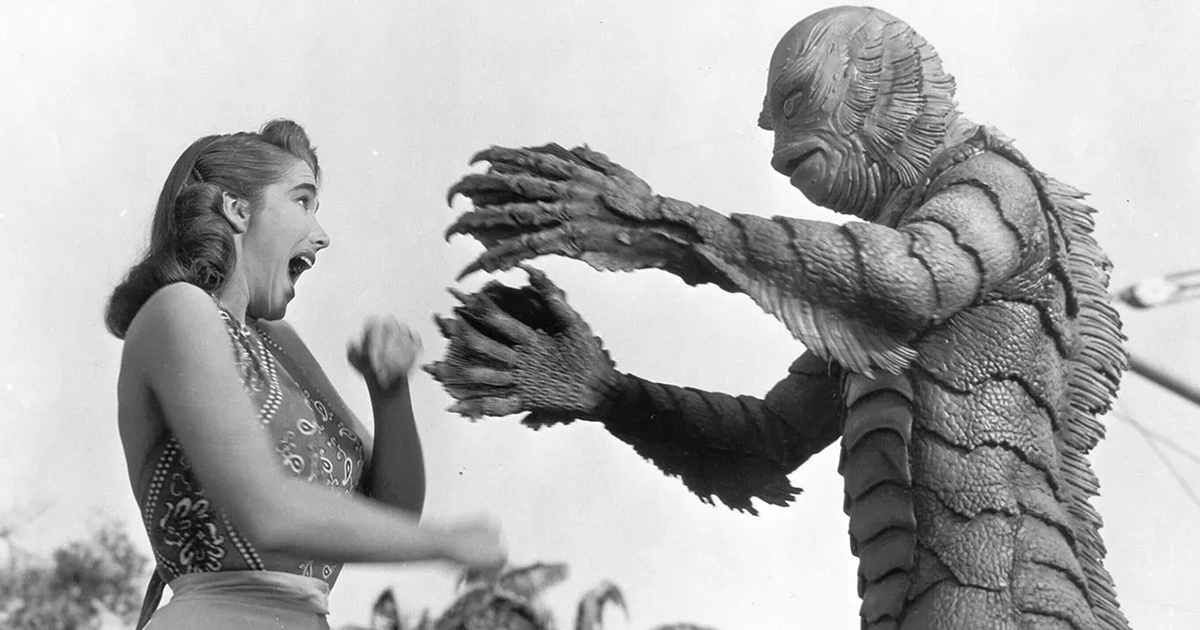
Scientists discover a prehistoric ‘man-fish’ in the Amazonian jungle and attempt to capture him for study. But we all know how that goes, right? When the creature takes a fancy to the lone woman in the expedition crew (Julia Adams), he tries to pick off the men to get to her. Creature from the Black Lagoon is regarded the last, albeit late-coming, franchise in Universal’s Classic Monsters collection. Even though the film has a more ‘atomic age’ vibe than the studio’s earlier gothic fare, the ‘Gill Man’ still feels at home alongside Dracula, Frankenstein, and The Wolf Man.
The script is pretty simple and straightforward and the characters are shallow stereotypes, but we have to remember this film was designed to entertain teenagers feeling each other up at a drive-in double-feature. It falls into a ‘rinse and repeat’ cycle of monster attacks until the last five minutes, climaxing later than most films as the Creature finally kidnaps Adams and takes her to his cave lair. Even though the Creature appears to be vanquished in the end, it’s interesting that the protagonists, as scientists, do not relish harming him.
Director Jack Arnold (The Incredible Shrinking Man, It Came from Outer Space) brings A-movie quality to a B-movie genre piece, assembling a cast of attractive, likable actors, shooting in a moody central location, and filling the film with several beautiful underwater sequences that really pop — especially if you watch the film in its native 3D format. And of course, the film also features one of the most iconic monster designs in Hollywood history. The music in the film features an annoying, abrasive musical motif that blares whenever the Creature appears, but other passages of the score are actually quite nice, particularly cues composed by Henry Mancini.
The Creature from the Black Lagoon isn’t high art and was never meant to be. Anyone giving it a first viewing 75 years later should do so with an awareness of it’s time and function. But as low-brow, schlocky product for teens, you might find it over-delivers in quality and entertainment. And if at all possible, see it in 3D — the 3D photography is more compelling than most modern 3D films.
With Richard Carlson and Richard Denning as the film’s studly male leads, Antonio Moreno, Nestor Paiva, and Whit Bissell.