
[10]
Charlton Heston stars as Judah Ben-Hur, a Jewish prince whose life is thrown into years of soul-crushing turmoil after being betrayed by a childhood friend. That friend, a Roman soldier named Messala (Stephen Boyd), turns against Judah after he refuses to inform against his Jewish neighbors. To make a ‘good example’ of Judah’s defiance, Messala imprisons Judah’s mother, Miriam (Martha Scott), and sister, Tirzah (Cathy O’Donnell), and sentences Judah to life as a galley slave on a Roman ship. After saving the life of the ship’s consul (Jack Hawkins), Judah is granted freedom — to find his mother and sister, and exact his revenge on Messala.
Ben-Hur is, by every measure, one of the biggest movies ever made. With enormous, fully-built period sets, thousands of extras, and at over three-and-one-half hours long, the film’s action, romance, and drama impressed the hell out of audiences in 1959. Adjusted for inflation, it’s still one of the twenty-five highest grossing films of all time, and no film has ever won more Oscars than Ben-Hur (although two films, Titanic and Return of the King, have tied with it).
The accolades and milestones are well deserved, because it’s truly a great film, anchored by a well-paced script that keeps us engaged from start to finish. Heston is prone to over-acting in other films, but director William Wyler keeps him in check for what is probably his career-best performance. Heston gets to show his range as Judah Ben-Hur, transforming from an optimistic community leader to a broken-down slave, to a vessel of vengeance, and finally to a humbled man of God. His relationships with Messala, the Roman consul, and Esther (Haya Harareet), the woman he would eventually marry, are the ones that challenge his character — providing the film its emotional backbone.
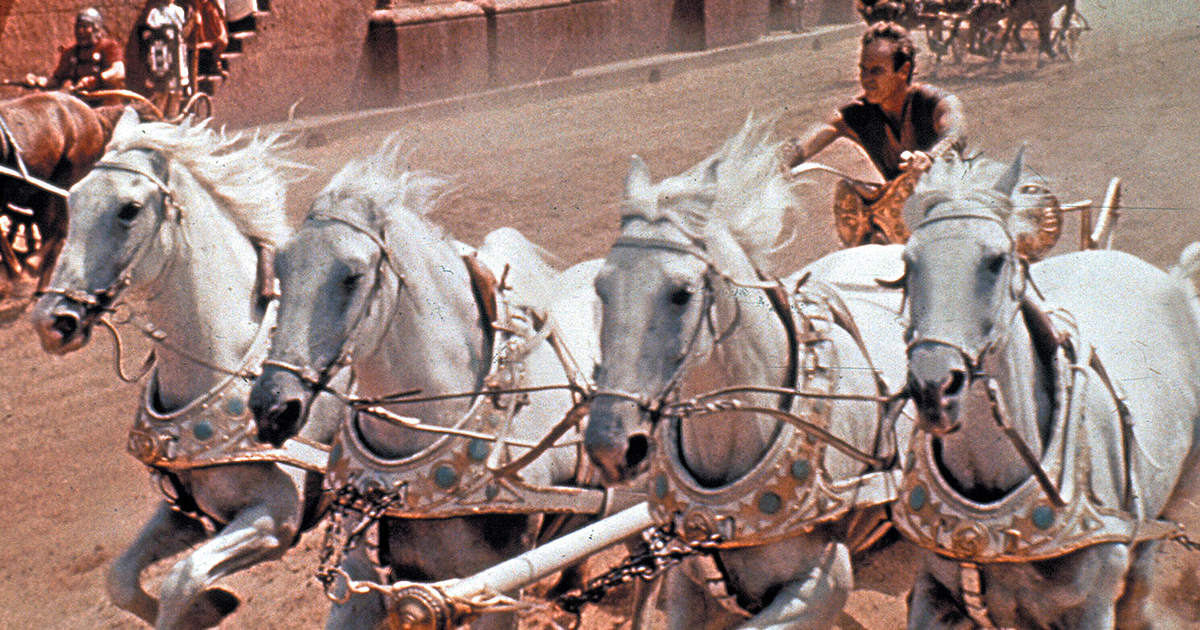
Ben-Hur is famous for its action scenes, particularly a maritime battle sequence and its much-celebrated climactic chariot race, a ten-minute tour-de-force of remarkable stunt work captured in breathtaking camera angles. But the action would mean little if the film didn’t provoke us on an emotional level. Karl Tunberg’s adapted screenplay, based on a novel by Lew Wallace, is ripe with pathos. Judah’s cold-hearted vengeance for Messala is equaled to the deep brotherly love they share at the story’s beginning. When Esther learns Judah’s mother and sister are still alive, afflicted with deadly leprosy, she promises to keep their whereabouts a secret from Judah — even though she knows he’ll stop at nothing to find them. The relationships in Ben-Hur are surprisingly nuanced. No one, not even Judah, is all good or all bad.
Well, except for one person. Ben-Hur is subtitled ‘A Tale of the Christ’, and indeed, Jesus Christ makes a supporting appearance — though we never hear his voice or see his face clearly. The film opens with his birth in the manger, then reintroduces him during a brief but fateful moment when he offers water to the condemned Judah as he’s being marched to the galleys. The last forty minutes return focus to Jesus, as Judah and Esther seek him out, hoping he can offer comfort or salvation to the dying Miriam and Tirzah. When they find Him, though, they witness him being persecuted worse than Judah ever was, as William Wyler re-enacts scenes of the crucifixion. I’m of two minds about Ben-Hur‘s ending. On one hand, I want Judah’s faith and perseverance to pay off for him and his loved ones. But on the other hand, I’m not sure that a literal, unambiguous miracle is the best way to end the movie.
Even though I might modify the ending, I wouldn’t cut a thing from Ben-Hur. It works exceedingly well at its epic length, taking us on an incredible, thrilling, emotional journey. I fell instantly under the spell of Miklos Rozsa’s grand score and enjoyed all the supporting players, including Hugh Griffith as the devious but charismatic sheikh who hires Judah to lead his four white stallions in the chariot race. We even get to know those damned horses a bit — enough to pray nothing happens to them. I literally gasped a few times during the race sequence. And I cried watching a man carry his dying sister out of a cave and into the light. Ben-Hur combines emotion, beauty, and grander as well as these things have ever been combined. It’s damn-near everything I want in a movie.
With Sam Jaffe, Finlay Currie, and Frank Thring as Pontius Pilate.
Academy Awards: Best Picture, Director, Actor (Charlton Heston), Supporting Actor (Hugh Griffith), Color Cinematography, Color Art Direction, Color Costume Design, Sound, Film Editing, Special Effects, Score (Miklos Rozsa)
Oscar Nomination: Best Adapted Screenplay (Karl Tunberg)