
[9]
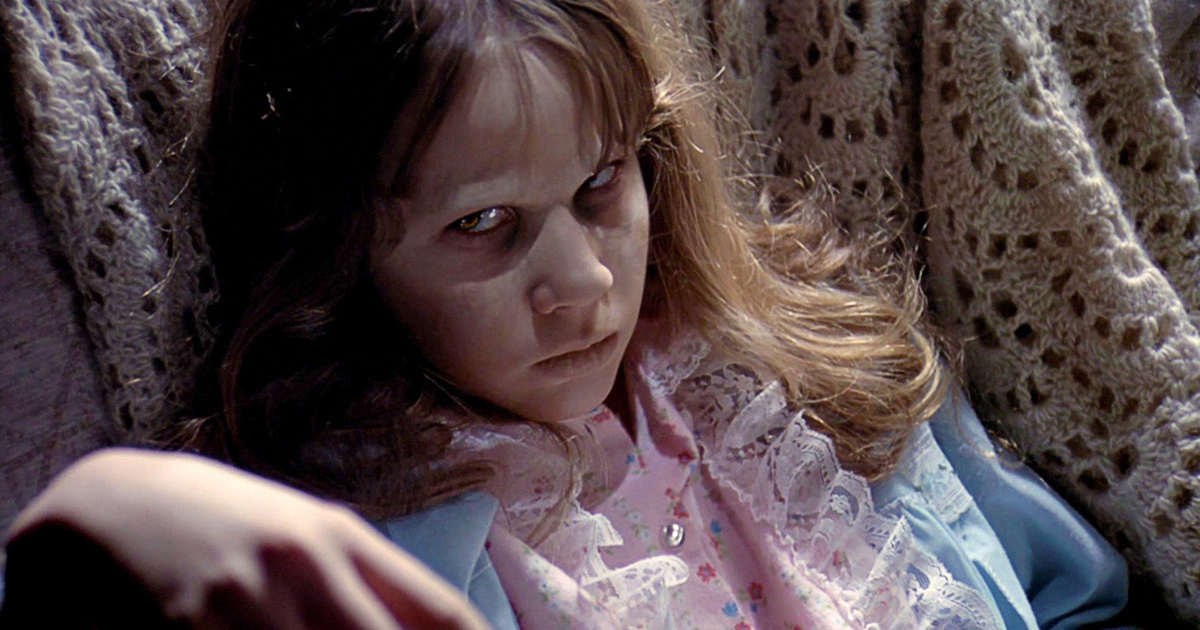
Director William Friedkin (The French Connection, Sorcerer) approaches author William Peter Blatty’s tale of demonic possession with disturbing seriousness and realism, an approach that struck fear in the hearts of moviegoers like no film has before or since. Ellen Burstyn stars as Chris MacNeil, an actress and divorced mother of twelve-year-old Regan (Linda Blair). When Regan tells her mother she’s communicating with ‘Captain Howdy’ through a Ouija board, she thinks her daughter is pulling her leg. But after Regan disrupts a party by pissing on a rug, Chris becomes worried. Regan’s bed begins violently shaking and the young girl becomes covered in cuts and bruises. Her mother takes her to a series of doctors and psychiatrists who run every conceivable test, only to suggest that maybe it’s time to bring in a Catholic priest.
At first, Chris balks at the suggestion that her daughter might be demonically possessed, but after a close friend is mysteriously killed and Regan assaults her mother in an unspeakable manner, Chris reaches out to Father Karras (Jason Miller). Karras is a faithless priest who blames himself for his mother’s recent death. Even if he believed in demonic possession, he’d be in no position to carry out an exorcism. But Regan, under the influence of the Devil, convinces him her possession is all-too real. The church agrees and sends for Father Merrin (Max von Sydow) to assist Karras with the ritual. But can these two priests, one with shaky faith and the other with a bad heart condition, stand any chance against such ancient evil?
Often feeling more like a documentary than a supernatural horror film, The Exorcist lulls you into a false sense of security with its measured pacing, only to shock the piss out of you when the Devil tightens his grasp on young Regan, whose health and behavior deteriorate dramatically as the film wears on. Friedkin succeeds in making her mother’s anxiety our own. The performances by Burstyn, Blair, and Miller are remarkably grounded, subtle yet primal. Lee J. Cobb brings a dash of needed dark humor as the police investigator, Kinderman, and Max von Sydow brings gravitas as Father Merrin. My only significant complaint about the film is that von Sydow doesn’t have enough character development or screen time given what a heralded part he plays in the film.
Through his high standards and commitment to authenticity, Friedkin succeeds in making the audience feel like voyeurs prying into a private nightmare. One of his most extreme demands was that the set be refrigerated so that we can see the characters’ breath. It’s a genius touch — you almost want to grab a blanket while watching. Enhancing the realism of the piece is the absence of a traditional musical score, inventive sound design, and convincing makeup effects by Dick Smith. Blatty’s Oscar-winning screenplay is also remarkable, so elegant and economic in the way it handles exposition and plotting, that it affords more time for the audience to simply bask in the chilling experience of it all.
No film ever rattled audiences like this one, and I doubt its impact can ever be rivaled. The Exorcist came out at just the right time — not long after censorship standards loosened, at a time when audiences were more innocent and naïve than they are today. The Exorcist dared to to depict demonic blasphemy and violence toward a child character that caused some viewers to faint, and many to walk out of the film before it was over. It was indisputably one of the most sensational films of the twentieth century. It’s endurance is a testament to how extraordinarily well-made it is.
With Kitty Winn, Jack MacGowran, and Rev. William O’Malley, who also served as a Catholic advisor on the film.
Academy Awards: Best Adapted Screenplay, Best Sound Mixing
Nominations: Best Picture, Actress (Burstyn), Supporting Actress (Blair), Supporting Actor (Miller), Director, Cinematography, Art Direction, Film Editing