Thoroughly Modern Millie (1967)

Thoroughly Modern Millie (1967)

[6]

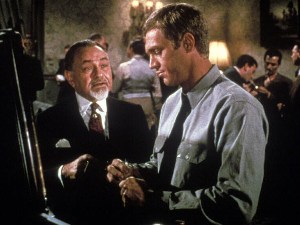
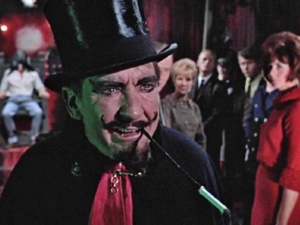
Julie Andrews stars in this 1920s madcap musical as the title character, a woman looking to land a job and a husband in the big city, but ends up embroiled with a nefarious white slave trader! Mary Tyler Moore is underutilized as the woman Millie has to rescue from slavery, but Carol Channing chews the scenery in a bizarre Oscar-nominated performance only she could have pulled off. The musical numbers are a little unrelated to the storyline and they do go on a bit long, but there aren’t many numbers in the movie, and I believe they’re all over before the intermission. After the intermission, things move very quickly. Director George Roy Hill (The Sting, Butch Cassidy and the Sundance Kid) stretches out of his comfort zone so well, the last half-hour will have you wondering if Blake Edwards took over the film. It’s an intentionally silly, over-the-top sort of movie that pays off better than most of its sort.

Doctor Zhivago (1965)

Doctor Zhivago (1965)

[4]

I knew I would eventually have to watch this 3-hour 20-minute behemoth and thank goodness it’s over. Doctor Zhivago is a sprawling epic about the Russian Revolution as seen through the eyes of a doctor (Omar Sharif) who wants to have his cake (his wife is played by Geraldine Chaplin) and eat it, too (his mistress is played by Julie Christie). The first half is dense with plotting and myriad characters — I was getting pretty sleepy. But once Zhivago becomes an exile, I became more alert and the movie picked up speed. Still, when it was all over, I was underwhelmed. He loved two women, he inspired a nation, and I just didn’t care.

Exodus (1960)

Exodus (1960)

[4] Paul Newman, Eva Marie Saint, and Sal Mineo put their lives on the line to lead hundreds of Jewish refugees into Palestine during the wake of WWII in Otto Preminger's Exodus. The film has its moments, but for subject…
Django (1966)

Django (1966)

[8] Franco Nero stars as a coffin-dragging vigilante who fights his way out between a gang of Mexican bandits and a militia of white supremacists in Django, one of the most famous of the spaghetti westerns. While director Sergio Corbucci…
H.G. Wells’ First Men in the Moon (1964)

H.G. Wells’ First Men in the Moon (1964)

[7] A British couple and a mad scientist embark on the world's first trip to the moon and end up getting more than they bargained for in this colorful fantasy featuring visual effects and animation by Ray Harryhausen. First Men…
The Prime of Miss Jean Brodie (1969)

The Prime of Miss Jean Brodie (1969)

[8]

Maggie Smith took home the Best Actress Oscar for her portrayal of Jean Brodie, a charismatic school teacher who dedicates herself to a class of impressionable young women. The film may sound like an all-girl precursor to Dead Poets Society, but it’s a far more nuanced and provocative take on the ‘inspirational teacher’ story. Brodie may begin as the hero of the story, but her tenacious influence and overly-romanticized world view end up having a devastating effect on some of her students. In her (subconscious?) attempt to live vicariously through her “girls,” she ends up creating a monster in her own image.

Reflections in a Golden Eye (1967)

Reflections in a Golden Eye (1967)

[7]

Director John Huston unites Marlon Brando and Elizabeth Taylor for their only screen pairing in this adaptation of the perverse Carson McCullers novel. Brando plays a sexually repressed Army major who turns a blind eye to his wife’s (Taylor) extramarital affair while simultaneously finding himself drawn to a mysterious young cadet who spends his days running naked through the woods and his nights as a peeping tom. The provocative subject matter is well handled by Huston, whose only missteps are bathing the entire film in a piss-yellow hue and whiplash-inducing camera movement in the film’s final, climactic shot. Good performances from Brando, Taylor, and supporting stars Julie Harris and Robert Forster.

A Fistful of Dollars (1964)

A Fistful of Dollars (1964)

[8]

I never particularly liked Westerns until I saw this film, my first ‘Spaghetti Western.’ Most people credit Sergio Leone for inventing the genre. If it weren’t for his so-called Man With No Name trilogy (three films starring Clint Eastwood, of which A Fistful of Dollars is the first) the sub-genre may have never taken flight. What Leone did was take the stagey, polished, over-produced Hollywood Western, drag it through the mud, tear it up around the edges, and make it more violent, more crude, more rock and roll.

Spartacus (1960)

Spartacus (1960)

[8]

Fans of Ridley Scott’s Gladiator might be surprised how much they will also enjoy (perhaps even prefer) its progenitor. Stanley Kubrick’s Spartacus is a briskly-paced epic, and uncharacteristically emotional compared to his other work. Kirk Douglas is iconic in the lead role, playing a slave forced to fight in the gladiatorial arena for the enjoyment of the aristocracy. Of course he falls in love with a fellow slave girl, of course he escapes, and of course he leads a mammoth army of slaves in revolt against Rome… but when these broad strokes are painted so earnestly, I don’t care. The bleak, bold final act of the film is what really sells the story for me.

On Her Majesty’s Secret Service (1969)

On Her Majesty’s Secret Service (1969)

[9] George Lazenby makes his one and only appearance as 007 in this underappreciated installment of the series. Lazenby was a model with little-to-no acting experience trying to take over a role that Sean Connery made iconic. With that said, the…