
[7]
After the British ratings board officially loosened up in 1970, Hammer Films went full-bore into bountiful boobage. Lust for a Vampire is one of the studio’s most scandalous productions for its considerable female nudity and sexual situations. Many cast and crew later disowned the film, and the studio was quick to return to less explicit fare within a year’s time.
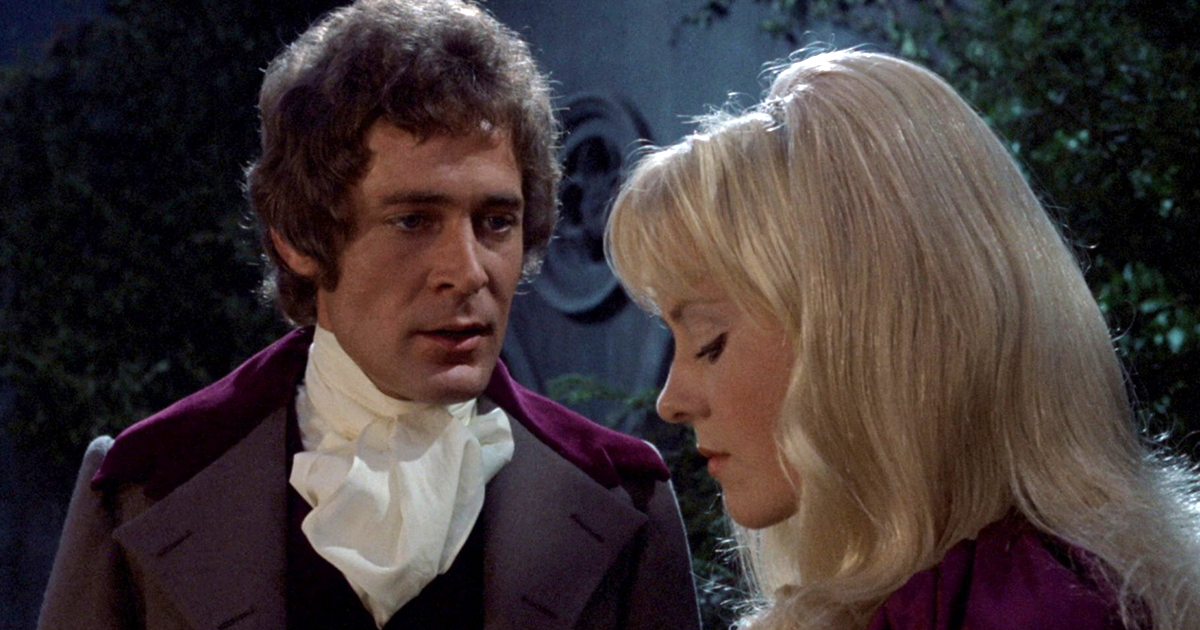
But time has been somewhat kinder to Lust for a Vampire than its initial audience and critical reactions. Yes, it’s cheezy. Charges of vulgarity are not unwarranted, especially considering how casually the film’s female characters remove their tops and slip into lesbianism. But as with many Hammer films, it’s also beautifully designed and shot, and features a couple of good performances. Fourth-billed Michael Johnson stars as Richard LeStrange, a writer who ingratiates himself into a rustic, 1830s ladies’ finishing school, where he falls instantly in love with a young woman named Mircalla (Yutte Stensgaard). Even when LeStrange learns Mircalla is a vampire preying on her classmates, he doesn’t care so long as he can keep bedding the buxom bloodsucker. Score one for vampire lust.
The film fetishizes Stensgaard’s beautiful body, wisely keeping the actress’s dialogue to a minimum. Johnson is serviceable, but the film’s best performance comes from Suzanna Leigh as the school’s dance teacher. She is the film’s moral center. She implores the headmistress (Helen Christie) to alert the police when the first girl goes missing, even though it may create scandal around the school. Her best scene is when she begs LeStrange to help her confront the reluctant headmistress, only to be disappointed by his lack of courage. The disillusionment hits even harder because she’s smitten with LeStrange, who’s covering for his vampire lover. Barbara Jefford is the film’s second-best performer. Even though she has limited screen time, she leaves an indelible impression as the vampire countess working in league with Mircalla, manipulating the school’s headmistress to cover their tracks.
The script credited to Tudor Gates is well paced. If it could have managed to make the film’s central romance between Mircalla and LeStrange remotely believable or compelling, Lust for a Vampire might be more defensible. As superficial as the drama is, this film is too weird and quirky to dismiss. The enhanced sensuality feels at home among the gothic setting, and the production values are high enough to encourage viewers to take the film more seriously than they might otherwise. The film strikes such a singular vibe, that when a goofy song titled “Strange Love” plays over LeStrange’s and Mircalla’s first love scene, it feels almost natural.
Against my better judgment, I really dig this weird, bad movie. It’s anything but boring, and like its vampire seductress, it’s oddly disarming.
Lust for a Vampire is considered the second film in ‘The Karnstein Trilogy’, named for the vampire family who terrorizes all three storylines. It’s preceded by The Vampire Lovers and followed by Twins of Evil.
Directed by Jimmy Sangster, a long-time writer for the studio. With Ralph Bates as a teacher who willingly submits to Mircalla, Mike Raven doing his best Christopher Lee impression as the film’s third vampire character, and a surprisingly dynamic score by Harry Robinson.