
[3]
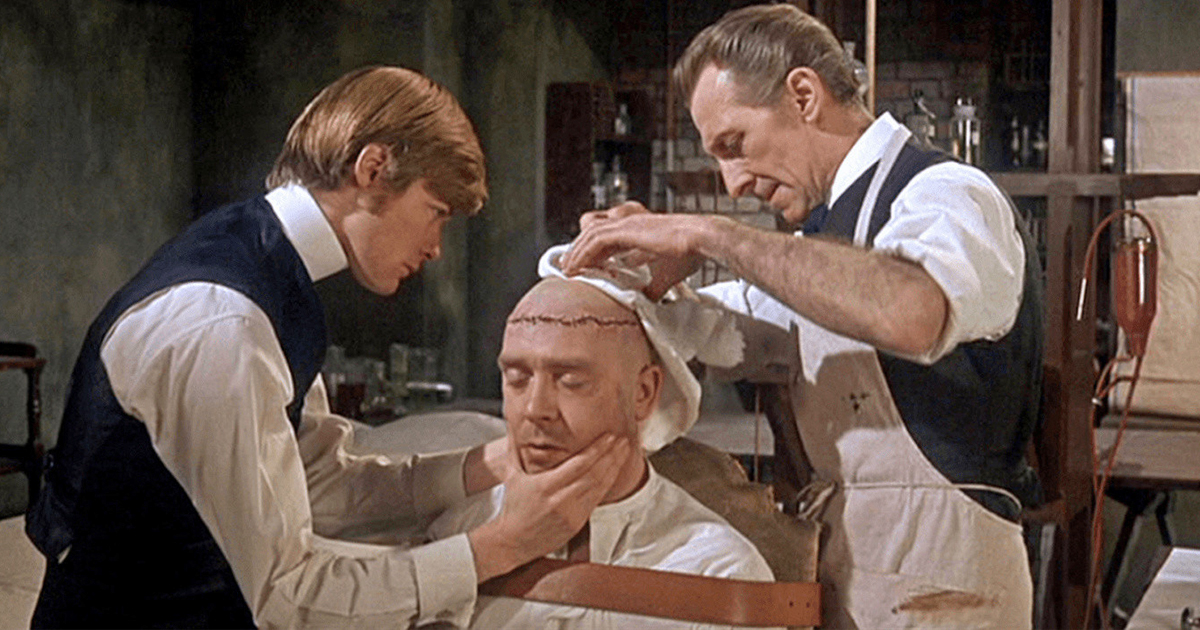
As much as I enjoy most Hammer horror movies, their Frankenstein series almost always underwhelms me. Frankenstein Must Be Destroyed is the fifth film in the series and the fourth to disappoint. (Only 1967’s Frankenstein Created Woman is worth a gander.) Peter Cushing returns as the title character, more villainous and abusive than ever before. This time around, he blackmails an asylum worker (Simon Ward) and his fiancée (Veronica Carlson) into housing him, feeding him, and being his lab associates. They kidnap a professor (Freddie Jones) and give him the brain of a former associate of Frankenstein’s who went insane. But when Jones wakes up with another man’s brain, he ends up wrecking Frankenstein’s plans by seeking out the dead man’s wife and piquing police curiosity.
Peter Cushing has some nicely smug and witty moments early in this film, but otherwise, his character has never been more unlikable — and not in a good way. At one point, he even sexually assaults Carlson’s character in a scene that feels completely disconnected from the rest of the film. (The scene was added, to both Cushing’s and Carlson’s protest, by producers trying to make the film more lascivious.) The core concept of the story feels pedestrian compared to the last few entries in the series, and the pacing drags tremendously throughout. Director Terence Fisher usually delivers great work for Hammer, but in this film all his attempts to build suspense only succeed in building tedium. Ward and Carlson have almost nothing to work with, relegated to human props for the controlling Cushing. Even composer James Bernard is strangely reserved here, delivering one of the sparsest scores in the entire Hammer filmography.
The best parts of Frankenstein Must Be Destroyed are two quirky supporting players. Freddie Jones (The Elephant Man, Dune) is wonderful as the brain transplant victim, especially when he visits the bed of his grieving wife (Maxine Audley) in another man’s body. Thorley Walters is also entertaining as the goofy cop investigating Frankenstein’s crimes. As much as I like these two performances, though, neither feels organic to the film. Jones’s character only features in the last twenty minutes, shifting the story’s focus almost entirely. And Walters is so silly, he almost takes the film into Monty Python territory.
Most Hammer films have a cozy, gothic romance, tongue-in-cheek feeling to them that seems to be missing here. The main characters are flat and unengaging. Early scenes of Frankenstein stalking a victim and fighting a burglar in his laboratory are better than anything in act two. The climax, featuring yet another Hammer house fire, is rushed and anti-climactic. All-in-all, this is possibly my least favorite of Hammer’s Frankenstein films — a dull, joylessly mean-spirited step backwards for the studio.