
[7]
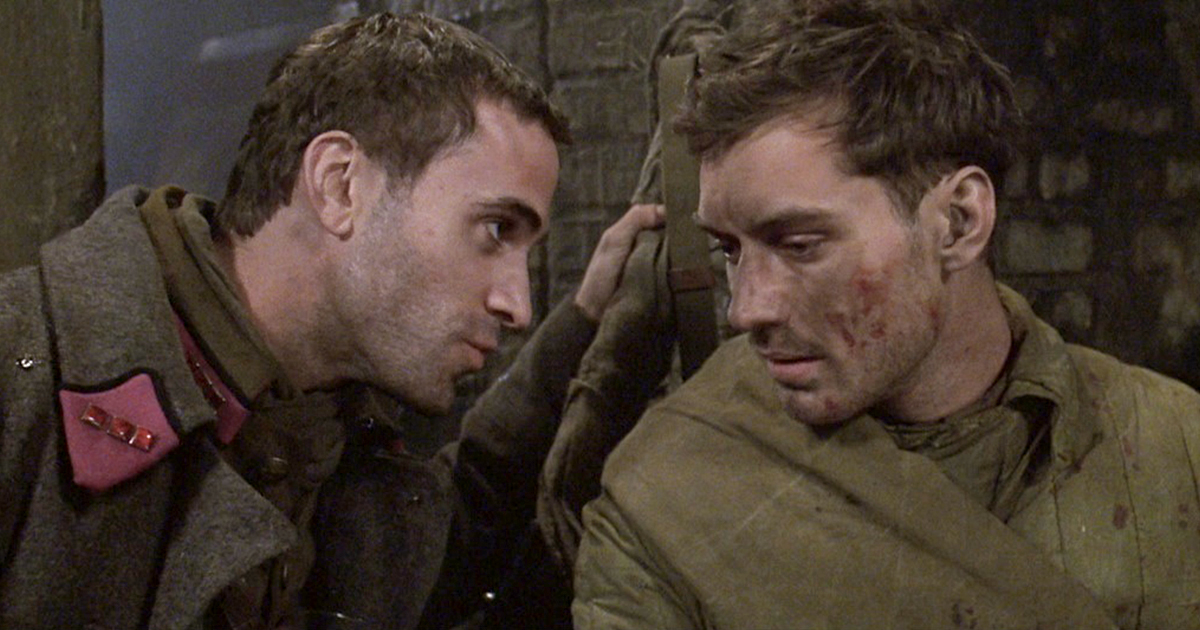
Jude Law stars as Russia’s celebrated World War II hero Vasily Zaitsev, a gifted sniper who stealthily picks off German soldiers during the battle of Stalingrad. A political officer, commisar Danilov (Joseph Fiennes), transforms Zaitsev into a near-mythic folk hero through daily newspaper articles, inspiring the Russians to persevere. But the success of the sniper unit soon motivates the Germans to deploy one of their deadliest snipers, Major Erwin Konig (Ed Harris) to the battlefront. As Stalingrad disintegrates to rubble around them, Zaitsev engages with Konig in a deadly cat-and-mouse game, and a love triangle forms between Zaitsev, Danilov, and a Russian militiawoman named Tania (Rachel Weisz).
Enemy at the Gates features fine performances from Law, Fiennes, and Weisz. The script gives all of them enough depth that we can appreciate their inner struggles as well as their outer ones. Law’s character worries he can’t deliver what the headlines promise his countrymen, while Fiennes is pressured by his superiors continue propagandizing his new friend, and Weisz is driven to put herself in harm’s way to avenge the murder of her parents. Wartime love triangles are one of cinema’s most overused tropes, but director Jean-Jacques Annaud (The Name of the Rose, Quest for Fire) executes it with admirable subtlety and believability. A wordless love scene between Law and Weisz, while they’re sleeping among other militiamembers, is particularly striking.
Ed Harris is reliably icy as the lead villain, especially in his scenes with a brave young Russian boy who’s feeding him misinformation. Surely he won’t kill that boy, right?… Bob Hoskins puts in a memorable performance as Fiennes’ hot-headed general, and Ron Perlman is fun (isn’t he always?) as one of Law’s fellow snipers. Of course, none of these actors are Russian or German, nor do they try to pull off the corresponding accents. Summon up a little suspension of disbelief, and you’ll hardly notice.
While apocalyptic Stalingrad makes for a highly visceral setting, viewers should not expect the usual, highly choreographed action spectacle of many other big budget studio productions. After a harrowing opening sequence following Law and other young soldiers into the battlefront, the film becomes more deliblerately paced and the action becomes focused and tactical, relying on tension and suspense over pyrotechnics. Enemy at the Gates doesn’t escape narrative convention — it even has a relatively happy ending — but Annaud keeps the film interesting and emotionally engaging through the eyes of his three lead characters.