
[7]
Christopher Lee tries to rescue two young people from being baptized into a satanic cult in The Devil Rides Out (also titled The Devil’s Bride in the U.S.). Lee is the one who brought Dennis Wheatley’s novel to the attention of Hammer Films, who handed the adaptation over to celebrated screenwriter Richard Matheson (The Last Man on Earth, The Incredible Shrinking Man) and their most reliable director, Terence Fisher (Horror of Dracula, Curse of Frankenstein). Lee plays a duke knowledgeable in the occult and black magic. He and a friend (Leon Greene) pay a visit to the son of their deceased comrade (Patrick Mower), only to discover he’s being inducted into a satanic cult. They succeed in rescuing Mower and another would-be inductee (Nike Arrighi), but the cult leader (Charles Gray) gives pursuit, summoning demons and mind control in an effort to get them back.
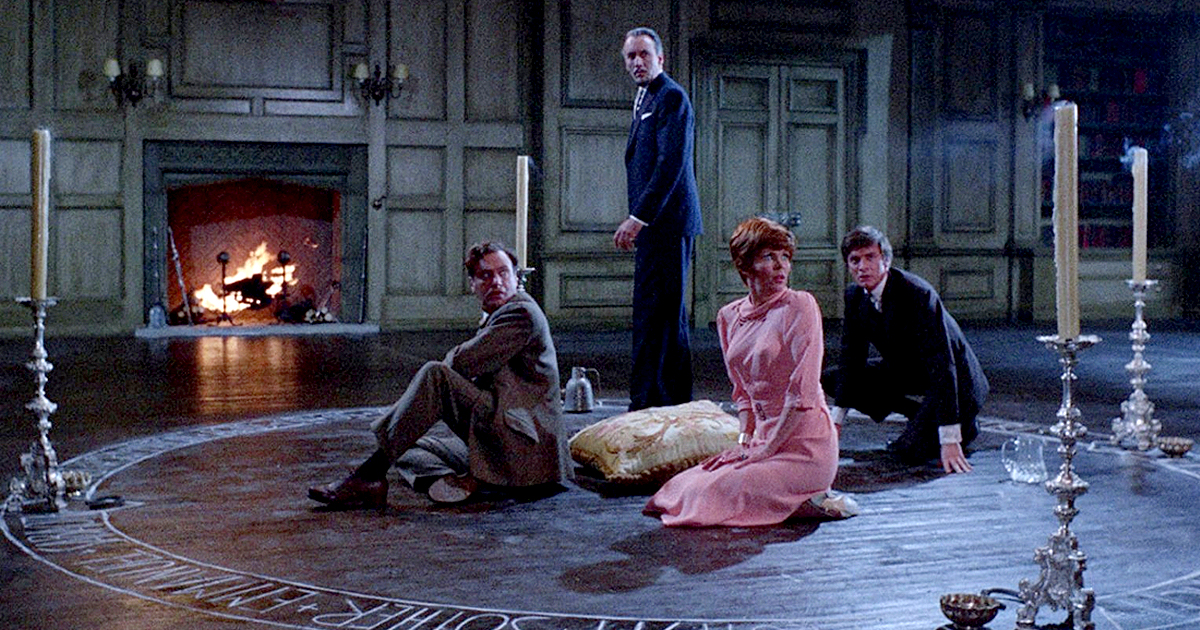
The Devil Rides Out is top-tier Hammer with solid casting, atmosphere, and a tight script that never struggles with momentum. Lee is commanding in the lead role and Gray plays a diabolical villain who uses his piercing blue eyes to mesmerizing effect. Arrighi is endearing as the vulnerable young woman Gray is able to possess through black magic. Sarah Lawson is also memorable as Lee’s niece, who gives safe harbor to Lee, Greene, and their cult refugees. It’s at Lawson’s home where Lee draws a protective circle on the floor and prepares to defend his friends against the supernatural forces of evil for the film’s spooky climax.
The film is unlike most other Hammer films, more grounded than gothic. Matheson’s screenplay moves perhaps too quickly to develop character relationships as much as I’d prefer. The film also features a number of sub-par special effects, a common shortcoming for Hammer’s low-budget productions. If the film’s visceral highlights — a goat-headed demon, a giant spider, and a skeletal warrior on a black winged horse — could have been executed more convincingly, The Devil Rides Out might have enjoyed more mainstream appeal. But fans of Hammer are probably inclined to be forgiving, especially considering that pretty much everything else about the film is as good as anything the studio ever did.