
[5]
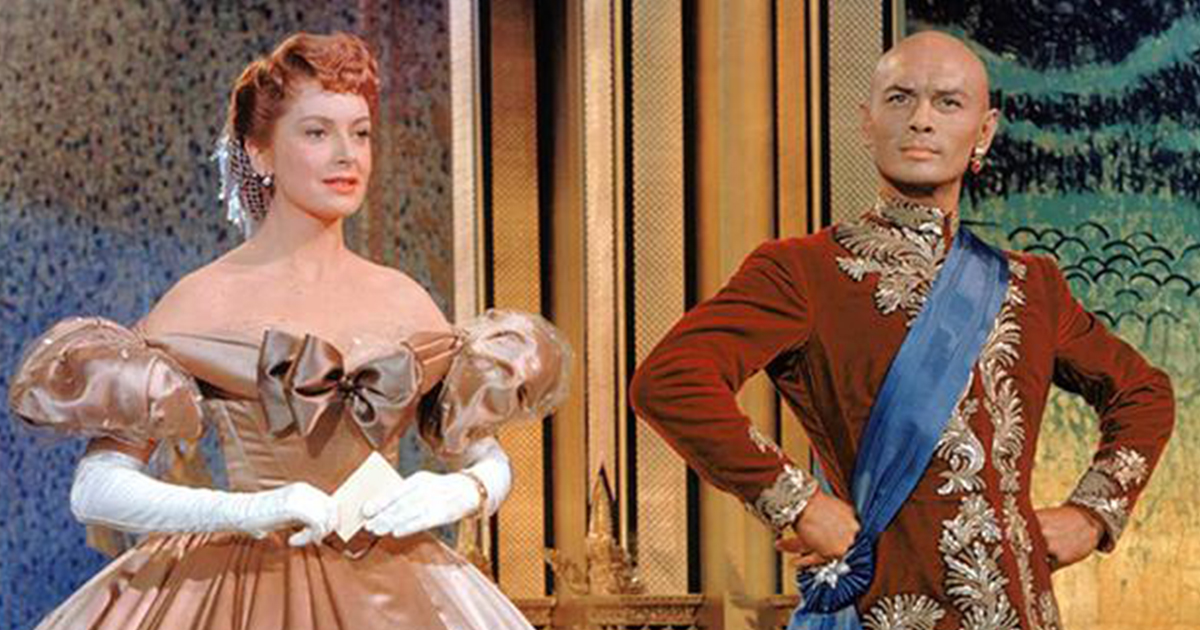
Deborah Kerr and Yul Brynner star in this opulent period musical from Broadway legends Richard Rodgers & Oscar Hammerstein. Kerr plays Anna, a widowed British school teacher who travels with her young son to Siam (modern-day Thailand) where she’s agreed to supervise the education of King Mongkut’s favored wives and children. The stubborn and prideful Mongkut (Brynner) clashes almost immediately with Anna, whose deeply humanist, feminist, and democratic values are often at odds with Siam’s more oppressive and patriarchal values. Anna is able to see through his bravado and insecurities, however, and begins to fall in love — with both the king and his children. But when one of his trophy wives (West Side Story‘s Rita Moreno) runs away with her lover, the king’s temperament is tested and Anna’s admiration is strained to the breaking point.
I have mixed feelings about The King and I. I love the look and tone of the film, captured in colorful, super-widescreen photography with lavish sets and costumes. I also love the core idea of a western woman’s gentle influence on an arrogant, would-be tyrant. It’s an interesting film from sociopolitical perspective, and as a ‘battle of the sexes’. Brynner and Kerr give strong, charismatic performances, but their dynamic is a dated one that gets less appealing as time wears on. The king is a chauvinistic brute who forces everyone around him to tip-toe around his ego. What’s worse is the way he emotionally manipulates Anna when he knows he can get away with it. These qualities were tolerated in the mid-20th century, but modern 21st century viewers may have little patience for the king’s bad behavior.
The Rodgers & Hammerstein songs are often memorable, with “Getting to Know You” being perhaps the biggest earworm. But unfortunately, the musical numbers aren’t the least-bit cinematic — presented in a dull, lifeless manner, with little-to-no choreography. With the exception of an odd but wonderful Siamese ballet production of Uncle Tom’s Cabin in the middle of the movie, the song numbers are little more than filmed versions of the stage production.
The last twenty minutes of the film also bug me. (Spoiler Alert!) After the king threatens Moreno’s character with a whip-lashing, Anna declares she’s leaving Siam for England. The king’s response? He literally gets sick and dies. While the romance between Anna and Mongkut is handled with great subtlety and restraint, this sudden sickness and death resolves it in a clunky fashion, robbing Brynner’s character of a full character transformation and Kerr’s of her convictions. The sequence is somewhat touching on its own, especially for the way Brynner passes the torch to his eldest son before passing. But as a ‘battle of the sexes’, The King and I essentially ends with a man dying rather than admitting he was wrong. It’s a sloppy, inelegant way to conclude a film that has the thematic potential to conclude much more meaningfully.
Directed by Walter Lang. With Martin Benson, Terry Saunders, and Rex Thompson. Based on a book by Margaret Landon, which was inspired by a true story. A previous film adaptation, Anna and the King of Siam, was released in 1946 starring Irene Dunne and Rex Harrison. A subsequent version starring Jodie Foster and Chow Yun Fat, Anna and the King, was released in 1999.
Academy Awards: Best Actor (Yul Brynner), Color Art Direction, Color Costume Design, Sound Recording, Musical Scoring (Alfred Newman, Ken Darby)
Oscar Nominations: Best Picture, Actress (Deborah Kerr), Director, Color Cinematography