
[6]
Waltzes from Vienna, or Strauss’ Great Waltz as it was retitled in America, is perhaps Alfred Hitchcock’s least popular film, and one the director regarded as one of the lowest ebbs in his career. While it certainly falls outside the director’s thriller groove, it’s a moderately entertaining biopic sprinkled with unexpected humor and heart.
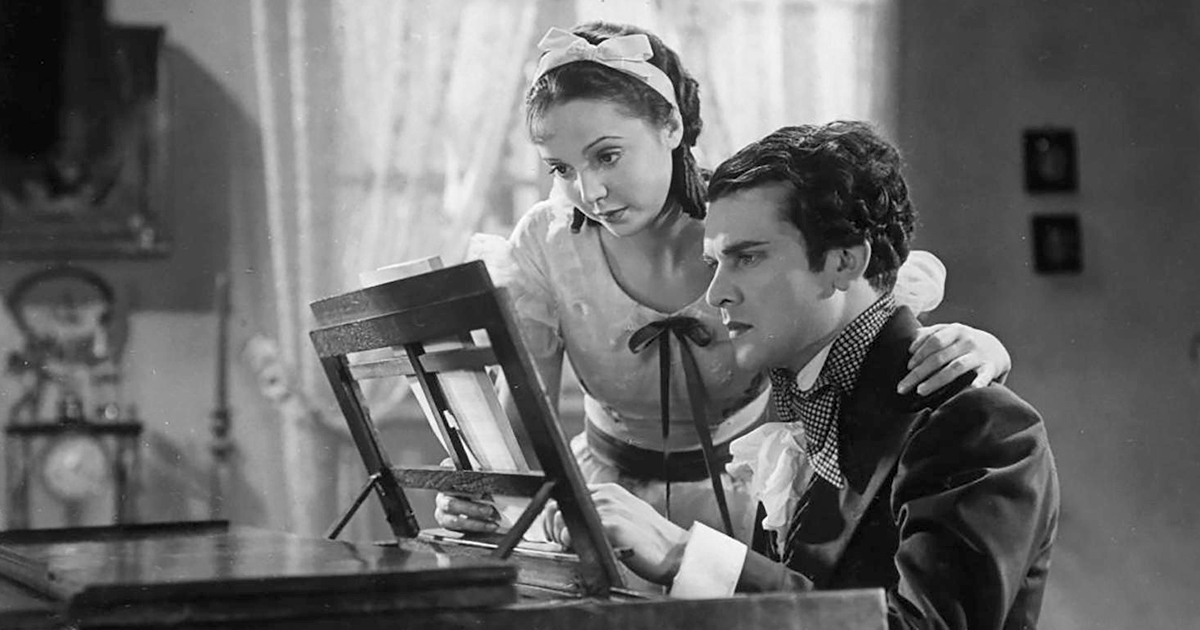
Esmond Knight stars as Johann Strauss II during the time he conceives his masterwork ‘The Blue Danube’ to the world. Strauss dedicates the piece to his girlfriend Resi (Jessie Matthews), who grows jealous as the composer works with a wealthy countess (Fay Compton) who contributes lyrics to the music. In addition to the love triangle, the film also juggles Strauss’ contentious relationships with his father (Edmund Gwenn), a bandmaster who fails to recognize his son’s talent, and Resi’s father, a baker who hopes the younger Strauss will give up music and work in his bakery. All these relationships come to a head during the climactic, premiere performance of ‘The Blue Danube’.
Like many of Hitchcock’s early films, Waltzes from Vienna feels a bit like an experiment. Hitchcock uses the opportunity to study the marriage of music to visuals to a greater degree than before. This is most evident during a sequence in which Strauss Jr. visits the bakery and lets the rhythms and sounds of the various appliances inspire the the melody of of ‘The Blue Danube’. Among the film’s more slapstick moments is Resi’s rescue from a burning building, in which her skirt is slowly pulled off when it catches on a ladder rung, leaving her exposed before a crowd of spectators. The climactic waltz sequence is the film’s most memorable. As the music builds, the audience begins to sway in their seats, ultimately rising and waltzing in front of the orchestra. It’s one of the warmest, most genuinely emotional scenes in Hitchcock’s filmography up to this point.
Edmund Gwenn and Fay Compton get the juiciest, more sophisticated roles and give the most confident performances. Everyone else is more than competent, with leading man Esmond Knight proving plenty charming enough to keep us watching. The script focuses on the love triangle a little too much, short-changing the more interesting father/son relationship. Sticklers for accuracy will have to excuse that considerable dramatic license is taken with the details of Strauss’ life story. Even if the film may not be likely to stick in your memory as well as many other Hitchcock films, the ‘low ebb’ branding seems harsh and unfair. It might be the least ‘Hitchcockian’ Hitchcock film, but Waltzes from Vienna is never boring, and often quite charming.
With Frank Vosper, Robert Hale, and Charles Heslop.