
[7]
After ending her late ’30s career slump with The Philadelphia Story, Katharine Hepburn followed up with another smash hit, Woman of the Year. It was her fateful first pairing with Spencer Tracy, with whom she’d make eight more films. He would also become the love of her life. Their on-and-off-screen chemistry began on this film, with their characters working for a major newspaper. She writes on international affairs while he covers sports. Hepburn belittles sports coverage during wartime, which sparks a public battle between the two that plays out in their daily opinion columns. But once they meet face to face, the attraction is instant and palpable.
After a short courting period, Tracy proposes and Hepburn accepts. But he soon realizes that marrying such a high profile ‘modern woman’ comes with serious drawbacks. The two rarely get a moment alone together before Hepburn’s work interrupts, and she’s all too quick to prioritize work over family — even when she adopts a child refugee without consulting Tracy. Things come to a head when Hepburn is heading out to receive a ‘Woman of the Year’ award without leaving anyone behind to watch the child. Tracy packs up his things and leaves that night, returning the child to the orphanage where he’ll be better cared for.
Woman of the Year rides the line between traditional and progressive values, subverting gender roles for its first three-quarters. Hepburn’s character is indeed fully capable of doing ‘a man’s job’, playing a traditionally male character who works hard, marginalizes her family life, and heeds the call of duty whenever her community calls on her. Modern audiences might object to how the film ends, with Hepburn ultimately deciding that work and recognition won’t make her happy. She makes an effort to be a more traditional wife by attempting to cook her first breakfast for Tracy — an exercise that quickly gets away from her, providing a comedic climax to the film.
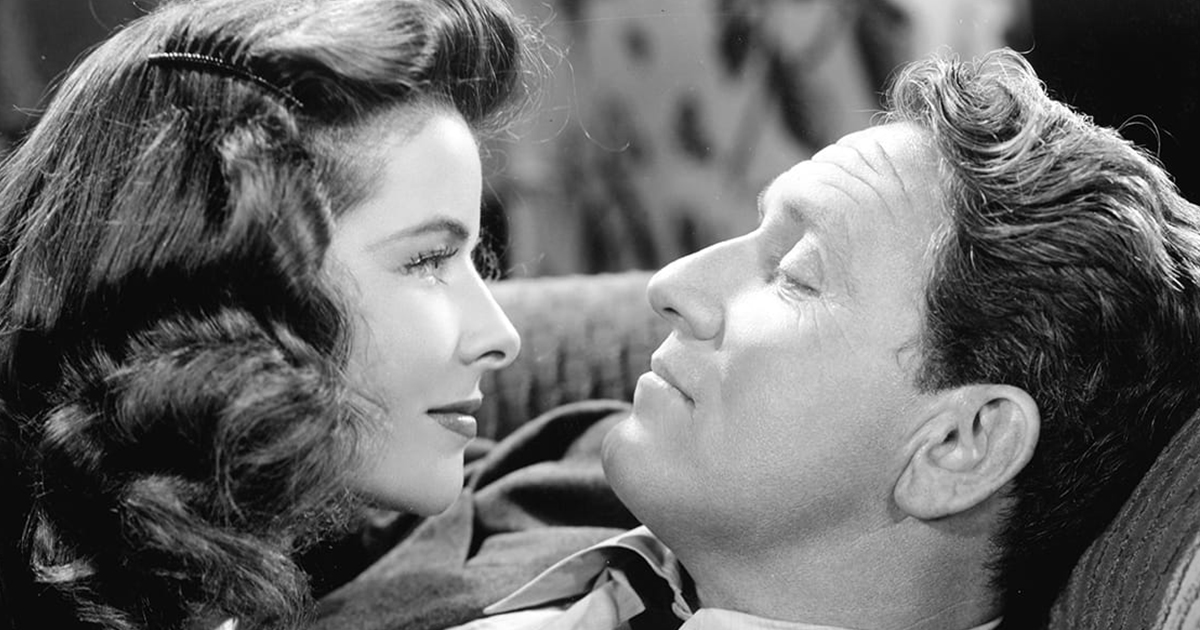
Woman of the Year is directed by George Stevens (Alice Adams, Quality Street), who downplays the film’s comedic potential more than I’d prefer. But he nails the romance between his two stars, with perhaps the duo’s most convincing scenes of tender intimacy. Fay Bainter gets the juiciest supporting role, playing Hepburn’s elderly aunt — a pioneering feminist whose late-in-life marriage inspires Hepburn’s character to reconsider her priorities.
Watching a trailblazer like Hepburn flirt with domesticity can be a little disconcerting, but the actor said many times in interviews that she didn’t think anyone could master both career and family. It’s the reason she never had children. Woman of the Year must have been particularly conversation-worthy in 1942 when women had joined the industrial work force for only a short time, implored to do so while America’s men fought overseas. Women today might find that they still relate with Hepburn’s persona and the Oscar-winning story. Yesterday’s women fought hard for the right to choose between family, a career, or a combination of the two, and women have been blessed (or cursed?) with that decision ever since.
With Reginald Owen, William Bendix, and Minor Watson.
Academy Award: Best Original Screenplay (Michael Kanin, Ring Lardner Jr.)
Oscar Nomination: Best Actress (Katharine Hepburn)