
[4]
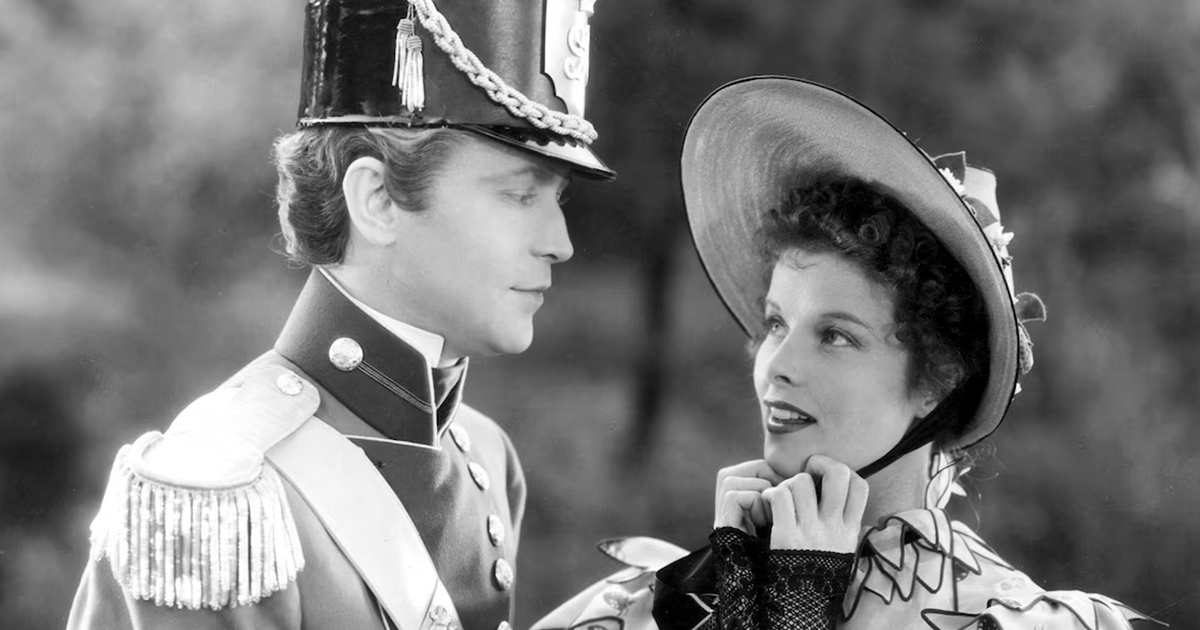
Katharine Hepburn is remembered as one of Hollywood’s brightest stars, but after having a few early hits like Morning Glory and Little Women, her career went into a tailspin for several years. In the mid-’30s she was even labeled ‘box office poison’ by the industry trades. Quality Street was the last of these infamous flops, before her career rebounded with Stage Door and The Philadelphia Story. The film is based on a coquettish play by Peter Pan author J.M. Barrie, about an old maid who gussies herself up and plays the part of her own younger niece to get back at an old boyfriend (Franchot Tone) who doesn’t recognize her after returning home from years of fighting in the Napoleonic war.
Hepburn is very good in the first quarter of the film, as she fools herself into thinking Tone is on his way over to propose to her, only to learn he’s going off to war. When the film jumps ahead ten years to his return, we’re expected to believe Hepburn is aged and unrecognizable when she clearly looks exactly the same — an ‘old maid’ at a mere thirty years of age. The way the characters both acknowledge her fading beauty is surprisingly shallow and cruel, so much so that modern-day viewers may be inclined to write off Tone’s character all together. The rest of the film is a fairly standard comedy-of-errors, with Hepburn playing both the old maid and the ingénue niece. Her older sister (Fay Bainter) helps her maintain the charade, not just with Tone, but with a trio of nosey spinster neighbors as well.
Hepburn thought it would soften her controversial tomboy image to play a demure woman waiting for a man to swoop her off her feet. Even though it’s good to see her demonstrate her range as an actor, the part isn’t a good fit for a trailblazer like Hepburn. The doppelganger ‘mistaken identity’ comedy schtick quickly wears thin in Quality Street and the romance is one that never feels sincere. Franchot Tone is an underwhelming leading man, but Fay Bainter (future Oscar-winner for Jezebel) wins a few chuckles with her dry reactions to some of the plot’s shenanigans. Eric Blore is also funny as an oafish recruiting officer who makes all the women scoff with his flirtatious behavior.
Perhaps the best thing about Quality Street is that it seems to have convinced Hepburn to stop playing against her nature. Rarely again would she ever try to squeeze her indomitable spirit into the mold of meek or abiding characters. As it turns out, audiences just needed a few years to recognize that Hepburn was never meant to fit the mold of a 19th century woman. The movie gods sent her to broaden our conception of what 20th century women could be.
Directed by George Stevens (Alice Adams). With Cora Witherspoon, Estelle Winwood, and Joan Fontaine in a small, uncredited role.
Oscar Nomination: Best Score (Roy Webb)