
[6]
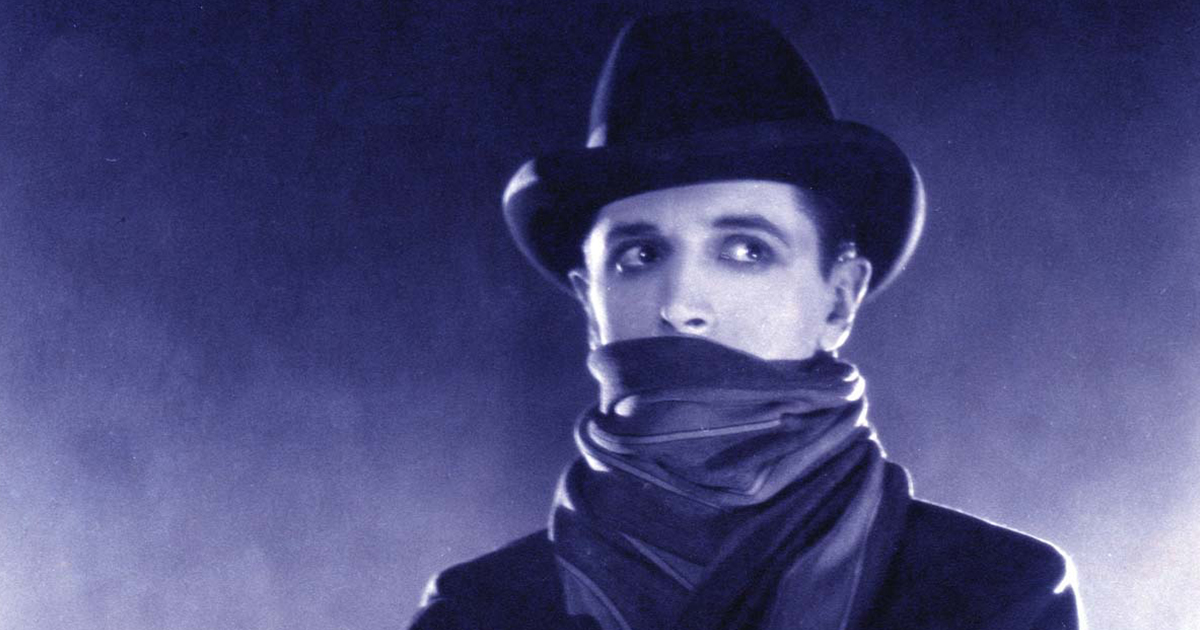
Alfred Hitchcock directed two other films prior to this one, but the director regarded The Lodger as the first true ‘Hitchcock film’. It’s also widely regarded his best from the silent era. The Lodger opens with London in a panic over a string of murders committed by ‘The Avenger’, a man who hides his face with a scarf and preys on blonde women every Tuesday night. Against this backdrop, an elderly couple take in a new tenant who they begin to suspect may be the killer. He quietly creeps out of the house on Tuesdays and orders the family to take down all their pictures and portraits of blonde women. They are especially worried when the lodger begins dating their daughter Daisy — who just so happens to be blonde.
The Lodger is based on a novel by Marie Belloc Lowndes, who was inspired by the 1888 slayings of the infamous Jack the Ripper. The film moves well, with Hitchcock adopting a shadowy German Expressionist style that enhances the atmosphere and paranoia. Ivor Novello is beguiling in the title role. A handsome matinee idol, he easily captures our sympathies with his good looks, while Hitchcock works to heap suspicion upon him. The director might spend too much time building that suspicion. The second act drags a little as a love triangle forms between Daisy (June Tripp), the lodger, and a police detective (Michael Keen). But the third act — which differs dramatically from Lowndes’ novel — throws in a nice twist that pleasantly subverts our expectations, rejuvenates the story, and increases our emotional involvement with the movie.
The Lodger is the first film to exhibit many of the qualities that would later define Alfred Hitchcock as an auteur director. The Avenger, who (99-year-old spoiler alert!) never actually appears in the film, turns out to be the first Hitchcock ‘MacGuffin’, an object, person, or event that sets a story in motion or drives its main characters, while remaining insignificant or irrelevant in itself. The script gives an early taste of Hitchcock’s ongoing preoccupations with blonde women, the wrongfully accused, and kinky sexuality — as evident in the way Keen’s character frightens Daisy with a pair of handcuffs.
It’s worth noting that the assistant director on The Lodger is Alma Reville, a fellow filmmaker who met Hitchcock in 1921 and married him in December, 1926, shortly before The Lodger was released. Hitchcock relied tremendously on Alma for the duration of his long and storied career, giving her absolute veto power with scripts, and considerable influence over casting as well. Her contributions to the Hitchcock legacy are far more considerable than her credits might indicate.
When he received the American Film Institute’s Lifetime Achievement award in 1979, Hitchcock said: “I beg permission to mention by name only four people who have given me the most affection, appreciation, and encouragement, and constant collaboration. The first of the four is a film editor, the second is a scriptwriter, the third is the mother of my daughter Pat, and the fourth is as fine a cook as ever performed miracles in a domestic kitchen. And their names are Alma Reville.”
With Marie Ault and Arthur Chesney.