
[9]
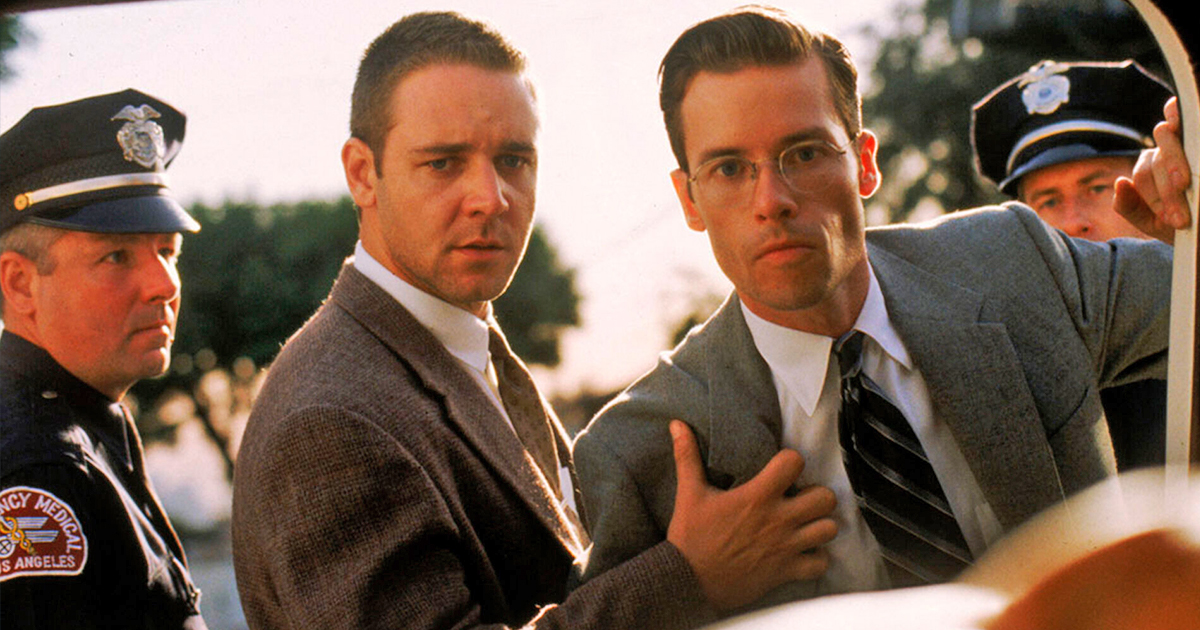
In 1950s Los Angeles, three police officers with very different approaches overcome their differences to collaborate on a murder case that ultimately unveils widespread corruption at the highest levels of law enforcement and the government. Guy Pearce plays the politically-minded opportunist who’s a stickler for rules and procedure. His contrast is Russell Crowe’s character, an impulsive hot-head ready to throw a punch, especially at abusers of women. And then there’s Kevin Spacey as a consultant for a popular TV program who relishes his celebrity, even when it tempts him to compromise his morality.
Morality and justice are at the heart of L.A. Confidential, based on a book by James Ellroy and directed with panache by Curtis Hanson (8 Mile, Wonder Boys). Pearce’s and Crowe’s characters are committed to moral outcomes and justice, even if Crowe’s path to getting there borders on immoral at times. Their adversarial relationship is further complicated when both men find passion with a person of interest in the case, a high class prostitute played by Kim Basinger. For most of the film, the two men work from opposite ends on the mystery. Meanwhile, Pearce solicits the help of Spacey, whose somewhat sleazy character has the biggest character transformation — perhaps inspired by Pearce’s earnest devotion to the department’s highest ideals. Despite the period window dressing and intricate plot, the journey of these three disparate men toward collaboration is what the movie is really about.
Most films skew either toward plot or character and the really good ones tend to strike a balance of the two. L.A. Confidential is perhaps the most equalized example I’ve ever seen. Even if the characters weren’t so immensely engaging, this might still be a good movie based purely on the merits of its mysterious plot — one involving drugs, corrupt cops, and high class hookers made to look like Hollywood stars (Basinger plays the Veronica Lake look-alike). Director Hanson keeps things moving at a brisk pace, cutting the drama and intrigue with a dash of welcome humor. Danny DeVito’s character, a tabloid journalist, is responsible for a lot of that levity. Rounding out the notable cast is James Cromwell, who gives a strong supporting turn as the bureau’s police chief. This engrossing film is further elevated by accomplished contributions from cinematographer Dante Spinotti, production designer Jeannine Oppewall, costume designer Ruth Myers, and composer Jerry Goldsmith.
With David Strathairn, Ron Rifkin, and Graham Beckel.
Academy Awards: Best Supporting Actress (Kim Basinger), Adapted Screenplay (Brian Helgeland, Curtis Hanson)
Oscar Nominations: Best Picture, Director, Cinematography (Dante Spinotti), Art Direction, Sound, Film Editing, Score (Jerry Goldsmith)