
[6]
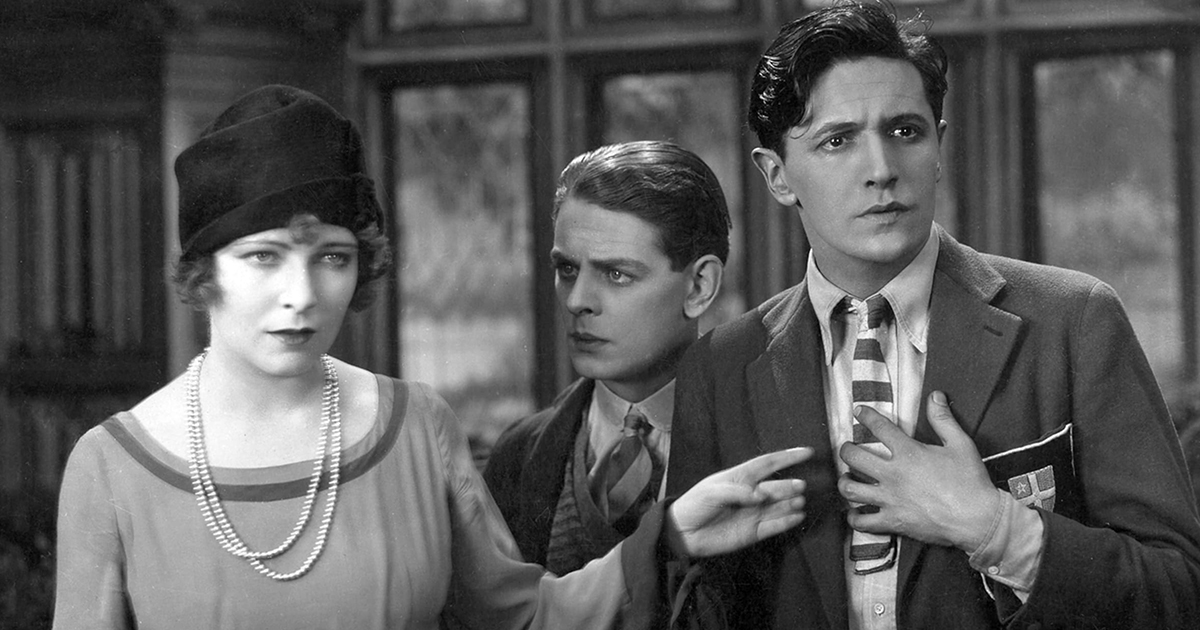
Alfred Hitchcock’s fourth silent film reunites him with handsome leading man Ivor Novello (The Lodger: A Story of the London Fog). Novello plays a college student who takes the blame for the sexual indiscretions of his best friend (Robin Irvine). After a woman (Annette Benson) wrongfully accuses him of knocking her up, Novello promises to keep the lie a secret to protect his friend’s academic future. Novello is expelled from school, eviscerated by his enraged father (Norman McKinnel), and his life is sent into a tragic, somewhat surreal downward spiral.
In the episodic script, Novello’s character is then forced to become a bit player in a theater production, scraping by until his godmother leaves him an inheritance. Things are looking up, so he takes a wife — a extravagant and adulterous actress (Isabel Jeans) who overdraws his bank account and throws him to the curb. Next, he’s forced to become a dancing gigolo, pimped out by a greedy old woman (Barbara Gott) to any lustful hussy who ponies up fifty francs for a dance. When he realizes how far he’s fallen, he withdraws to a dockside shanty and becomes delirious with grief and depression. Three fellow vagabonds put him on a boat for home, where he has a feverish nightmare in which all the women who’ve wronged him mock him mercilessly.
Downhill bears Hitchcock’s recurring themes of dangerous women and the man wrongfully accused, but it’s otherwise not a film that feels particularly Hitchcockian. The fragmented, episodic narrative works better than I imagined it would. And even though the main character’s undoing is of his own volition, I found the film emotionally engaging. Hitchcock is often called misogynistic, but I found it refreshing to see women portrayed against type here as scheming, opportunistic monsters. I also thought it was interesting that one of the women who pays her fifty francs to dance with Novello looks very… well, manly.
Novello proves again, as with The Lodger, to have an expressive face that begs our empathy. His acting style is more progressive and realistic than some of the supporting players, especially Norman McKinnel, who overacts to almost comical effect. The script, based on a play written under a pseudonym by Novello and his writing partner Constance Collier, is pedestrian compared to most other Hitchcock films, with an ending that feels somewhat arbitrary and anti-climactic. Even though the story meanders, Novello pulled me into this movie and kept it interesting on a psychological level. Downhill may not be quintessential Hitchcock, but watching a young man descend through layers of Hell a la Dante’s Inferno is more interesting than I was expecting.
With Violet Farebrother.