
[7]
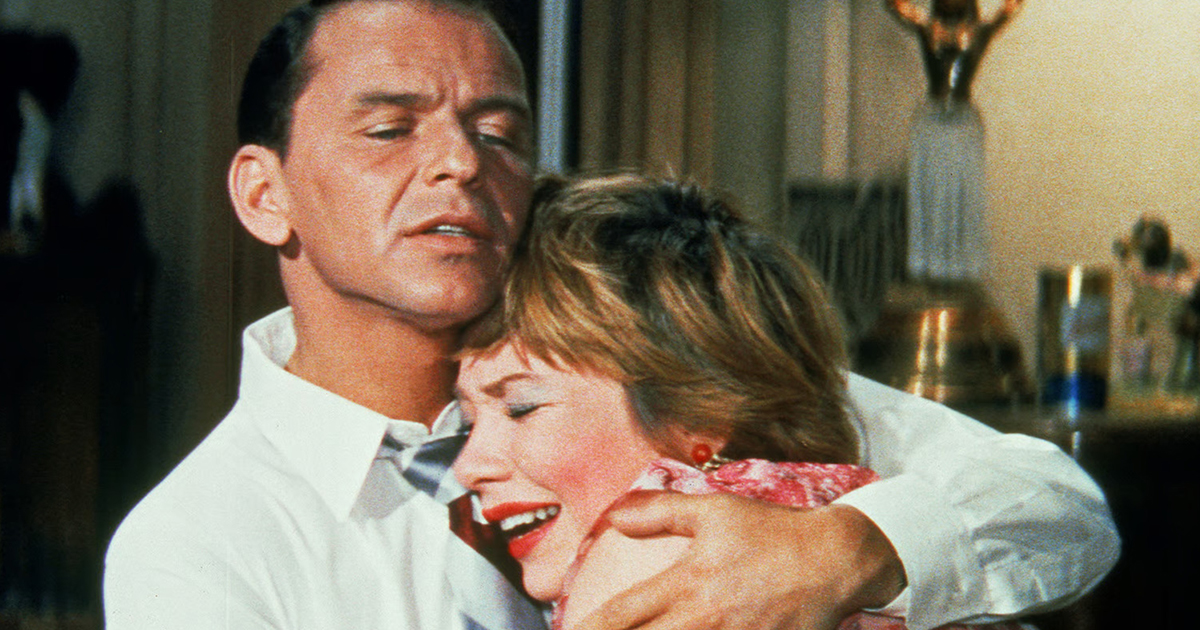
Frank Sinatra plays Dave Hirsh, a war veteran who returns to his scenic Indiana home town where family secrets and town gossip threaten to disrupt the lives of many. He arrives with a young, naïve floozie named Ginnie (Shirley MacLaine) who followed him on a bus from Chicago. She’s infatuated with him, even though he’s more interested in a local English teacher, Gwen (Martha Hyer). Gwen is a big fan of Dave’s published novel and encourages him to keep working on a second one — but she’s reluctant to enter into a relationship with a man she deems as beneath her. Meanwhile, Dave befriends a playboy gambler named Bama (Dean Martin), with whom he gets into a few skirmishes. This worries Dave’s brother Frank (Arthur Kennedy), a prominent citizen who doesn’t want the family name to get tarnished — even though he himself is having an extra-marital affair.
Some Came Running is a multi-character soap opera directed with beautiful, melodramatic flare by Vincent Minnelli (Father of the Bride, An American in Paris). The plot is loose and somewhat unfocused, so it’s better to think of the film as a ‘hang out’ movie with a thematic point more than a narrative one. Based on a very long book by James Jones (From Here to Eternity), the adaptation suffers a bit from too many characters and subplots. The film works best when it centers on the hedonistic trio of Sinatra, MacLaine, and Martin. The point of the story seems to be a particularly salient one to the 1950s, as characters wrestle with the decision to either ‘keep up appearances’, or let a more ’60s mentality take over and just ‘let it all hang out’.
As much as I dislike Frank Sinatra and his real-life ties to gangsters, he gives probably his best, most grounded and believable performance here. MacLaine also gives one of her finest turns, earning the first of her six Oscar nominations for playing Ginnie. Their unlikely relationship is built effortlessly, with tremendous commitment on MacLaine’s part and a complete lack of sentimentality on Sinatra’s. MacLaine delivers some profound lines of dialogue late in the film, as she tries to convince Sinatra to love her, even though she’s not his intellectual equal. “I don’t understand you, but that don’t mean I don’t like you. I love you! But I don’t understand you. Now what’s the matter with that?” One of the film’s many dichotomies is that their relationship feels abusive at times, while also putting one foot forward in terms of social progress. Ginnie, in her own disarmingly gentle way, insists to Dave, “You gotta remember. I’m human.”
Dean Martin is a scene-stealer as the drunken Bama, a bad influence on Dave, but a good friend nonetheless. This was his first of six pairings with Sinatra, an unofficial beginning to the ‘Rat Pack’. Their real-life friendship comes across in their onscreen chemistry. I’m not as much a fan of Arthur Kennedy or Martha Hyer, though. Their characters aren’t as well written and their performances are less convincing. (The Academy disagreed and gave Oscar nominations to both.)
Some Came Running may test your patience with its loose, lackadaisical plotting, but that’s the very quality that gives its cast room to create fully-formed, relatable characters. Minnelli further underscores their interactions with his reliance on wide shots over closeups, captured in beautiful Eastman color and cinemascope photography. The idyllic rivertown scenery is another highlight, although I’m admittedly biased. This film was shot in my own back yard, in beautiful Madison, Indiana.
With Nancy Gates, Leora Dana, Betty Lou Keim, Larry Gates, and a dynamic score by Elmer Bernstein.
Oscar Nominations: Best Actress (Shirley MacLaine), Supporting Actor (Arthur Kennedy), Supporting Actress (Martha Hyer), Costume Design, Song (“To Love and Be Loved”)