
[8]
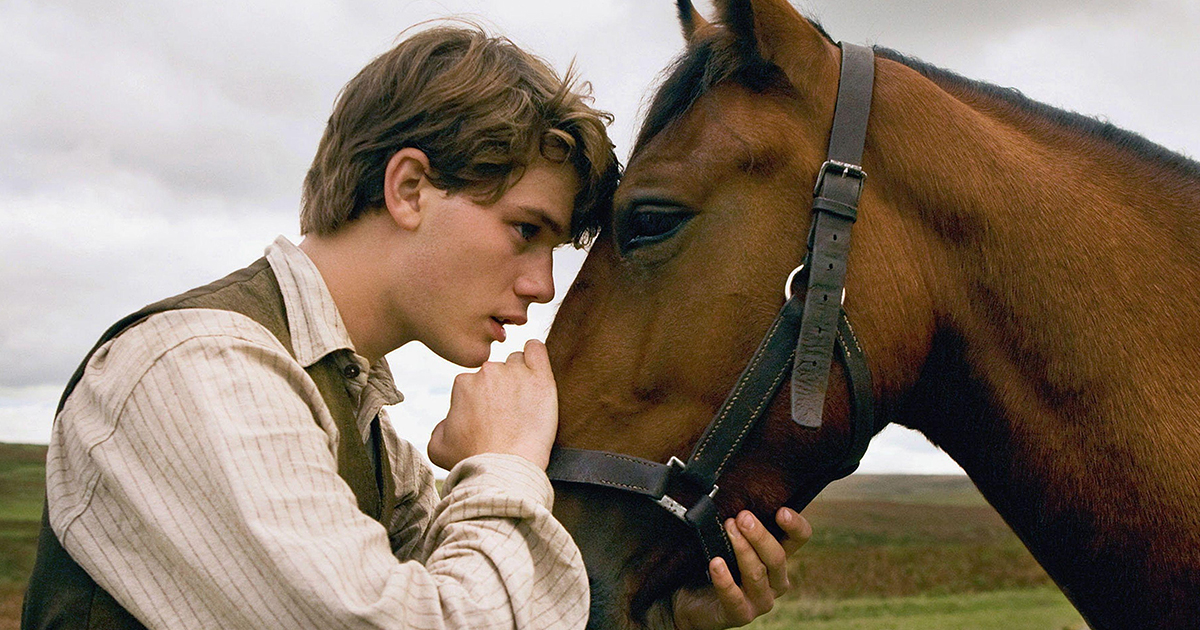
Steven Spielberg traverses the European battlefront of World War I through the eyes of a horse named Joey in this adaptation of Michael Morpurgo’s novel and a stage play by Nick Stafford. We see this foal born, trained by a teenaged farmer named Albert (Jeremy Irvine), sold to the British cavalry, and kidnapped by German soldiers. He passes through several owners while Albert enlists in the army and searches for him. Since it’s a Steven Spielberg movie, you know Albert and Joey will be reunited in the end, but their adventure gets pretty harrowing and neither of them may ever be the same afterwards.
After its pastoral first act where Albert and Joey bond, War Horse becomes episodic throughout act two. Joey sees deadly action with a cavalry officer played by Tom Hiddleston, helps two German brothers flee the battlefront, and brings a little joy to an orphan girl and her grandfather before being forced to perform back-breaking labor hauling heavy artillery for the Germans. Each of these stories may sound disparate and unrelated, but they hold together thematically, giving Joey and the audience an outsider’s perspective on human behavior during crisis and the grim reality of war. In all of the different episodes, kindness matters, even as war continues to devastate indiscriminately and mercilessly.
The most remarkable sequence in the film is both its darkest and most hope inspiring. Joey gets caught at night between the German and English forces — that infamous area known as ‘No Man’s Land’. He trips through several barbed fences and ends up tangled to the point he can’t move anymore. The next morning, a lone English soldier waves a white flag and attempts to help Joey. One German soldier does the same. After freeing Joey, the combatants wish each other well and return to their opposing trenches. Some may find the scene contrived, but I’m happy to say I’m not so jaded. It moved me tremendously.
Depicting war from an innocent animal’s perspective might sound manipulative and easy, but as I was watching War Horse I started to realize there’s not as much difference between men and horses as we might think. Neither Albert nor Joey wanted to go to war. Both are afraid. Both see carnage and are wounded. Both lose loved ones. Joey’s a horse, so naturally, he’s not ever going to wax philosophically about his wartime experiences. But neither will Albert. Earlier in the film, Albert wonders why his father (Peter Mullan) never speaks about his service in the Second Boer War in South Africa. At the end, father and son are reunited and no words are spoken. Because there are no words for some horrors. War Horse has a good message for whenever those horrors threaten to consume us: It’s better to keep moving forward rather than succumb to grief. And even though kindness never guarantees salvation, it can sometimes turn the tide.
With Emily Watson, David Thewlis, Benedict Cumberbatch, and Niels Arestrup.
Oscar Nominations: Best Picture, Cinematography (Janusz Kaminski), Score (John Williams), Sound Mixing, Sound Editing, Art Direction