
[7]
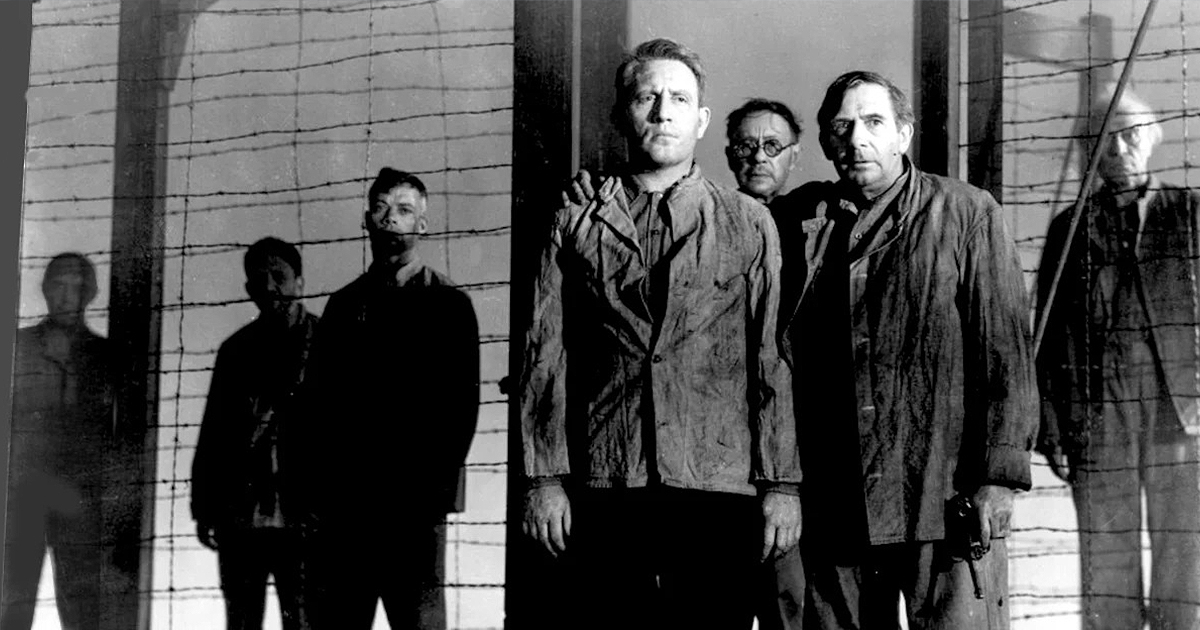
Spencer Tracy stars as a concentration camp escapee in this grim, pre-World War II drama-thriller from director Fred Zinneman (A Man for All Seasons, From Here to Eternity). After breaking out of the Westhofen camp with six other Jewish prisoners, Tracy’s character repeatedly dodges the Gestapo while seeking out a rebellion leader who can give him a passport to freedom. One by one, the other six escapees are recaptured and hung on crosses erected in the camp yard by the Nazi commandant. Can Tracy rely on some sliver of remaining human kindness among the German people to lead him to salvation, or is he doomed to take his place on the seventh cross?
The Seventh Cross is beautifully photographed and performed. The script, based on a novel by Anna Seghers, is pretty gripping in its first half, but once Tracy settles in at a hotel and begins a secret love affair with a sympathetic barmaid (Signe Hasso), it loses a little momentum. Tracy is terrific as always, working a bold character arc where he’s slowly able to transform his anger into gratitude — a tall order for a Jew fleeing the Nazis. Hume Cronyn and Jessica Tandy (real life sweethearts since 1940) share the screen together for their first of thirteen films together. They play ‘non-political’ married couple who give Tracy shelter, soon realizing that no one can remain non-political when the Nazis are involved. Hasso makes a good love interest for Tracy, even if her subplot slows the pace a bit.
The Seventh Cross suggests great evil can be thwarted by myriad, somewhat small gestures of good will. The film is provocatively narrated by one of Tracy’s dead fellow escapees, who speaks to Tracy in the narration as though he’s trying to communicate with him from the beyond. He implores Tracy not to give up on the goodness of people, even when it seems the whole world is out to destroy you. There are several instances in the story when characters take risks and make sacrifices to help Tracy, but the film is ultimately a little naive in its optimism. A year after it was released, it took two very catastrophic gestures called ‘Fat Man’ and ‘Little Boy’ — the bombs dropped on Hiroshima and Nagasaki — to end the second world war. The Seventh Cross does, however, paint a compelling portrait of a society that ignorantly abides a dangerous, authoritarian power — unwilling or unable to see the tragic, human collateral of being ‘non-political’.
With Agnes Moorehead, Herbert Rudley, and Ray Collins.
Oscar Nominee: Best Supporting Actor (Hume Cronyn)