
[7]
The first X-Men movie came along at an interesting time in the history of so-called ‘comic book’ movies, long before the Marvel Cinematic Universe became a reliable box office phenomenon. It was only a few years after the infamously goofy Batman and Robin erased the public’s good will toward the Caped Crusader, and two years before Sam Raimi’s ebullient Spider-Man would resurrect interest in superheroes. But X-Men may have played a more important role in the evolution of the genre than we give it credit for. It grounded superhero storytelling in contemporary reality, a direction in which Christopher Nolan would later find enormous success with his Batman reboot trilogy.
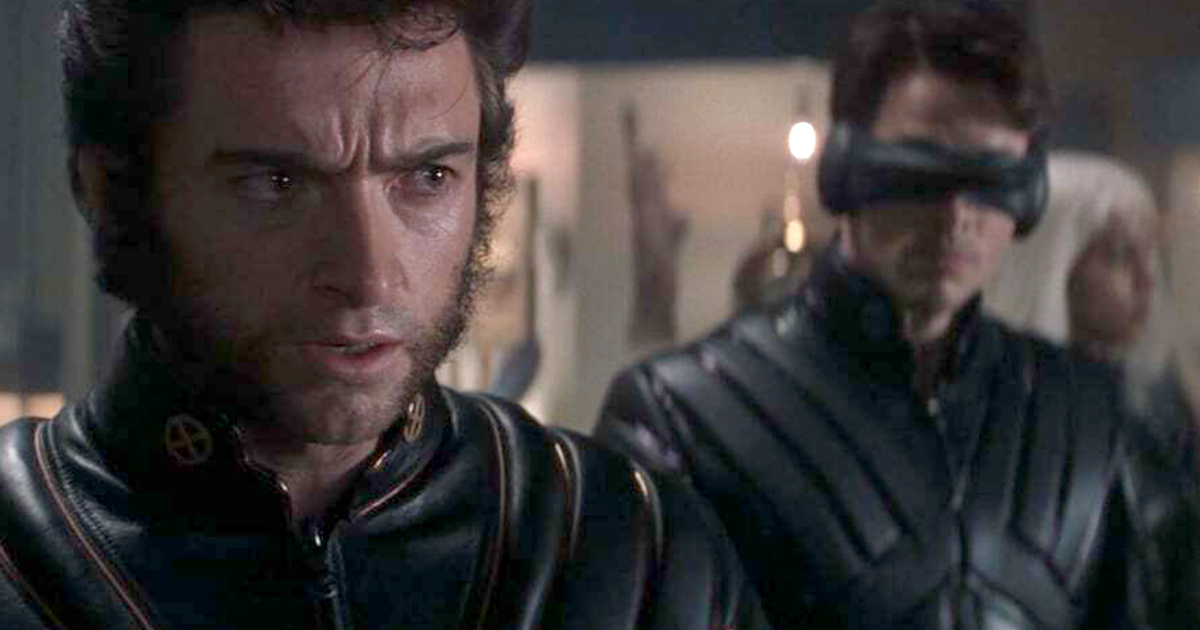
The film focuses on the character of Logan (Hugh Jackman), who cage-fights under the nickname ‘Wolverine’, and how he comes to meet a runaway girl named Rogue (Anna Paquin). The two are ambushed by dark forces and rescued by the X-Men, who invite them to join their ‘school for the gifted’ in upstate New York. ‘Gifted’ is code for ‘mutant’, as all the X-Men possess genetic superpowers. Logan’s is the ability to quickly heal any wounds, which combined with his military-administered metal skeletal plating, makes him damn-near indestructible. Logan barely remembers how he acquired this plating, including his metal, retractable claws, but Professor Charles Xavier (Patrick Stewart) promises to help him sort out his foggy past. Xavier is the founder of the school and the leader of the X-Men, who operate covertly, protecting normal humans from any evil mutants who might wish them harm.
The screenplay, credited to David Hayter, is best in its first half. Logan is set up as an interesting character and the setting of the school is an intriguing one. The X-Men offers a level of comfortable fantasy and wish fulfillment to any viewers who identify as an ‘outsider’ in any way. The characters are essentially ostracized ‘freaks’ who create their own home together, along with new ‘found family’ bonds. It’s not hard to understand why X-Men resonates with so many gays and lesbians. The second half of the movie falls into a standard ‘let’s foil the villain’s evil plan’ scenario, with the well-meaning X-Men battling evil mutants at the Statue of Liberty, where the film’s central villain, Magneto (Ian McKellen), is ready to set off a device that will turn everyone in New York into mutants. Compared to other superhero movies, the film is low in action spectacle, relying mainly on well-choreographed hand-to-hand combat rather than pricey visual effects. It may be just as well — character is what counts in X-Men, and there’ll be plenty of opportunity for spectacle in the sequels.
Stewart and McKellen are both indelible in their leadership roles, but Jackman is the film’s major casting coup. He’s rugged and ripped, with the kind of reluctant hero vibe that serviced Harrison Ford so well in Star Wars and Raiders of the Lost Ark. Few other performers get a chance to eek out any memorable performances, but everyone seems well-suited to their roles. Rebecca Romijn is striking as the shapeshifting Mystique, a practically nude, all-blue assassin who works for Magneto. The other X-Men include Halle Berry (Monster’s Ball) as Storm, James Marsden (Disturbing Behavior) as Cyclops, and Famke Janssen (Deep Rising) as the telekinetic Jean Grey. The Phantom Menace‘s Ray Park and wrestler Tyler Mane play Magneto’s henchmen.
While the grounded, more realistic approach is a refreshing change of pace, the film could still use a little more humor. It also feels a little too short, wanting for more character interactions and grace note moments. Photography, production design, and costume design are all strong, and Michael Kamen’s score is a good one — not as great as the franchise deserves, but he at least gives it a distinct, somewhat contemporary sound. In the end, X-Men isn’t quite as spectacular or entertaining as many other superhero films, but it succeeds in one vitally important way: It makes us want to see more.
Directed by Bryan Singer (The Usual Suspects). With Bruce Davison and Shawn Ashmore.