
[7]
A young girl sees her mother murdered at the hands of her father, who just so happens to be London’s infamous Jack the Ripper. When the girl comes of age (played by Angharad Rees), she’s triggered to continue her father’s murderous reign. A Freudian psychiatrist (Eric Porter) eventually takes her in, believing he can cure her uncontrollable, murderous episodes. But can her darkness ever be conquered, or will it end up consuming them both?
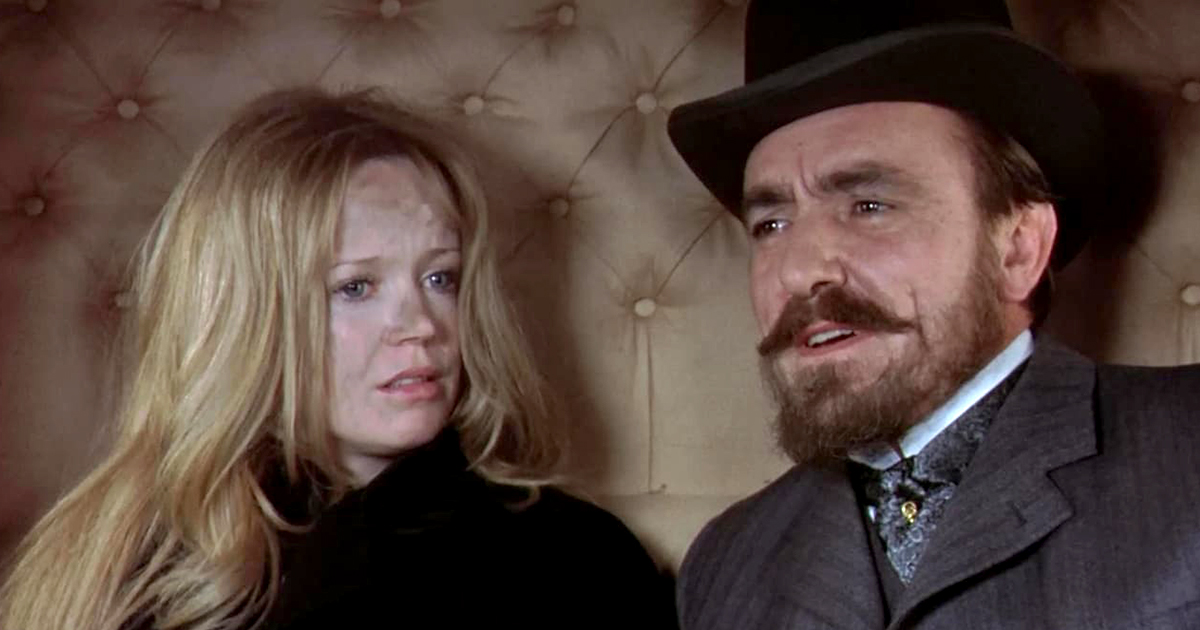
Hammer Film’s output in the 1970s is spotty at best, but Hands of the Ripper is one of their better efforts from the period. While the screenplay never explains how the spirit of Jack the Ripper is able to possess his daughter, the film creates a compelling dynamic between Rees’ and Porter’s characters. They begin with a sort of surrogate father/daughter relationship, but the film slowly introduces a few subtle, psychosexual angles that make the story more interesting. It’s in the third act, when Porter finally tries to kiss Rees on the lips, that their relationship takes a tragic but satisfying turn.
Director Peter Sasdy (Taste the Blood of Dracula, Countess Dracula) does his best work for Hammer here, utilizing terrific turn-of-the-century sets and a moving, romantic score composed by Christopher Gunning. He also assembles an unusually strong cast without relying on any ‘Hammer regulars’. Porter is commanding and charismatic as the psychiatrist, while the childlike Rees is able to play both extremes required of her character — the innocent, fearful girl as well as the impulsive, kill-happy monster. Dora Bryan is memorable as Rees’ former caretaker, a psychic scam artist who pimps Rees out to customers willing to pay extra for it. Margaret Rawlings plays more credible psychic who ends up helping Porter and Rees unearth the girl’s mysterious past. While the kill scenes probably seem quaint by today’s standards, they pushed the limits for 1971 audiences, requiring considerable editing for various theatrical and television markets.
Hands of the Ripper doesn’t break any molds, but it’s a well-made return to Hammer’s cozy, gothic horror formula — and a respite from their otherwise wonky work in the ’70s.
With Jane Merrow, Keith Bell, Derek Godfrey, Marjorie Rhodes, and Marjie Lawrence.