
[7]
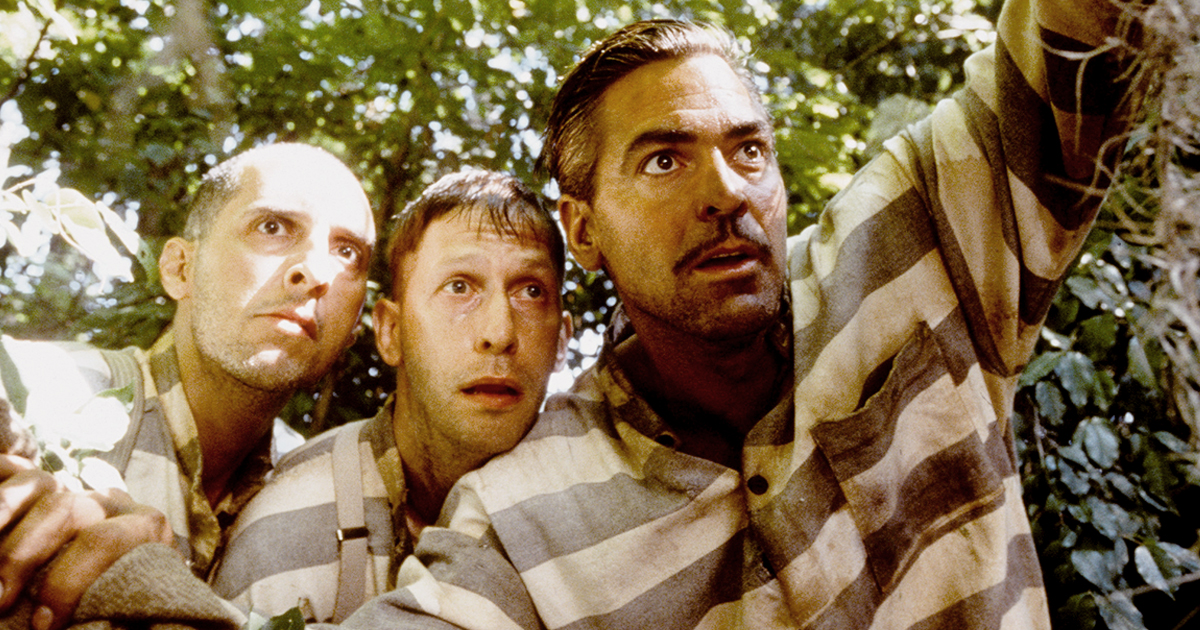
In the Deep South of the 1930s, George Clooney, John Turturro, and Tim Blake Nelson star as convicts who escape a chain gang to seek out buried treasure at Clooney’s home. The three men encounter a colorful array of characters on their journey while evading recapture by the police and inadvertently becoming a bluegrass singing phenomenon known as The Soggy Bottom Boys. When they finally reach Clooney’s home town, they discover his wife (Holly Hunter) is planning to remarry. As Clooney tries to win her back, the trio entangle with the Ku Klux Klan, a heated governor’s race, and maybe — just maybe — the Lord almighty.
O Brother Where Art Thou is another fine quirky feather in the cap of filmmakers Joel and Ethan Coen (Raising Arizona, The Hudsucker Proxy). The Oscar-nominated screenplay is based loosely on Homer’s The Odyssey, giving literature students a fun exercise recognizing all the parallels. John Goodman wears an eyepatch, essentially becoming the Greek myth’s monstrous cyclops, while the deadly sirens are depicted as three beautiful women bathing in a creek (one of the film’s best scenes). As clever as the script is, it gets increasingly unfocused toward the end. The sum of the parts is still pretty entertaining, though.
As with many Coen Brothers movies, character is king. Clooney gives perhaps a career-best performance as the fast-talking devotee of Dapper Dan hair pomade. Turturro and Nelson’s characters are drawn in broad, cartoonish strokes, but the actors somehow keep them human and relatable. The great Holly Hunter is under-utilized, but Charles Durning (The Best Little Whorehouse in Texas) is well cast as the exasperated governor trying to win re-election against a populist insurgent, and Stephen Root (Office Space) is memorable as an incredibly creepy radio station manager.
Then there’s the music. This movie wouldn’t be half what it is without it’s soundtrack full of traditional American tunes, gospel, and bluegrass. The album, supervised and produced by T Bone Burnett, actually made more money than the film and remains one of the top ten best-selling soundtracks of all time. It also won the Grammy for ‘Album of the Year’. The most memorable song is the one that gets a climactic refrain in the film, “I Am a Man of Constant Sorrow”, an infectious and foot-stomping good time whether you’re a fan of country/bluegrass or not.
O Brother Where Art Thou also has the distinction of being the first film ever to be color-graded digitally, ending the age of beautiful photochemical coloration and beginning an ugly new dawn — in my opinion.
With Chris Thomas King, Wayne Duvall, and Michael Badalucco as George “Babyface” Nelson. But don’t call him “Babyface”.
Oscar Nominations: Best Adapted Screenplay (Joel and Ethan Coen), Cinematography (Roger Deakins)