
[4]
Director Travis Knight (Bumblebee, Kubo and the Two Strings) accepts a daunting high wire act with this comedy/fantasy film based on the He-Man ’80s cartoon series and toy line. How do you make goofy cartoon for boys into an epic adventure with four-quadrant mainstream appeal? Knight tries to sustain the action with a blend of operatic drama and self-deprecating humor. Unfortunately, the mixture is off and Masters of the Universe never soars like it should.
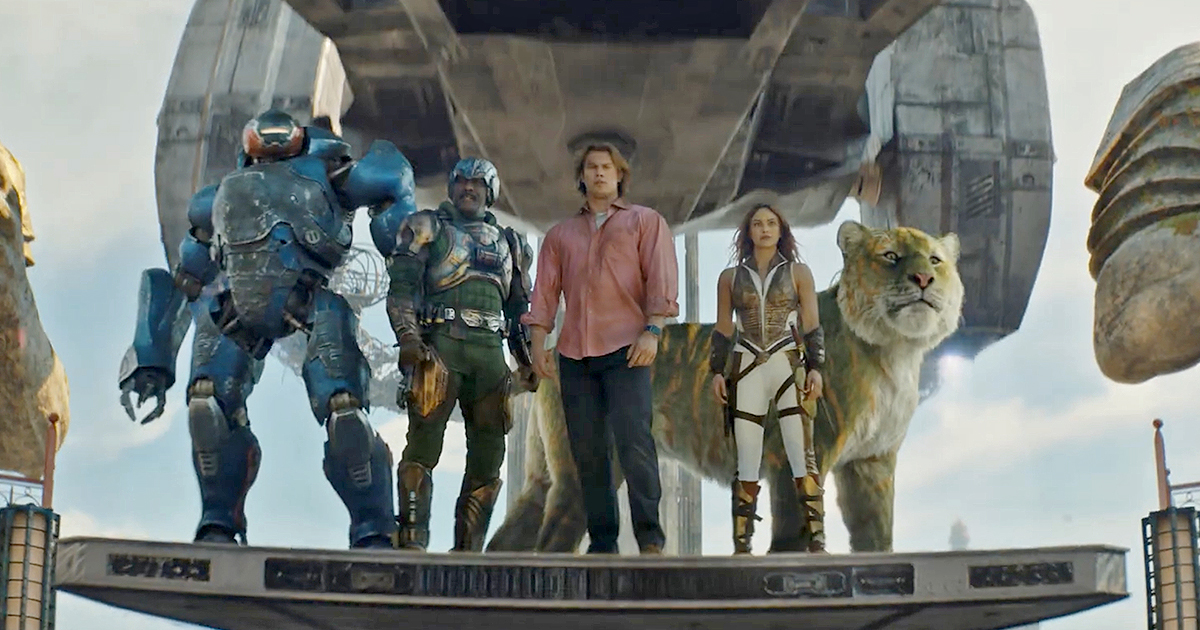
Nicholas Galitzine plays Adam, a prince of the world Eternia who is sent to Earth when his city is attacked by the evil Skeletor in the opening act. He’s stuck there for fifteen years until he finally finds the Sword of Power, a mystical object that can help him get back home. Once back in Eternia, he teams up with old friends from his childhood — his combat trainer, Man at Arms (Idris Elba), who is now a miserable drunk, and his daughter Teela (Camila Mendes), a confident tomboy who’s ashamed of her father. When they discover Adam’s parents are still alive and prisoners of Skeletor, they launch a rescue mission and prepare to do battle with Skeletor, who’ll stop at nothing to seize the Sword of Power.
The screenplay for this film has four different writers, with additional people given story credit. This explains a lot, because Masters of the Universe feels like a film pulled in different directions, trying to be faithful to an old-school ‘boy’s brand’ from before the dawn of political correctness and wokeness. You can tell the film wants to celebrate traditional masculinity — things like honor, loyalty, and yes, strength — while simultaneously apologizing at every opportunity for doing so. The film is so deeply embarrassed by its source material, it feels the need to lampoon itself almost every two minutes. As a result, action scenes lose their momentum and a small handful of dramatic moments are severely undermined. You can mix goofy comedy and serious fantasy together successfully, but the comedy here often doesn’t land well, and the dramatic moments aren’t set up well enough to pay off. Knight and the writing team should have had more faith in the material, and should have taken the assignment a little more seriously.
In making 1978’s Superman, director Richard Donner famously said the key to the film’s success is ‘verisimilitude’, or the quality of seeming true or real. No matter how fantastical a story may be, as long as you set up rules and parameters in the beginning, and the audience accepts them, you’ll have verisimilitude. This film has no verisimilitude. The characters don’t feel real or grounded enough to invest in their causes. Without emotional investment in the characters, the action rings hollow no matter how cleverly its staged. The film reaches for emotional or psychological verisimilitude a few times, especially when Adam tries to rescue his father, and again when Skeletor gets inside Adam’s mind during the film’s climax. These are among the film’s best, most human moments, but they aren’t set up to have a lasting impact.
Without verisimilitude and sincerity, I was largely disengaged from this movie from start to finish. The 1987 movie, which is a mixed bag at best, is a more entertaining and satisfying film to me. But Travis Knight’s version isn’t all bad — far from it. Galitzine and Idris Elba are well cast as Adam and Man-at-Arms, even when the script doesn’t serve them well. And even though he’s not quite as good as Frank Langella in the ’87 version, Jared Leto steals the show as Skeletor. Skeletor looks cool, sounds cool, and leaves an indelible impression — he’s a great villain. Guy Hendrix Dyas’s production design and Richard Sales’s costumes are often striking. Daniel Pemberton’s score is overbearing at times, but conjures instant magic when it incorporates guitar work from Queen’s Brian May.
With Alison Brie, Sam C. Wilson, Morena Baccarin, and a nice cameo by Dolph Lundgren.