
[8]
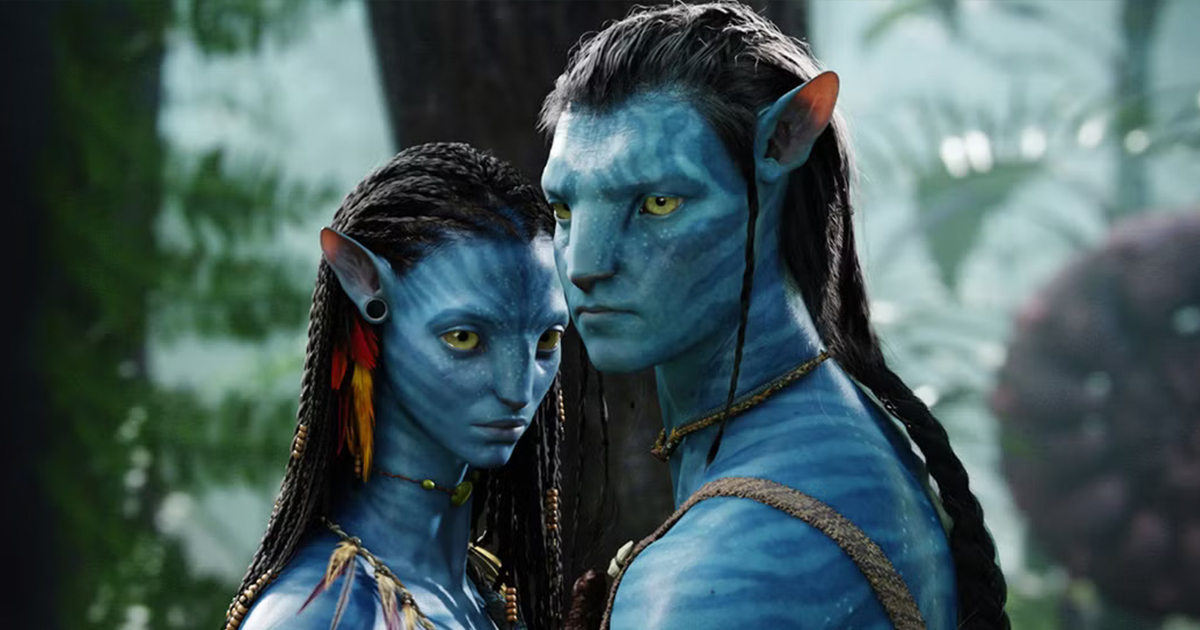
James Cameron’s first film since Titanic is a sci-fi/fantasy epic with a healthy sense of adventure and discovery. Sam Worthington stars as Jake Sully, a marine sent to the far off world of Pandora to help the military ravage the environment to extract a precious mineral for use back on Earth. Sully is a paraplegic and confined to a wheel chair, but the military wants him because his DNA matches his late brother’s, making him the only other person who can biologically merge with a genetically engineered ‘Avatar’ that perfectly imitates one of the planet’s native Na’vi.
Once in his new Na’vi body, Jake’s aim is to infiltrate the native population and report his findings back to Colonel Quaritch (Stephen Lang). Jake comes to love and respect the Na’vi, particularly a warrior princess named Neytiri (Zoe Saldana) who opens his eyes to the Na’vi’s profound connection to nature. When the military uses his reports to attack and suppress the Na’vi, he experiences a crisis of conscience: Does he dutifully serve the human marines, or does he aid this strange, alien race in their ecological cause and fight for survival?
From its floating mountains to its bio-luminescent flora and fauna, the world of Pandora never stops unfolding before our eyes, and it’s a beautiful, trippy little place to visit. The core concept of Avatar — that of experiencing life through a separate host body — is intriguing, even if the story essentially boils down to a remix of FernGully: The Last Rainforest, Dances with Wolves and Dune, with Jake becoming a long-prophesized savior in Na’vi lore. Avatar is highly experiential, successfully transporting us to a fascinating world and engrossing us in Jake and Neytiri’s story. It’s so successful in its escapism, that one can overlook the sometimes sophomoric nature of Cameron’s screenplay, one lacking grace in its unwieldy exposition, or depth to most of its characters. The villains, including Stephen Lang’s gruff colonel character and Giovanni Ribisi’s money-grubbing executive, are the most one-dimensional.
As portrayed by Worthington, Jake Sully is a quintessential, reticent male hero type with whom most viewers will be able to relate. Sigourney Weaver (Aliens) is memorable as the leader of the Avatar experiment, beginning the film doubtful of Jake’s potential to help her team, but later becoming a genuine ally to Jake and the Na’vi. Zoe Saldana’s character, however, steals the show. As Neytiri, she gives a raw, primal performance that goes a long way keeping us engaged with the movie. She makes us care about her, her people, and her home.
The Na’vi are computer-generated characters, but their movements and facial expressions are the result of Cameron’s innovative “emotion-capture” technology, which faithfully translates a flesh & bone actor’s performance onto the visage of their CG counterpart. It’s a breakthrough in the evolution of visual effects, making computer generated effects more lifelike than ever before.
Avatar was released in a cloud of hype, with words like “game changer” and “masterpiece” thrown around a little too casually. Comparisons were drawn to the original King Kong and Star Wars. While the advancements in visual effects and 3D technology earn those comparisons, the film ultimately has not had as profound an impact on culture. But it’s still a beautiful and exciting film, anchored by Jake’s compelling character transformation and the filmmaking prowess of a master craftsman.
With Michelle Rodriguez, Joel David Moore, CCH Pounder, and Wes Studi.
Academy Awards: Best Cinematography, Best Visual Effects, Best Art Direction
Oscar Nominations: Best Picture, Best Director, Best Score, Best Film Editing, Best Sound Mixing, Best Sound Editing