
[5]
Alfred Hitchcock directed Blackmail just as synchronized sound was being added to the movies. It has the distinction of being Britain’s first sound feature, although it was also released as a silent version. I opted to watch the silent version since sound technology was pretty rough those first few years. Blackmail is a more simple, straightforward story than Hitchcock’s previous silent films, with much more in common with The Lodger than anything else. Together, they were the first thrillers for the director who would later be known as ‘The Master of Suspense’.
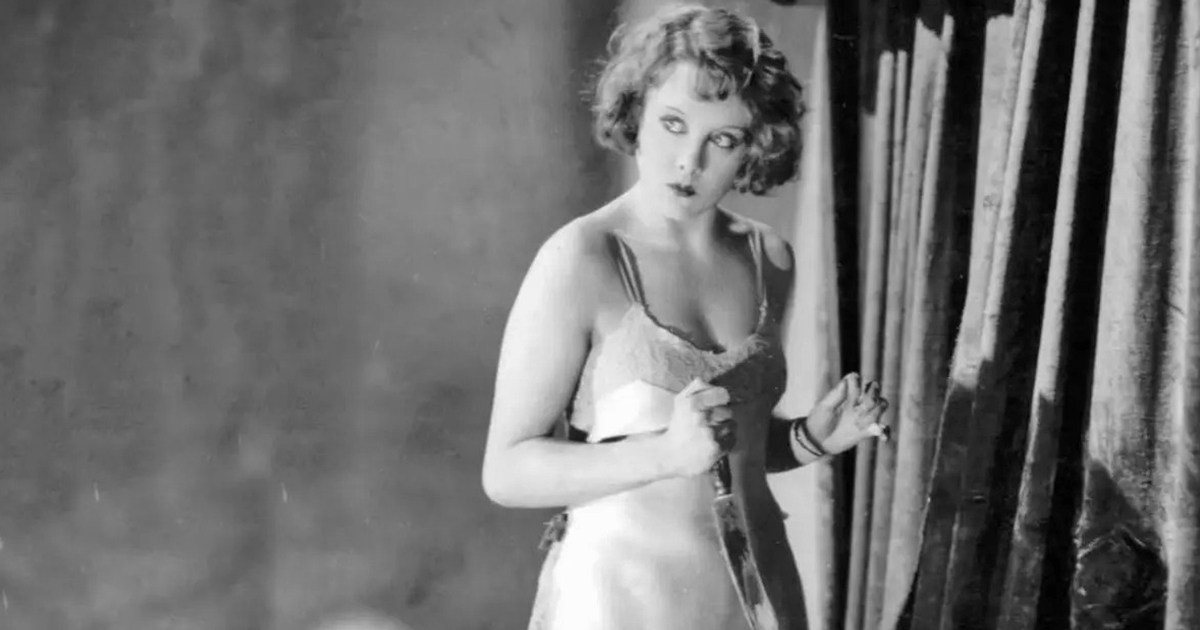
Blackmail centers around a woman named Alice (The Manxman‘s Anny Ondra) who cheats on her policeman boyfriend (John Longden) with a painter (Cyril Ritchard) who attempts to rape her. During the struggle, she defends herself with a knife, fatally stabbing the man in the back. Convinced she’ll be charged with murder, she tries to cover her tracks. But the next morning, her boyfriend is assigned to the case. He discovers one of her gloves at the scene of the crime and tries to confront her about it. But before she can confess to him, a third man who saw Alice with the painter shows up and threatens to blackmail both of them for food and money.
I like the first half of Blackmail. As long as the film follows Alice, and especially while she interacts with her attacker, the film is taut and interesting. But once the story shifts to the blackmail plot, something feels incongruent. For one, I’m not convinced Alice would be so afraid of the police as to not report her attack to them — although Hitchcock was famously phobic of lawmen. I’m also not convinced that her boyfriend, callously spurned by her the night before, would be so quick to cover for her as he does in the final act. And third, the blackmailer (played hammily by Donald Calthrop) simply isn’t a terribly interesting or engaging character. In short, Blackmail peaks early, with nothing in the second half that’s nearly as suspenseful or engaging as Alice’s fateful one-night stand.
Fans of Hitchcock can have a field day making connections between this film and many of the maestro’s future works. The film opens with a lengthy, ritualistic sequence of two police officers arresting, interrogating, fingerprinting, and imprisoning a crook — perhaps Hitch’s most formal declaration of his anti-law sentiments. The film also includes an attractive woman who gets punished for her sexual indiscretion, a false accusation, and a villain pursued across a national landmark — in this case, the British National Museum, where the blackmailer meets his fate in the climax.
Blackmail contains a lot of creative directing and dramatic camera movement. I also very much enjoyed the relatively new orchestral score by Neil Brand, who seems inspired by Bernard Herrmann’s famous collaborations with Hitchcock. My misgivings are entirely with the script and its inability to maintain momentum after the rape and murder sequence. While this film and The Lodger are widely considered Hitchcock’s two most important early works, I have to stick up for Downhill and The Manxman. Even though they aren’t thrillers and may not be as obviously ‘Hitchcockian’, I enjoyed them more than this film.