
[4]
The Looney Tunes characters (Bugs Bunny, Daffy Duck, Porky Pig, and company) were at the forefront of pop culture for half a century, but since the 1980s they’ve been sadly fading from relevance and memory. I grew up watching these characters on TV and I continue to love them in my 50s. So when I heard there was a new movie about Wile E. Coyote suing the ACME company for pain and suffering, I was interested.
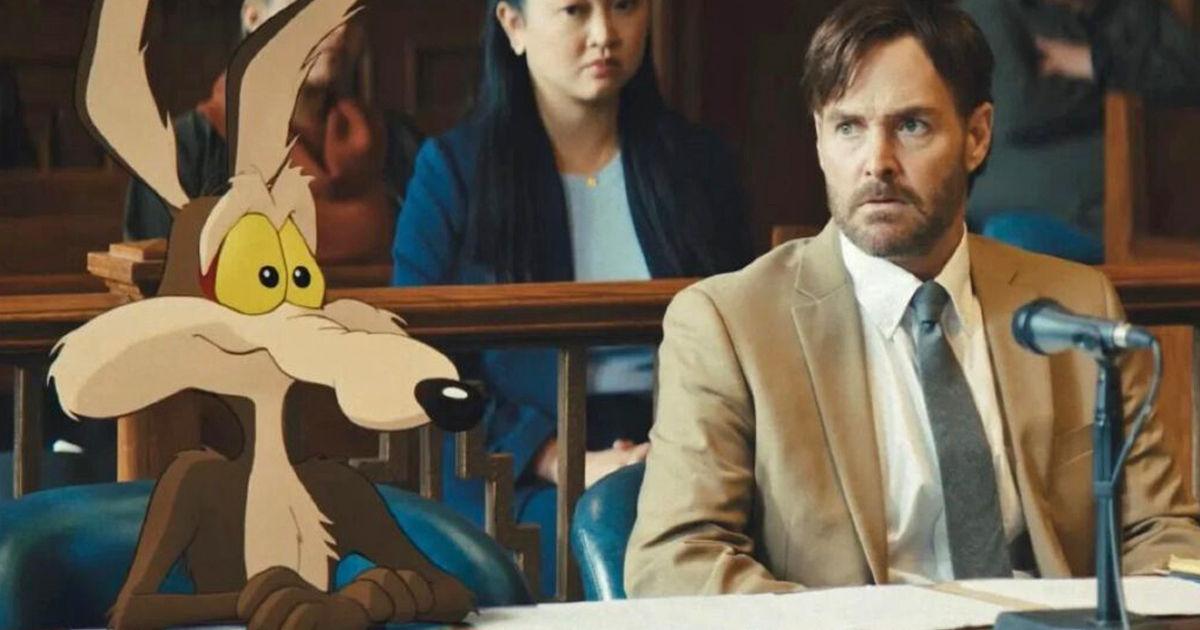
Coyote vs. ACME is a live-action/animation hybrid like Space Jam or Who Framed Roger Rabbit. The main storyline kicks off when Coyote shows up at a sleazy law firm to coerce a lawyer played by Will Forte into representing him. Forte’s character has settled with the ACME corporation countless times, failing to see the company’s reckless pattern of hostile treatment toward cartoon characters. The bulk of the film is spent with Forte and Coyote as they gather evidence and witnesses, occasionally dodging obstacles thrown in their path by ACME representatives played by John Cena and everyone’s favorite animated blowhard, Foghorn Leghorn.
The last twenty minutes are easily the best in this movie, when Forte and Coyote square off against Cena and Leghorn in a congressional hearing (Elmer Fudd presiding). Coyote’s single-minded drive gets acknowledged in a surprisingly emotional way, and the nature of his obsessive relationship with the Roadrunner is deepened. But up until that point, Coyote vs. ACME lacks stakes compelling enough to sustain a feature-length story. The characters are too shallow to hold our interest and the situations are too irreverent to invest in. The cartoon antics become tedious and the humor often falls flat. John Cena and Tweety-Bird have the best scene in the movie, when Cena interrogates Tweety over what criminal activities he tinks he taw. It’s ultimately a movie that feels too childish for adults, but slightly too sophisticated and nostalgic for today’s kids to understand or enjoy.
On the plus side, Coyote gets his due as a full-fledged co-star. It’s admirable how well the film involves a mute character who communicates through signs and pantomime, but the relationship between Coyote and Forte’s character needed to be taken a little more seriously to give more emotional weight to the story. Forte is not very funny, but it’s also not a well-written part. Many viewers will wish the animated characters had more screen time. Bugs Bunny and Daffy Duck each get one scene each, while most other characters are kept to one-time cameo appearances, including the Tazmanian Devil, Porky Pig, and Pepe LePew, who is acknowledged in a humorous way as a sexual predator.
It’s also worth noting that most of the Looney Tunes characters appear to be created with 3D animation instead of traditional hand-drawn animation. It works surprisingly well for Wile E. Coyote, but it’s far less convincing with other characters, most noticeably Foghorn Leghorn. Only Bugs Bunny appears to be hand-drawn (thank goodness). Even though this film didn’t quite work for me, I’ll continue to hold a flame for Bugs and his pals — forever optimistic that the Looney Renaissance will come.
Directed by Dave Green; written by James Gunn, Samy Burch, and Jeremy Slater. With Lana Condor and Luis Guzman.