
[5]
Alfred Hitchcock adapts Sean O’Casey’s popular stage play about a poor Irish family that inherits a small fortune but ends up losing so much more. Juno (Sara Allgood) is the matriarch, who’s constantly cleaning up after her husband (Edward Chapman), ‘The Paycock’ (or Peacock), a lazy do-nothing who struts around town as if he owned the place. Their children are young adults who still live at home — daughter Mary (Kathleen O’Regan) and son Johnny (John Laurie). The family’s mood takes a joyous upswing when a lawyer (John Longden) informs them of an inheritance coming their way, but the fantasy is short-lived. The family borrows against the pending cash windfall, but the money never comes. As the repo men empty their apartment, the family receives two additional blows when Mary gets knocked up out of wedlock and Johnny is dragged away by political rivals.
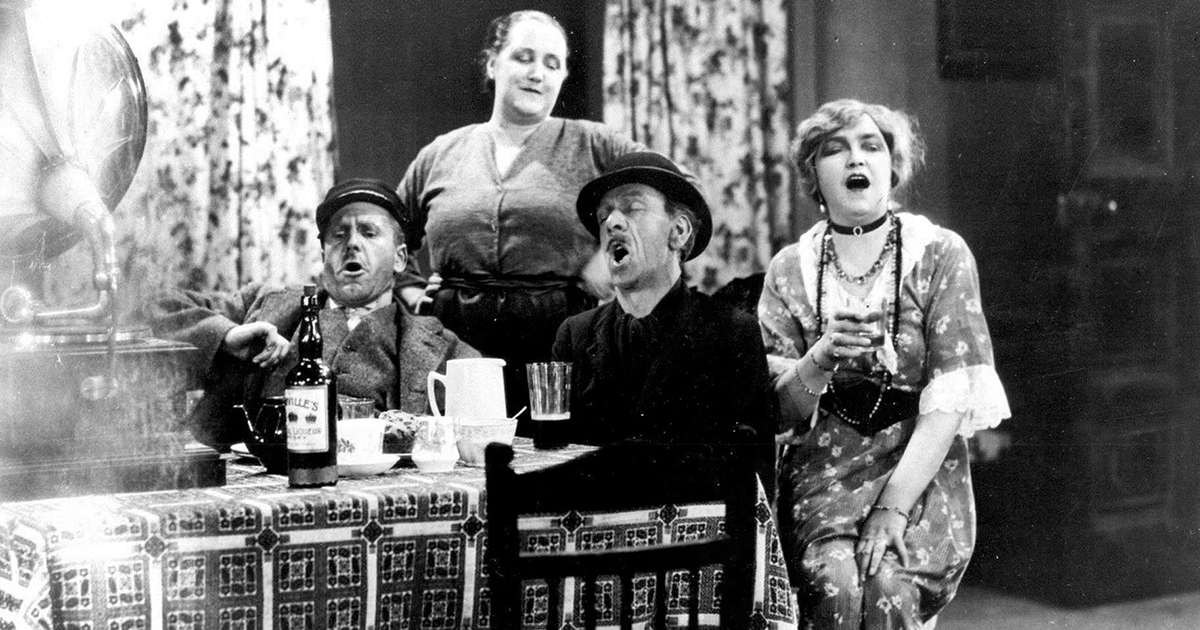
Juno and the Paycock was an experiment for Hitchcock, who wanted to see how cinematic he could make a stage play. By his own admission, the adaptation is a failure. The action is confined almost exclusively to a single room and rarely utilizes any cinematic techniques. Even though Hitchcock was embarrassed by his own contributions (or lack thereof), the play itself is a somewhat interesting tragi-comedy. There’s a pleasant ‘hang out’ quality to the middle, celebratory portion of the film, when friends and neighbors join the family for an evening of drinking and singing. The third act’s sharp turn — the pregnancy and fate of Johnny — is melodramatic in its broad strokes. What’s more poignant are the social consequences of worsening poverty. The main characters lose the love and support of all their friends and neighbors and end up turning against each other, permanently fracturing their family unity.
With Maire O’Neill and Sidney Morgan.