
[9]
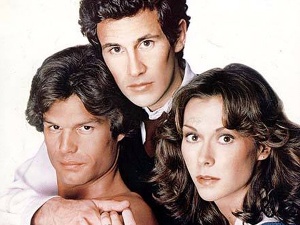
Michael Ontkean (Twin Peaks, Slap Shot) and Kate Jackson (Charlie’s Angels) play a married couple, long time best friends whose relationship begins to fracture when Ontkean’s character begins to explore his crush on a writer played by Harry Hamlin (LA Law, Clash of the Titans). Hamlin’s character is afraid of making anything remotely resembling a commitment, but he nevertheless gives Ontkean the courage to reveal his newfound revelations to Jackson. Jackson, a TV executive who feels her biological clock ticking, is of course devastated by the confession. Is their marriage salvageable? Can they at least remain friends?
This film is not well-regarded or remembered, but it’s time I come clean with my tremendous fondness for it. Making Love is a brave film featuring gay characters well before it was widely ‘acceptable’ to do so. As one of the first major studio films to broach the subject, I think it deserves a little grace for a few mawkish or overly-sentimental moments in the screenplay. Michael Ontkean is commendable for his sensitive portrayal (this man truly deserved a much bigger acting career). He and Kate Jackson have an infectious chemistry together throughout the first half of the film. You really feel as though they’ve been best friends for many years, so much so that you’re really invested in how Onkean’s confession will affect Jackson. You can almost believe that these two characters might still be able to make their marriage work. Hamlin is sardonic and charismatic as the love triangle’s foil, though his character comes off excessively ‘butch’ — as though he’s willing to play gay, but maybe not ‘too’ gay. I don’t want that to sound like a major criticism, though, because the three lead actors carry this film on their capable shoulders and I love all three of them.
Under the direction of Arthur Hiller (Love Story, Outrageous Fortune), there’s no sensationalism or exploitation here — no nudity or explicit sex scenes. Its cause is nobler than that, and I greatly admire the sensitivity and restraint. The decision for Jackson and Hamlin to punctuate the film with interview segments where they talk to the camera against a pure white background may seem pointed — but I’ve come to appreciate those abstract moments. It makes the film feel more intimate than it might otherwise. Leonard Rosenman’s simple piano-driven score is also a really nice touch.
Maybe I’m railing against our cynical, emotionally repressed, and socially isolated times — but I love this imperfectly executed but well-meaning film a hell of a lot. The fact I’ve seen it more than ten times over the years means it touches me on a personal level, and I value that quality in a film above all others.
With Wendy Hiller, Arthur Hill, Nancy Olson, and Terry Kiser.