
[9]
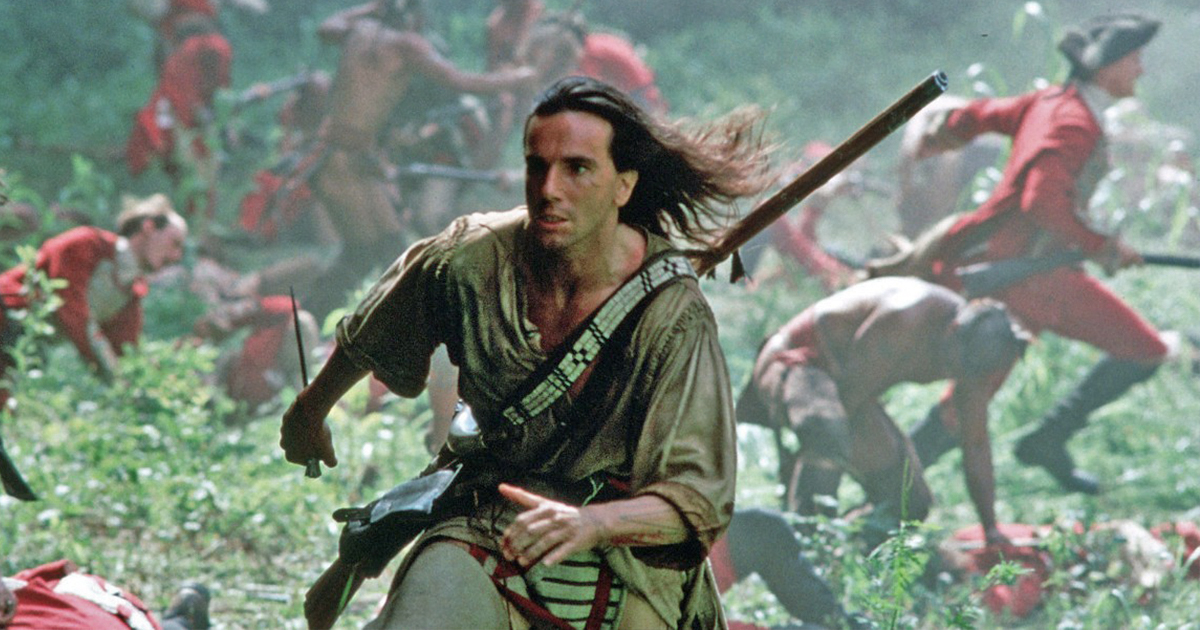
Director Michael Mann (Manhunter, Heat) adapts James Fenimore Cooper’s novel (with additional credit to the screenwriters of a 1936 version of this movie) set during America’s French and Indian War. Three Mohican fur trappers, the last of their dying tribe, rescue a British Colonel’s daughters from a Huron Indian ambush. The trappers take it upon themselves to escort the women to safety at Fort William Henry, only to discover the fort is about to fall to the French army. Making matters worse, a fallen Huron chief has vowed vengeance on the British, hellbent on killing the Colonel and his daughters, too. Along the adventure, one of the trappers, an adopted half-white man named Hawkeye, falls in love with one of the daughters — but can their love survive the battles, betrayals, and twists of fate that lie ahead?
The Last of the Mohicans is storytelling on a grand, old-fashioned scale that ‘hits on all quadrants’, to use a Hollywood business phrase. It has historical romance for the women, and it has action/adventure for the men. It succeeds on both counts, hanging impressively mounted action set-pieces on the backbone of a compelling, effortless love story. Daniel Day-Lewis, hot after his first Oscar win with My Left Foot, stars as Hawkeye, grounding the film with his trademark commitment to realism and detail. He bridges the gap between action hero and romantic heartthrob seemingly without much effort.
As his love interest, Cora, Madeleine Stowe is up to the task. While her character is technically the traditional damsel in distress, she’s no shrinking violet. She picks up a gun when she has to, and isn’t afraid to fire it. The film lets their relationship grow very naturally, through argument, circumstance, and prolonged reaction shots where very little is said. Their most romantic scene is one in which she asks him, “What are you looking at, sir?” He says, “I’m looking at you, miss.” She seems uncomfortable with his gaze at first, but slowly gazes back at him. No more words are said, and the scene ends with them both smiling. I wish more love stories could be told this elegantly.
Stories about the American frontier fascinate me more and more as I get older. The more we enter into the dark, impersonal age of computers and impersonality, the more nostalgic I am for westerns and other films that take place in simpler, more human and dramatic times. The untamed wilderness is the biggest star in this movie. Cinematographer Dante Spinotti (Heat, L.A. Confidential) beautifully captures deep forests, rivers, and mountain peaks — giving the movie escapist appeal that invites repeat viewings for anyone who appreciates America’s natural beauty.
Russell Means and Eric Schweig co-star as Hawkeye’s Mohican father and brother. Wes Studi is a stand-out as the villainous Magua, the vengeful Huron who’ll stop at nothing to kill Cora and her sister. The sister, Alice, is played by Jodhi May. Her character and her budding relationship with Schweig’s character, Uncas, is underdeveloped — but that doesn’t stop it from giving the film’s climax a powerful emotional punch. The soundtrack, composed by Trevor Jones and Randy Edelman, offers thunderous grandeur when called for, and a Gaelic vibe for the lighter, more romantic moments. It’s widely considered one of the best loved scores of the ’90s.
With Steven Waddington, Maurice Roeves, and Patrice Chereau.
Academy Award: Best Sound