
[7]
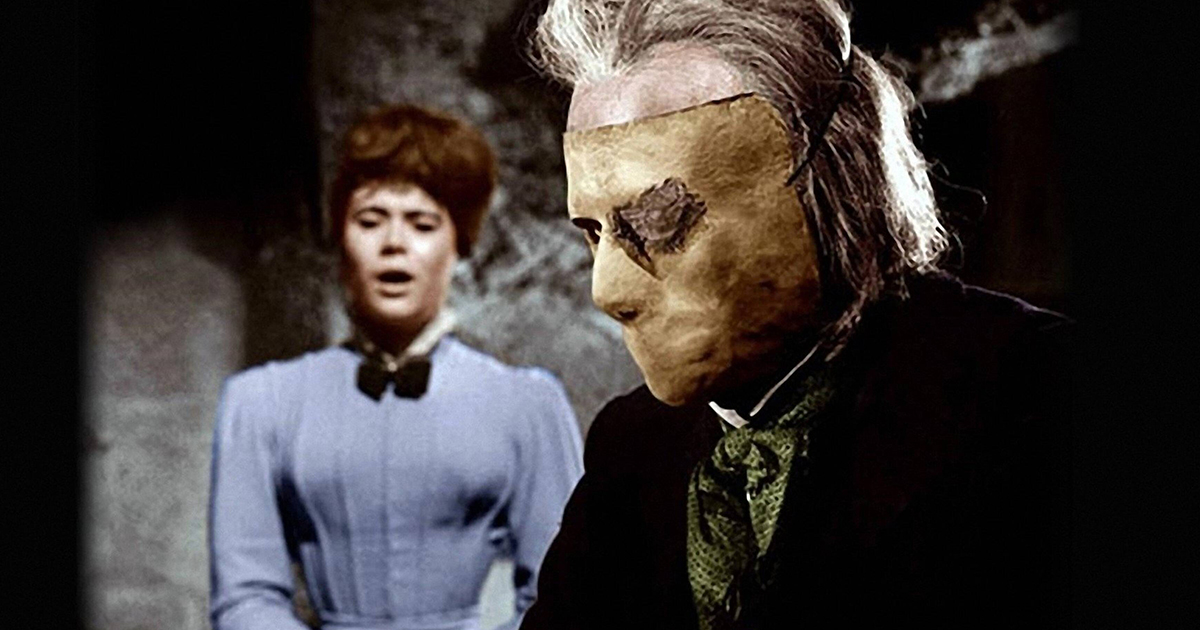
In Hammer Film’s loose adaptation of Gaston Leroux’s story, a disfigured composer (Herbert Lom) dwells within the bowels of a London opera house, where a lecherous impostor (Michael Gough) has stolen his life’s work and is cashing in on it. When the ‘Phantom’ hears the singing voice of the latest production’s heroine (Heather Sears), he has his feral dwarf companion (Ian Wilson) kidnap her and bring her to him for aggressive tutelage. Meanwhile, the singer’s new boyfriend (Edward de Souza) has uncovered the truth about the artist behind the music and is on his way to rescue his beloved from the Phantom’s lair.
While screenwriter Anthony Hinds takes more than a few liberties with the source material, he still captures the spirit of the piece remarkably well. Director Terence Fisher (Hammer’s go-to guy) is at the top of his game, overseeing one of the studio’s best-paced and aesthetically pleasing productions. The Phantom’s lair is an impressive set, and the casting is on point. This is one of few Hammer films where the romantic subplot feels more than perfunctory. There’s chemistry between Sears and De Souza, and Herbert Lom makes a pretty solid Phantom despite having comparatively little screen time. He is somewhat upstaged by Michael Gough as the film’s real villain. Gough usually plays kindly uncles, so it’s fun watching him play a supreme douchebag who steals music, yells at everyone, and submits Sears to the old ‘casting couch’ scenario. The film is strong until its last ten minutes, when the climax unfortunately fizzles a bit, failing to satisfyingly resolve the conflict between the Phantom and Gough’s character, and suddenly turning the dwarf character into a last-minute villain.
With Thorley Walters, Harold Goodwin, Martin Miller, and a remarkable score by Edwin Astley, who also wrote the music for the film’s opera production of ‘Joan of Arc’.