
[8]
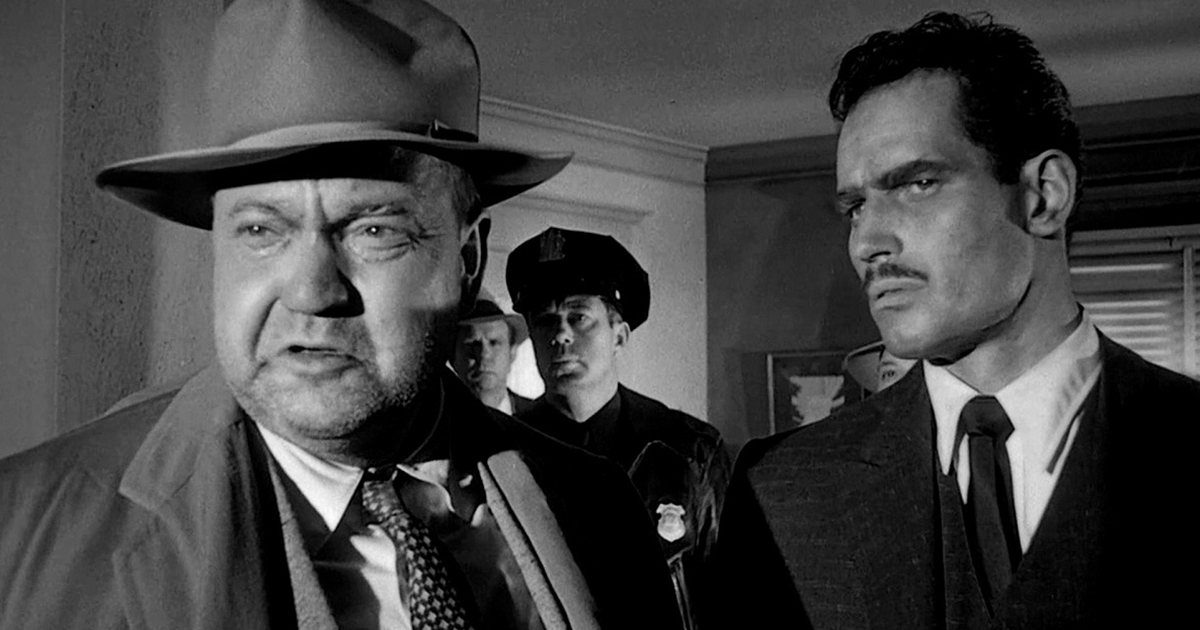
Writer/director Orson Welles also co-stars in his adaptation of Whit Masterson’s novel Badge of Evil, a sinister late-era film noir thriller set at the U.S.-Mexican border. Charlton Heston plays a Mexican narcotics officer who spars with Welles’s corrupt American police captain after he discovers Welles planted evidence to convict a man accused of murder. When Welles learns Heston plans to bring him down, he conspires with a notorious Mexican drug family who resent Heston for locking away one of their own. Touch of Evil spirals into seedier territory when the cartel kidnaps Heston’s wife (Janet Leigh) and frames her for use and possession of heroin and marijuana, hastening Heston’s resolve to entrap Welles at any cost.
Touch of Evil features an engrossing plot, beautifully stark cinematography by Russell Metty (Spartacus, The Omega Man), and a dynamic score from Henry Mancini that combines Latin jazz with elements of rock and honky-tonk — a pioneering score that influenced many films in its wake. But the best thing about the film may be Welles’s grizzled performance as the morally bankrupt police detective. Welles often shoots himself from extremely low angles, allowing his corpulence to fill the frame in a memorably imposing manner. His character will do anything for a conviction, whether it’s locking away an innocent person or committing murder first-hand. It’s arguably one of cinema’s greatest villains.
Heston gives another tight-lipped ‘actory’ performance as usual, but Leigh does well as a damsel in distress, and Dennis Weaver (Duel) gives perhaps the film’s second-best performance as the quirky, child-like night manager at the hotel where the cartel holds Leigh hostage. Touch of Evil may appeal more to cinephiles and film noir fans more than mainstream moviegoers. There’s a lot of exposition to process before the film engages us with its juicy character conflict. But if you enjoy film as an artform, Welles’s purposeful and creative direction will keep you interested from the very first shot — a three-and-a-half minute long take that follows a bomb as it moves across the border.
[Note: This review is of the longer, 1998 ‘Reconstruction’ of the film, which incorporates deleted footage and is edited more in line with Orson Welles’s original vision for the film. The original theatrical version was edited by the studio prior to release and is approximately fifteen minutes shorter.]
With Joseph Calleia, Akim Tamiroff, and a welcome, featured performance from Marlene Dietrich as a fortune-telling ex-lover of Welles’s. Zsa Zsa Gabor also makes a fleeting cameo.