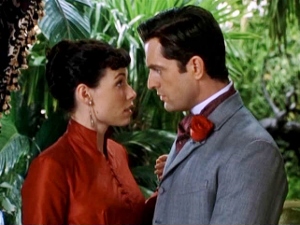
Go (1999)
[7] Of all the edgy, non-linear pretenders to the throne that came in the wake of Pulp Fiction, Doug Liman's Go may be among the best. The story weaves in and around a handful of disparate characters that interact at a grocery…


In the final film from Stanley Kubrick, a socialite couple (Tom Cruise and Nicole Kidman) get in over their heads when they decide to follow their adulterous impulses. This movie gets a bad rep, but I think it’s primarily because the casting of two superstars led to more commercial audience expectations. It’s a more intimate portrait than that, and beautifully made. I really love the weed-smoking scene, especially for the sinister undertone in Kidman’s performance. She outshines Cruise in this movie. Thematically, I enjoyed the exploration of infidelity — men’s, women’s, real, imagined. I find it interesting that the female character needs her husband to acknowledge her desires, while he seems uncomfortable acknowledging his own. (Ironic casting of Cruise? I think so.) And of course, it’s also fun to see the posh, clandestine orgy scene of Kubrick’s dreams (with the full-frontal shots restored to the most recent DVD and blu-ray releases).
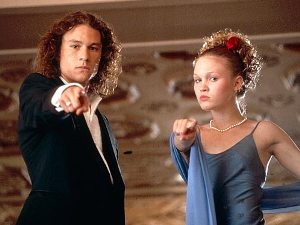
A high school boy named Cameron (Joseph Gordon Levitt) wants the beautiful Bianca (Larisa Oleynik) to be his prom date, but the girl’s tyrannical father (Larry Miller) won’t allow it unless her vitriolic older sister, Katarina (Julia Stiles), tags along. So Cameron and his friends set out to buy Katarina a date. The mysterious bad boy of the school, Patrick (Heath Ledger), agrees to their ruse, but neither he nor Katarina count on actually falling for one another.

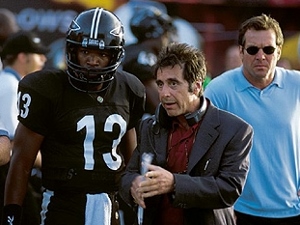
I really like Oliver Stone about half the time, but the show-offy style he used with Natural Born Killers and J.F.K. doesn’t service Any Given Sunday. Those other films, with their multiple perspectives and drug-induced visions, felt right to employ rapid editing and multiple media. But Any Given Sunday is (or should have been) a reality-based ensemble drama about the rigors and tribulations of everyone who works in football. Freeze-frames, stock photography of rolling thunder clouds, and ecclesiastic Moby music don’t work here — they only serve to portray football as something holy and sacred, and the players as celebrities or gods.
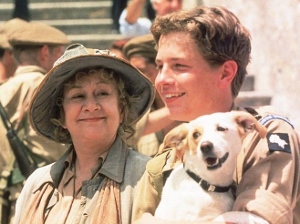
In pre-World War II Florence, a group of elitist British dames and a garish American art collector take in a small boy and raise him. When Britain and America enter the war several years later, the young man returns the favor by looking after the women when they’re interned by the Italian police — and helping to smuggle one of them out of the country when her nefarious husband plans to hand her over to the Gestapo. Tea with Mussolini is a semi-autobiographical tale from director Franco Zeffirelli (Romeo and Juliet, The Taming of the Shrew). The script could have gained a stronger perspective by sticking more to the young man’s point of view, but the sentiment comes across beautifully and I find it impossible to resist the cast of characters.

SPOILER REVIEW
I really liked American Beauty when it was first released. Maybe I was wooed by its quirky introspection and aesthetic achievments. Or maybe it was screenwriter Alan Ball’s fresh new way of blending the real with the surreal. Or even the meditative lilt of Thomas Newman’s trend-setting score. But whatever the reason(s), watching the film ten years later, I realize — American Beauty ain’t all that. It’s kinda whack.