
[9]
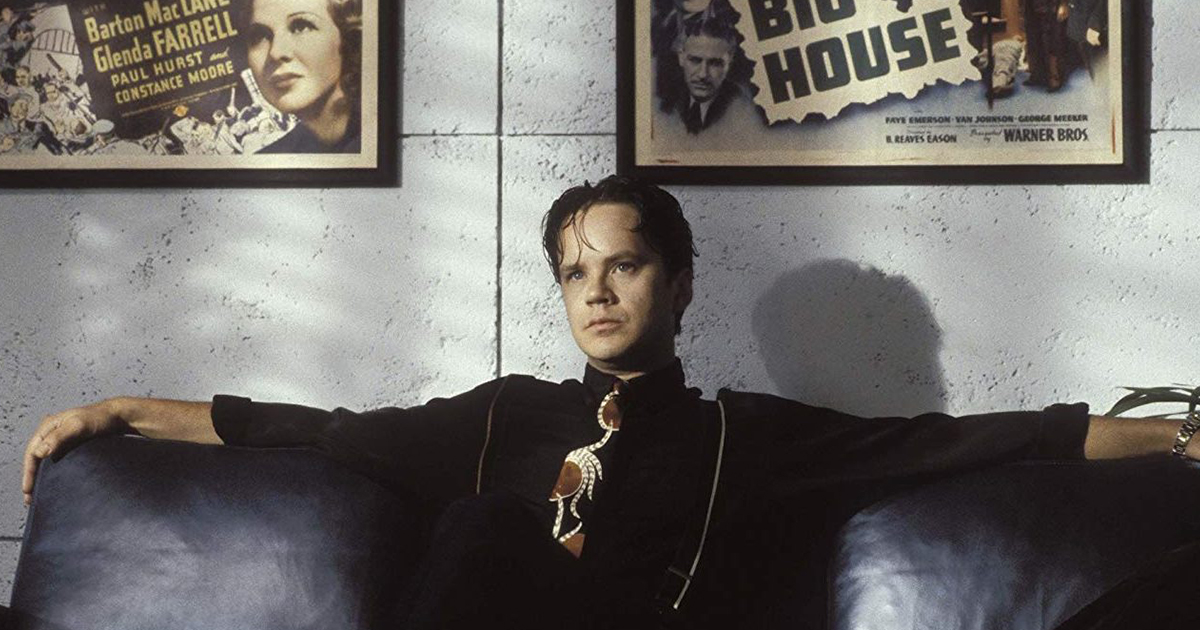
Director Robert Altman made his post-Popeye comeback with this biting takedown of the film industry. Tim Robbins (Jacob’s Ladder, The Shawshank Redemption) stars as Griffin Mill, an unscrupulous studio executive who’s paranoid about being replaced by an up-and-coming rival (Peter Gallagher). His paranoia deepens when he starts receiving death threats via postcard and fax from a mysterious screenwriter. When Mill thinks he’s found the writer, he gets into a fight with the man (Vincent D’Onofrio) and ends up killing him. Mill begins dating the dead writer’s girlfriend (Greta Scacchi) while the Pasadena police (Whoopi Goldberg and Lyle Lovett) make him their prime suspect. Will Mill keep his job, get the girl, and get away with murder like a movie gangster? Or will justice kill his own Hollywood ending?
The Player, based on a book by Michael Tolkin, is a great vehicle for Altman, whose improvisational nature keeps the cast and crew on their toes and inventive at all times. It gives the film a documentary feel, with its constantly roaming camera serving as our voyeuristic window into a murky world where posturing matters more than sincerity, and commerce always wins out over artistic integrity. It’s a very dark comedy underlining Hollywood’s immorality, but it’s also neo-noir piece. Altman, whose style is usually spartan or plain, designs The Player with subtle nods to the ’30s and ’40s, encouraging us to view the film as a film noir gangster piece from that era.
Tim Robbins delivers a remarkable leading performance. We see the wear and tear on his psyche as the workplace rumors and death threats multiply. And even though this character is a murderer who cheats on his girlfriend (Cynthia Stevenson), Robbins makes Mill charismatic enough to keep us watching — even if we feel a bit icky for empathizing him. As the dead writer’s girlfriend, Greta Scacchi perhaps has the most difficult role in the film. She’s a painter who loves to work with ice, clear plastic, and the color blue. D’Onofrio’s character refers to her as ‘the ice queen’. And indeed, she does not mourn her boyfriend’s passing. Nor is she much concerned when she learns Robbins’ character has stood outside her window at night and watched her work. When Robbins finally tries to confess his crime to her, she doesn’t want to hear it. The two characters are sociopaths meant for each other. In this movie about making movies, The Player becomes one of the movies its characters might produce, eschewing justice, morality, and humanity for a happy ending at any cost.
The supporting cast is an embarrassment of riches. Goldberg brings a little welcome comedy as the police detective, especially when she unnerves Mill by waving around tampons. Fred Ward is intimidating as the studio security man, tasked with keeping Mills’ indiscretions out of the news. Richard E. Grant and Dean Stockwell are memorable as two filmmakers who make colorful script pitches to Mill. Director Sydney Pollack makes an always-welcome appearance as Mill’s lawyer. Stevenson, as Mill’s colleage and girlfriend, is one of the only fully human characters in the movie — and in the end, she’s one of the only characters who suffers for it.
Another fun reason to watch The Player is for its parade of celebrity cameos — maybe more than any other movie ever, including (as themselves) Jack Lemmon, Anjelica Huston, John Cusack, Cher, Jeff Goldblum, Buck Henry, Harry Belafonte, Karen Black, Charles Champlin, Burt Reynolds, Peter Falk, Susan Sarandon, Andie MacDowell, and many, many others. Look for additional climactic cameos from the single-biggest male and female superstars of the day. (Let it be a surprise.) Further distinguishing this film is a strikingly original and dynamic score by Thomas Newman. His soundtrack features an unusual palette of instruments and a main theme that struggles to hit its notes the way a Hollywood executive might struggle to convey a genuine human emotion.
With Brion James, Gina Gershon, and Jeremy Piven.
Oscar Nominations: Best Director, Adapted Screenplay, Film Editing