
[10]
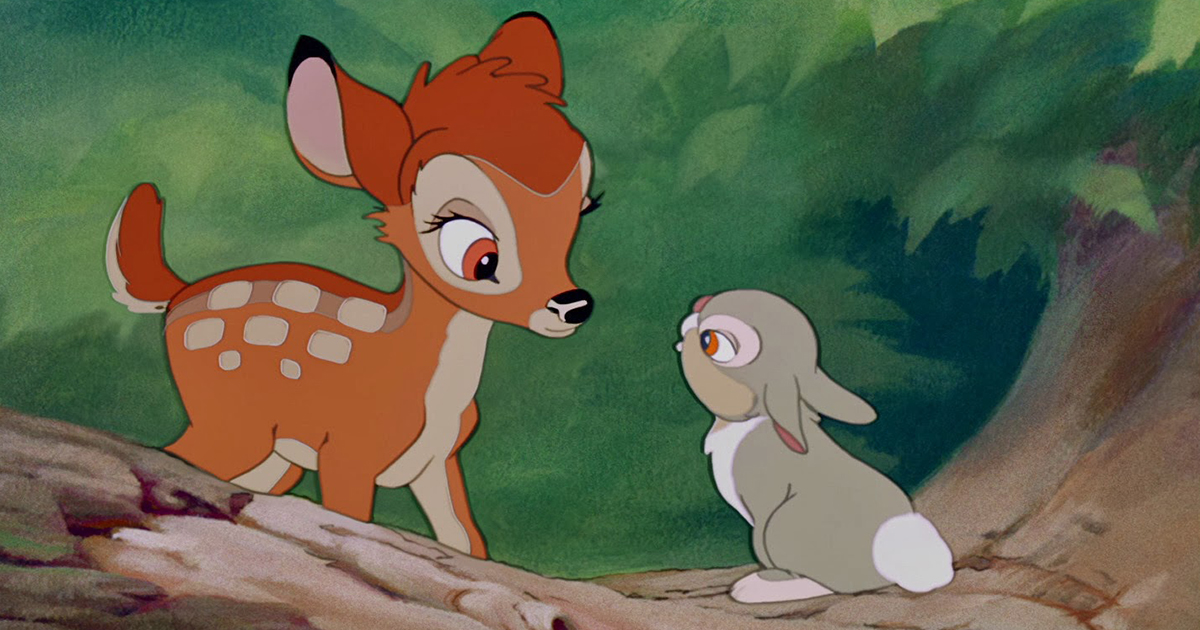
With relatively little dialogue and an abundance of montage, Walt Disney’s Bambi plays out like a beautiful tone poem on rites of passage, death and rebirth. There’s a ‘circle of life’ undercurrent to the film that makes it especially meaningful for parents and children to watch together. It’s also a wonderful ‘hang out movie’, giving its characters and setting time to entrance us. It escapes the ‘tyranny of narrative’ perhaps better than any other movie, telling us a story in such subtle, indirect ways that the formula is sometimes invisible to us. It takes the time for grace note moments. It stops, literally, to smell the flowers. There’s something pure about Bambi. Something infectious and inspiring.
Many a child has been traumatized by Bambi, and rightly so. The death of Bambi’s mother remains one of the most dramatic moments in film history, executed with beautiful restraint — a gunshot, a drawn-out sequence where young Bambi searches in vain for her, and then that horrible line uttered by the Prince of the Forest, who we later learn is Bambi’s father: “Your mother can’t be with you anymore.” On top of everything else I’ve said about Bambi, it is also bold enough to make us, the viewer, the ultimate villain of the film, beseeching us to be good stewards to nature and animals — a noble cause I personally take very much to heart.
While Bambi carries considerable dramatic weight, the film is more than balanced out by a lot of genuinely sweet and endearing moments, aided tremendously by some winning child voice-over performances and stunning animation. The sequence where a butterfly lands on Bambi’s tail is probably one of the most gorgeously rendered bits of character animation ever created. The songs in the film may not be the most memorable, but they complement the film very meaningfully, often marrying sound to sight in a striking, Fantasia-like fashion.
Groundbreaking in its narrative approach, aesthetic realism, and technological achievement, Bambi is, by my estimation, the single-greatest animated film of all time. Upon my most recent rewatch, I noticed a detail I never picked up on before. During a changing of the seasons sequence, there’s a shot of two browned leaves clinging a tree — the last holdouts in Fall’s deference to inevitable Winter. Immediately, through imagery alone, I felt for those two leaves. A gust of wind causes them to lose their hold and they drift to the ground. In my mind, I was hoping they would land together — and sure enough, they do, one overlapping the other. I thought, ‘I bet Disney did that on purpose.’ When I browsed the special features on my Blu-ray, indeed I found storyboards for a deleted sequence in which those two very leaves hold a conversation about life, death, and what lies beyond. Even though the sequence was trimmed and the leaves’ dialogue removed, the imagery still communicates such profound ideas. Another example of the magic of Bambi.
Directed by James Algar, Samuel Armstrong, and David Hand. Based on a story by Felix Salten. Featuring the voices of Donnie Dunagan, Hardie Albright, Peter Behn, Stan Alexander, and Will Wright.
Oscar Nominations: Best Sound, Best Song (“Love is a Song”), Best Scoring