
[8]
Director Denis Villeneuve (Blade Runner 2049, Arrival) takes a stab at delivering Frank Herbert’s dense, complicated science-fiction novel to the big screen. Dune centers around a teenaged royal named Paul Atreides (Call Me By Your Name‘s Timothée Chalamet) whose family is chosen by the galactic emperor to oversee production of the universe’s most valuable substance, the spice mélange, on the desert planet Arrakis, nicknamed ‘Dune’. But the planet’s previous custodians, the greedy Harkonnens, want their cash cow back and have planted a traitor in the Atreides’ midst to help them destroy Paul’s family and regain control of spice production. Against this political backdrop, Paul is having dreams that start coming true — that he’s a messiah destined to lead Dune’s native population, the Fremen, in a holy war to reclaim their planet from the Harkonnens and the Emperor.
Dune was adapted by David Lynch (Mulholland Dr.) in a lush 1984 version that failed miserably at the box office but has since become a cult sensation. It was also presented as a Sci-Fi Channel miniseries in 2000. Both versions are mixed bags, leaving room for a more perfect Dune to be made. Dune: Part One is obviously not the complete story, but at the mid-point of Villeneuve’s interpretation, his version is stronger in some ways, and weaker in others — but overall a highly enjoyable adaptation so far.
One of the ways in which this new Dune excels is in its casting. Chalamet has the chops to play anything, and he’s the first actor cast age-appropriately in the role of Paul Atreides. Rebecca Ferguson (Doctor Sleep) has the next-meatiest role as Paul’s mother, Jessica — a woman torn between her maternal bond to Paul and her allegiance to a manipulative sisterhood of witches who have their own designs for her and her son. The supporting cast includes Oscar Isaac filling the shoes of Paul’s doomed father, Leto; Stellan Skarsgard as the vile Baron Harkonnen; and Oscar-winner Javier Bardem (No Country for Old Men) as Stilgar, a leader among the Fremen. Charlotte Rampling is creepy as the Reverend Mother Mohiam, who tests Paul’s willpower in one of the movies scarier moments.
Villeneuve also succeeds at successfully telling the story better than any previous version. While Lynch’s version has a stronger first act, his film is too overly-ambitious in telling such a long tale in just over two hours, resulting in a rushed second half that boggles the minds of the uninitiated. The Sci-Fi Channel miniseries has more time to tell the story, but is marred by too many budgetary compromises to tell it properly. While Villeneuve resorts to some of the same clunky methods of doling out exposition that Lynch employed (namely Paul’s educational ‘filmbooks’), he is the first director to get both an adequate budget and an adequate run-time, solving many of the problems that led some to believe Dune might be unfilmable.
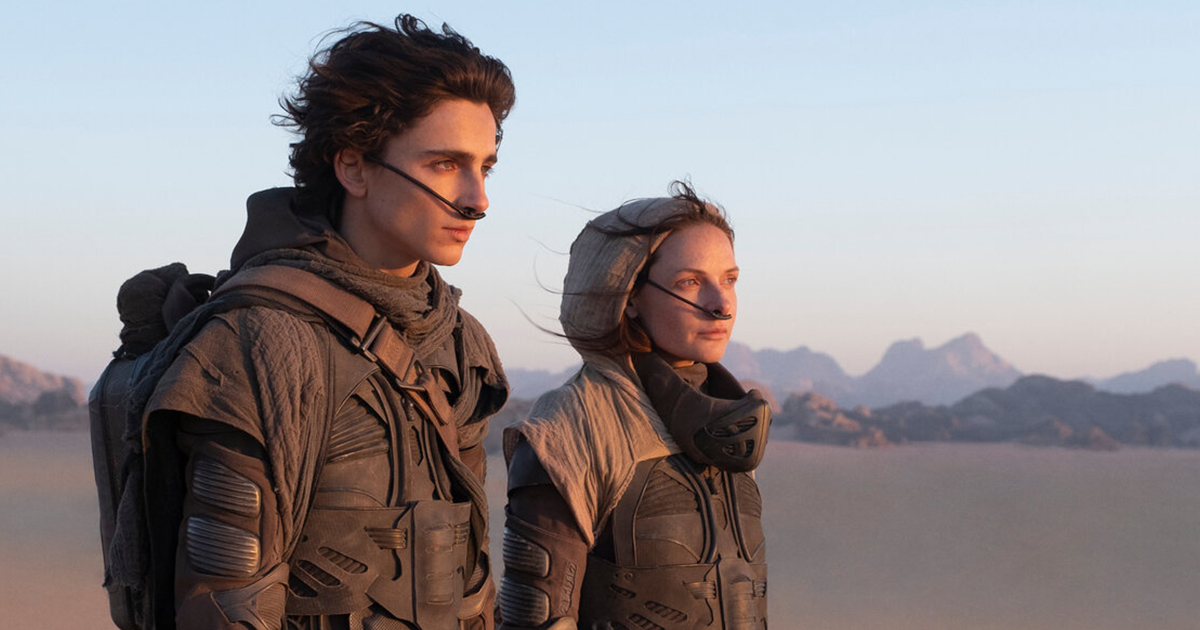
In the area of spectacle, the Atreides’ rescue of an abandoned spice harvest crew from a giant sandworm is an exciting one. The Harkonnen attack on the Atreides’ desert stronghold is also, literally, explosive. Both of these sequences, and a few others, are executed more powerfully here than in either the 1984 or 2000 versions. The scale of the sets and environments are sometimes overblown to the point of abstraction, but Villeneuve brings a lot of Herbert’s sci-fi concepts to life better than we’ve ever seen before — including the characters’ body shield technology, the iconic ornithopter vehicles, and the visible functionality of many life-saving desert tools.
David Lynch’s Dune (of which I’m a huge fan) still has the edge over Villeneuve in overall aesthetic. That’s more a testament to Lynch’s incomparable set and costume design than a knock against Villeneuve’s team, who do an excellent job bringing Herbert’s many worlds and cultures to life. And as for those famous sandworms? This reviewer calls it a draw there, preferring the design of Lynch’s behemoths but the execution of Villeneuve’s. Lynch may also get the edge in music, with rock group Toto’s combination of brooding orchestra and electric guitar generating more emotion than Hans Zimmer’s less melodic, more conceptual and experimental effort.
Speaking of emotion, this new Dune prefers to avoid it. One can understand Villeneuve perhaps wanting to avoid the awkward, melodramatic moments of Lynch’s version, but it also makes for a more austere and ‘removed’ viewing experience. While the intricate plot of Dune might be engaging enough all on its own, it takes most of Part One‘s two-and-one-half-hour run time to get invested in Paul and Jessica as characters. Villeneuve’s screenplay is nearly devoid of humor, levity, or personality. Actors like Josh Brolin and Jason Momoa, as Paul’s teachers Gurney Halleck and Duncan Idaho, seem cast for their charm, yet both actors feel curiously constrained in their roles. In short, Villeneuve could have ‘loosened up’ a bit.
As someone who read and enjoyed Dune as a child, I’ve looked forward to every iteration of this terrific story. I think the perfect Dune is somewhere between Lynch’s and Velleneuve’s versions. I still prefer Lynch’s version overall. As wonky as it is, its design aesthetic is irresistible to me, and I find it a more emotional and meaningful interpretation of the material. It also has a unique, meditative quality that’s hard to describe. But Villeneuve’s version is very strong and sure-handed, and will probably appeal more to general audiences.
With Dave Bautista, Stephen McKinley Henderson, Sharon Duncan-Brewster, Chang Chen, Zendaya, and David Dastmalchian.
Academy Awards: Best Sound, Cinematography, Film Editing, Production Design, Score, Visual Effects
Oscar Nominations: Best Picture, Makeup & Hairstyling, Costume Design, Adapted Screenplay