
[7]
Even though it’s unrelated to Hammer’s popular series of Dracula-centric films, The Kiss of the Vampire is an intriguing entry in the studio’s gothic output. Gerald (Edward de Souza) and Marianne (Jennifer Daniel) are a honeymooning couple whose car breaks down near a remote village in Southern Europe. They get a room at the village’s inn and are promptly invited to dinner at the home of an aristocratic Ravna family who lives nearby. At first, the family seems warm and inviting, but their sinister intentions soon become clear.
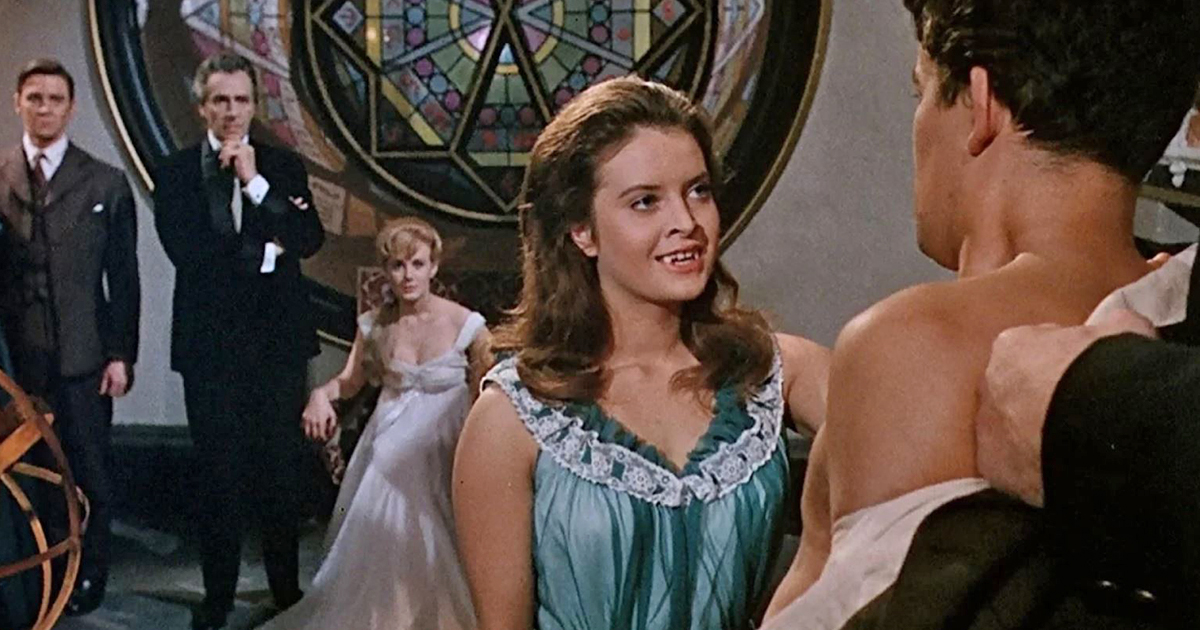
At a masquerade party a few nights later, the Ravnas separate the lovers. While Gerald is drugged, they reveal to Marianne that they are a cult of vampires. The family patriarch (Noel Willman) forces his bite on her, magically brainwashing her and forcing her to become a compliant member of the cult. When Gerald wakes in the morning, both the Ravnas and the inn-keepers (Peter Madden and Vera Cook) insist that he arrived in the village alone. Before he goes mad from everyone’s gaslighting, Gerald encounters a gruff professor (Clifford Evans), a Van Helsing-like character who has been hunting the Ravnas. He and Gerald join forces to break into the Ravna mansion, rescue Marianne, and perform a ritual to restore her humanity and destroy the Ravnas.
For a gothic vampire movie, The Kiss of the Vampire feels surprisingly fresh and unpredictable. The element of a vampire cult recruiting members is intriguing, although what the cult believes in or endeavors to achieve remains unclear. There’s also a generous dash of unspoken sexual tension throughout the film, especially when the eldest Ravna son (Barry Warren) entrances Marianne with his piano playing. Warren and Noel Willman make several glances at each other and at the honeymooners that are loaded with sexual hunger and desire. This sexualizing of vampires was latent in earlier vampire films, but is more explicit here. It’s an approach we’d see more and more of in subsequent vampire movies, culminating in the codependent bloodsuckers of Anne Rice’s Interview with the Vampire.
The final third of the movie makes some odd, inelegant jumps in plotting, but the climax is a refreshingly unusual one. Hammer’s given us one gothic hero after another physically engaging with their vampire nemeses armed with stakes and crucifixes, but we’ve never seen our hero performing a ritual from afar that results in a swarm of bats breaking into the Ravna mansion and wiping out the fanged baddies. It may seem an odd choice, but at least it’s an original one.
The acting is mixed bag, with some of the women appearing to be in over their head (namely Jacquie Wallis as one of the Ravna daughters and Vera Cook as the innkeeper’s wife). The men fare much better, with Clifford Evans and Barry Warren giving the strongest performances. Evans has a Maximillian Schell vibe about him. He’s a man of few words, whose glaring eyes convey multitudes. One of his best moments is the opening of the film, in which he crashes a funeral and — to the shock of the bystanders — drives a wooden shovel through the coffin and into the deceased’s heart. There’s a scream from within the coffin as the crowd freaks out and disperses. Evans merely walks away without explanation or concern — one more vampire down, however many to go. Hammer should have returned to this character because he’s beguiling enough to carry a few sequels.
Warren is erudite as the Ravna son. He’s at turns creepy and cold, seductive and curiously effeminate. One might suspect the actor might have been gay. He was married to two different women, but it’s rumored that he had a sex change and lived as a woman the last few years of his life.
Director Don Sharp proves more than capable in his first Hammer production. James Bernard provides another brooding and bombastic score, and the cinematography is handled by Alan Hume, who would later lens Return of the Jedi. With Isobel Black and Noel Howlett.