
[7]
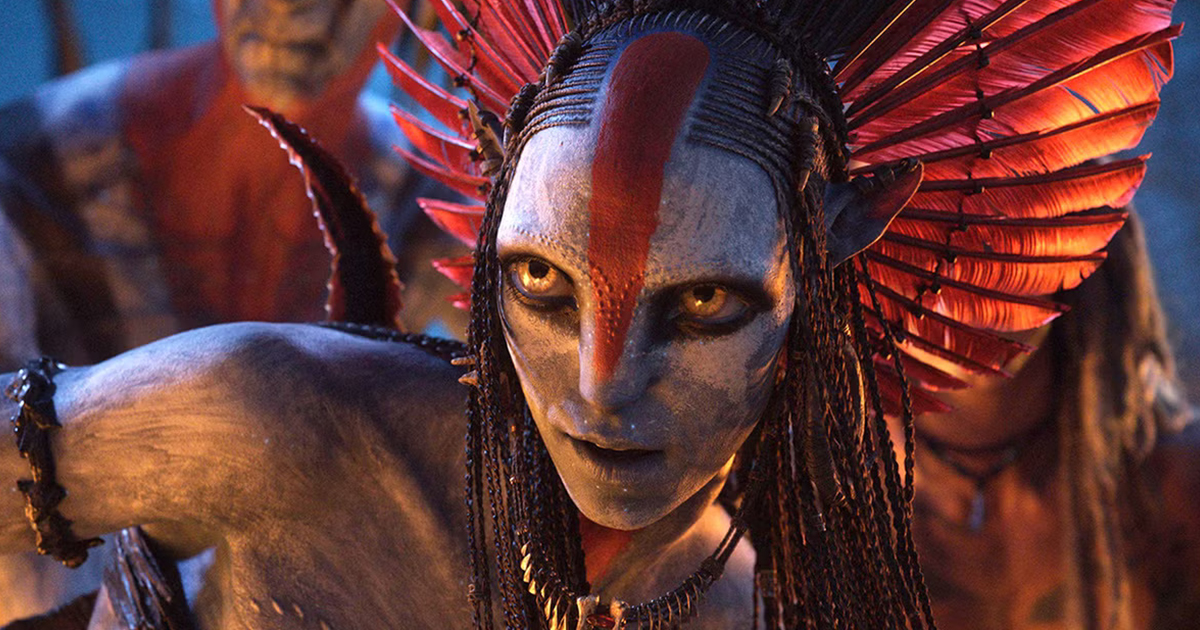
The Sully family are back in James Cameron’s third Avatar movie, one that recycles as much material as it invents, but ultimately satisfies. Jake (Sam Worthington) and Neytiri (Zoe Saldana) are still reeling from the death of their eldest son in The Way of Water. Narrating Fire and Ash is their youngest son, Lo’ak (Britain Dalton), who feels personally responsible for his brother’s death to the point of contemplating suicide. Feeling his parents also blame him for the tragedy, Lo’ak eventually leaves home in search of the outcast Payakan, a whale-like creature with whom he’s established a tight bond.
Meanwhile, Jake and Neytiri’s two adopted children are especially integral to the plot this time. Kiri (Sigourney Weaver playing a 15-year-old) learns more about her unique lineage and further develops her connection to Eywa, Pandora’s ‘Mother Nature’. That connection saves the life of Spider (Jack Champion), the family’s adopted human son, when his oxygen mask fails and he nearly suffocates breathing Pandora’s air. Kiri communes with Eywa, who transforms Spider’s organs so he can breathe freely. What at first seems a miracle, however, soon becomes a curse when Giovanni Ribisi’s mining corporation captures Spider to backwards-engineer his ability to breathe the planet’s air — a breakthrough that would allow even more dangerous humans to come to Pandora.
The best parts of Fire and Ash are the new parts, including Jake and Neytiri’s Biblical-level struggle over whether or not to sacrifice Spider for the greater good of Pandora. There’s also a new, violent and atheist ‘Ash’ tribe of Na’vi who team up with Quaritch (Stephen Lang) and the Earth military. Oona Chaplin (granddaughter of Charlie Chaplin) gives a memorable performance as the sadistic leader of these ‘Ash’ people.
Other parts of the film, while well-executed, feel like a rinse-and-repeat from the previous film, continuing the upsetting whale hunting storyline and Quaritch’s ongoing pursuit of Spider, his biological son. The film also climaxes the exact same way the previous two films did, with the Na’vi hopping on their flying dragons and battling the Earth military’s giant machines. Unlike The Way of Water, however, Fire and Ash has a greater sense of evolution and finality to it. It’s more emotionally satisfying, and wherever it does repeat The Way of Water, it does it better. If The Way of Water didn’t exist, or if it didn’t preview so much of what the third film has in store, it might have allowed Fire and Ash to have a greater dramatic impact.
The first Avatar was a somewhat novel film, especially as a big-screen 3D experience. The Way of Water and Fire and Ash only partially succeed in expanding the story and deepening the characters, but not necessarily enough to justify their long run times. Even though the films move at a brisk, exciting pace, one can’t help but wish more were happening on a dramatic level to push this saga forward. Even though the films sometimes get caught ‘grinding their gears’ and repeating themselves, they’re still eye-catching and entertaining. If you enjoyed the first two Avatar films, you’ll like the third. James Cameron has plans for more of these films, but unless he makes some bold, original moves to reinvigorate the story, maybe it’s time to let Pandora rest.
With Kate Winslet, Edie Falco, and Cliff Curtis.
Academy Award: Best Visual Effects
Oscar Nomination: Best Costume Design (Deborah Scott)