
[7]
Hammer Films’ and Peter Cushing’s fourth Frankenstein film is easily the best up to that point, even though Cushing takes a bit of a back seat in the narrative. In Frankenstein Created Woman, the first half of the story centers mainly on the Baron’s young assistant Hans (Robert Morris) and the object of his affection, Christina (Susan Denberg), a pitiable but kind young woman with a scarred face and a few gnarled limbs. After a trio of wealthy, well-connected brats tease and torment Christina, Hans gets into a skirmish with them. The bullies get their revenge by framing Hans for a murder and he’s executed by guillotine half-way through the film, right before Christina’s eyes. She’s so grief-stricken, she jumps off a nearby bridge and drowns herself.
In the film’s second half, Baron Frankenstein and his cohort Doctor Hertz (Thorley Walters) work together to preserve Hans’s soul, transplanting it into Christina’s reanimated, newly-beautified body. This idea could have been treated more provocatively, but by putting a man’s soul in a woman’s body, Christina essentially just hears Hans’s voice in her mind. He persuades her to use her feminine wiles to seduce the three men who ruined their lives.
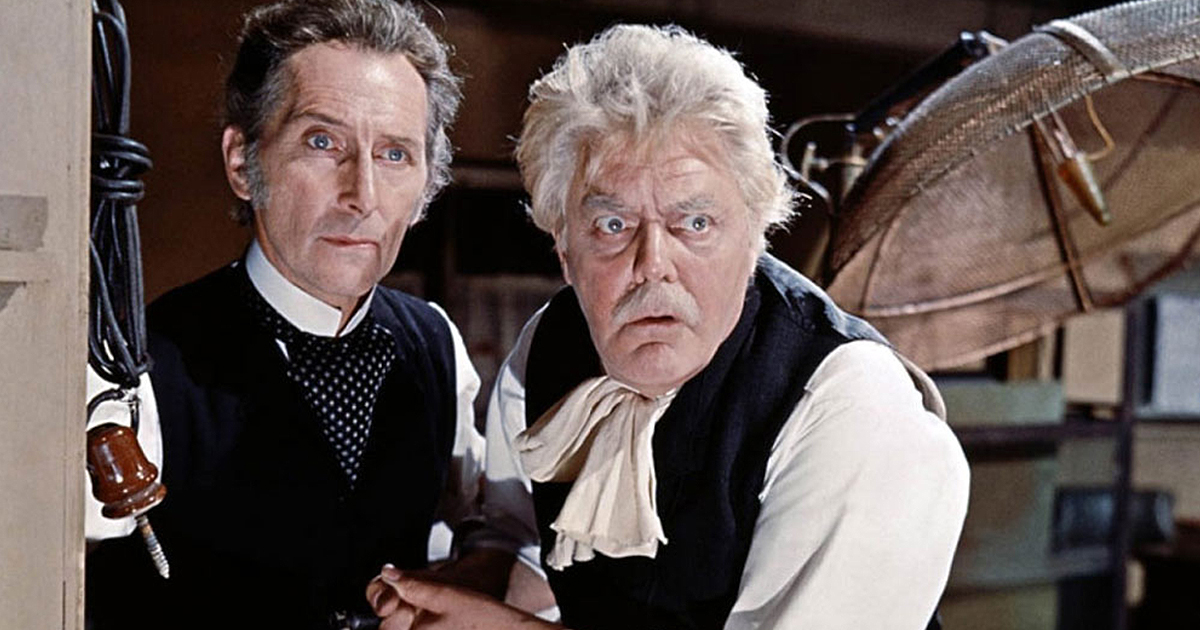
Even though Cushing doesn’t have as much to do, he’s as committed as ever when he’s on screen. He’s still playing the character as an obsessive sociopath, but the Baron’s a bit more kind and likable than in prior films. Thorley Walters is perhaps the most amusing associate the Baron’s ever had, giving a weird, darkly comic performance as an aging doctor who is perhaps experiencing the first signs of dementia. Susan Denberg, a 1966 Playboy playmate, proves more than just a pretty face (though her entire performance was over-dubbed by another actress). Robert Morris puts in a compelling performance as Hans, and Peter Blythe is memorably wicked as the cruelest of the film’s three villains. The most impactful scene in the film is one in which Blythe sings a horrifically mean-spirited song under Christina’s bedroom window, not knowing that it’s interrupting Christina and Hans’s first night in bed together.
Frankenstein Created Woman may not be as visceral or as flashy as some of Hammer’s other gothic horror offerings, but director Terence Fisher’s emphasis on the psychological distinguishes it, along with a screenplay that breaks free from the tired formula of the previous sequels.
With Barry Warren, Derek Fowlds, and a memorably romantic score by James Bernard.