Gone with the Wind (1939)
[7]
Hollywood’s most celebrated melodrama is still entertaining today. Vivien Leigh does a remarkable job playing one of the most volatile heroines in film history. Scarlet O’Hara begins Margaret Mitchell’s story damned spoiled, and I’m not sure she ever really learns her lesson, but Leigh renders a subtle transformation while always remaining true to character. My other favorites are Olivia de Havilland (sweet in everything she’s in), Hattie McDaniel (who deserved her Oscar), and Butterfly McQueen (for bringing a little comedy to the proceedings). I don’t get Leslie Howard as Ashley. For being the crux of the movie’s romantic triangle, I’d like to have known what was so darned special about him. Max Steiner’s music, especially the Tara theme, is among the most memorable ever composed for film.
Waterloo Bridge (1931)
[7]
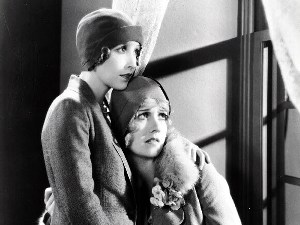
This is the first of at least three film versions of Robert L. Sherwood’s play about an American soldier who falls in love with a Londoner during a World War I air raid, unaware that she is a prostitute. Director James Whale (Frankenstein, The Invisible Man) delivers a solid melodrama with two great lead performers. I was particularly taken with Kent Douglass as Roy. At times, he seemed to display the kind of naturalistic acting style that wouldn’t become popularized until Brando hit the scene decades later. I totally bought Roy’s doe-eyed infatuation with Myra (Mae Clarke), hook, line and sinker. Clark is good with the tremendous amount of pathos the screenplay gives her to work with.
Doctor Zhivago (1965)
[4]
I knew I would eventually have to watch this 3-hour 20-minute behemoth and thank goodness it’s over. Doctor Zhivago is a sprawling epic about the Russian Revolution as seen through the eyes of a doctor (Omar Sharif) who wants to have his cake (his wife is played by Geraldine Chaplin) and eat it, too (his mistress is played by Julie Christie). The first half is dense with plotting and myriad characters — I was getting pretty sleepy. But once Zhivago becomes an exile, I became more alert and the movie picked up speed. Still, when it was all over, I was underwhelmed. He loved two women, he inspired a nation, and I just didn’t care.
Make Way for Tomorrow (1937)
[8]
Leo McCarey won the best director Oscar for The Awful Truth, released the same year, but told the Academy they’d awarded him for the wrong picture. He may be right. Make Way for Tomorrow is a disarming, bonafide love story between an elderly couple (Victor Moore and Beulah Bondi) who are forced to separate when the bank forecloses on their home. The film is remarkably restrained and unsentimental for its time. The characters constantly mask their true feelings, fending off melodrama by acting against our immediate expectations.