
[9]
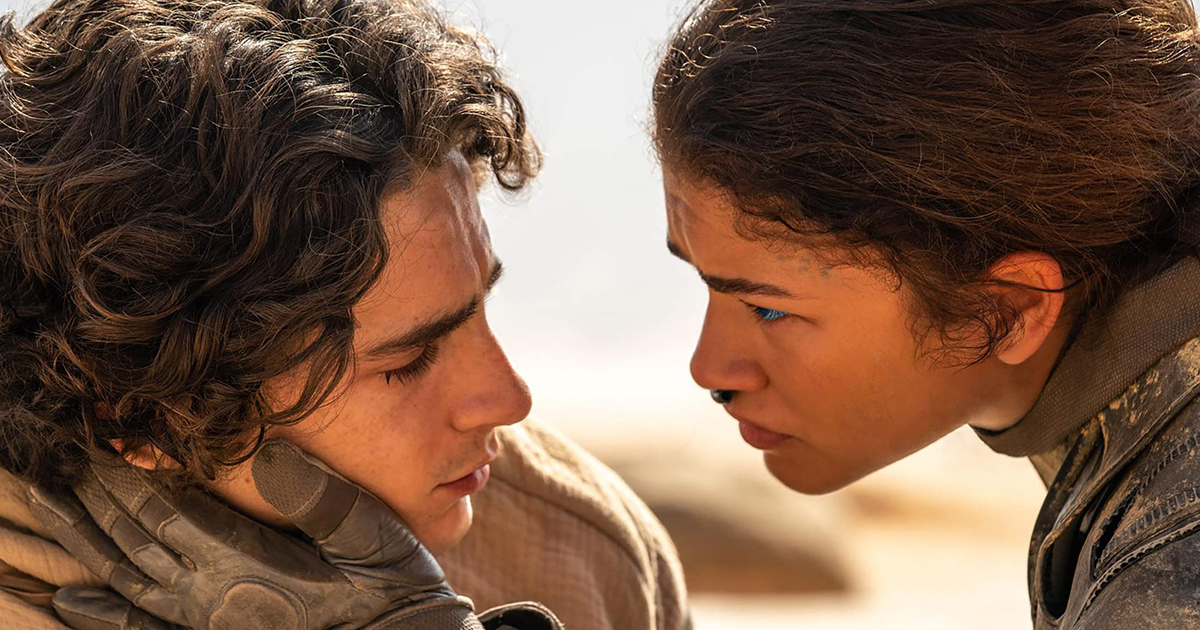
Director Denis Velleneuve (The Arrival, Blade Runner 2049) concludes his adaptation of Frank Herbert’s Dune with Dune: Part Two. The sequel picks up after the massacre of House Atreides at the hands of the vile Baron Harkonnen (Stellan Skarsgard). The baron exiles Paul (Timothee Chalamet) and his mother Jessica (Rebecca Ferguson) to the desert where they are adopted by the native Fremen. While Paul rails against any notion that he is the Fremen’s long-prophesized messiah, a path he foresees leading to ruin, he falls in love with a headstrong Fremen named Chani (Zendaya) who shares his secular beliefs. Meanwhile, Jessica becomes the Fremen’s new reverend mother, a position of power that better enables her to lay the groundwork for her son’s ‘religious’ ascension. As Paul leads the Fremen to successfully bring Harkonnen spice production to a standstill, the Emperor (Christopher Walken) and all the Great Houses convene on Arrakis for a climactic showdown that will change the fates of everyone.
While I really like Dune: Part One but have a few qualms about it, Dune: Part Two exceeds my expectations. The story finally gains its much needed emotional component, as Paul wrestles with his fate, stuck between the expectations of his mother, the Fremen, Chani, and his late father. We can feel the immense weight of consequence on the characters of Paul, Jessica, and Chani. Timothee Chalamet comes to fully and believably inhabit the character of Paul Atreides while Rebecca Ferguson gives a dynamic performance that shifts between loving mother and cold, scheming manipulator. Javier Bardem plays one of the film’s most likable characters, Stilgar, Paul’s Fremen mentor and a true believer in his messianic promise. Perhaps the strongest and most meaningful performance comes from Zendaya as Chani. At first, Chani is skeptical of Paul, yet fascinated by him. As they fall in love, they bond over their shared concerns for the future. Zendaya gives a fierce, moving performance as their relationship is tested by Paul’s ultimate resignation to his destiny.
Since I love David Lynch’s 1984 version of Dune so much, it’s impossible for me to talk about one version without comparing it to the other. While I think Lynch bests Villeneuve in design, and competes with him in adapting the first half of the story, Villeneuve easily beats Lynch’s handling of the back half. There’s no contest. The ’84 Dune skims over the second half of the book very quickly and haphazardly, robbing it of many story details and important character motivations — to say nothing of how it ends quite differently from the book and promotes a completely different message than what Herbert intended. If anything, Villeneuve might include too much of the book’s material in Part Two. The character of Lady Fenring (Lea Seydoux) could probably have been removed entirely, and while it’s important to introduce Paul’s climactic adversary, Feyd-Rautha Harkonnen (feral and ferocious Austin Butler), his earliest scenes don’t advance the plot very much.
I was of two minds about Hans Zimmer’s Oscar-winning score to Part One, thinking it functioned too much as sound design when the film begged for more melodic music to give it that missing emotional component. He compensates with Part Two, delivering one of the most beautiful pieces he’s ever written for Paul and Chani. The film ends with a stirring, climactic rendition of this piece, followed by a serene, solo vocalist version over the end titles.
With Parts One and Two combined, Denis Villeneuve’s Dune is just over five hours long, and it feels right at that length. It may not do everything quite to my liking, but it excels in many ways and ultimately succeeds in its most important function — transporting me to another time and place, and allowing me to fully escape into a world beyond my own.
With Josh Brolin, Dave Bautista, Florence Pugh, and Charlotte Rampling.
Academy Awards: Best Sound, Visual Effects
Oscar Nominations: Best Picture, Cinematography, Production Design