The Lion in Winter (1968)
To Kill a Mockingbird (1962)
[10]
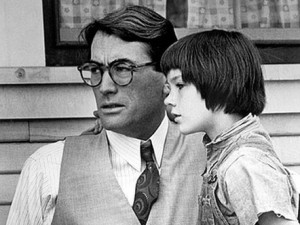
Harper Lee’s Pulitzer Prize-winning novel is lovingly adapted to film by director Robert Mulligan, screenwriter Horton Foote, and producer Alan J. Pakula. Gregory Peck earned the Best Actor Oscar for his portrayal of Atticus Finch, a lawyer of uncompromising morals who puts the safety of his family on the line to defend Tom Robinson (Brock Peters), a black man accused of raping a white woman. Finch is also a widower, raising his two young children with the help of his maid Calpurnia (Estelle Evans). The narrative is made a coming-of-age story through the eyes of Finch’s youngest, the feisty Jean Louise — or Scout (Mary Badham) as she’s nicknamed. Scout’s perspective on racism is balanced with her own fear and ignorance surrounding a neighbor named Boo Radley (Robert Duvall), who turns out to be her salvation when she and her brother are attacked by a bigot seeking revenge on their father.
Rio Bravo (1959)
Auntie Mame (1958)
The Incredible Shrinking Man (1957)
[10]
This terrifying tale of emasculation is my favorite sci-fi/horror flick from the atomic age. Grant Williams stars as Scott Carey, a man who gets caught in a strange mist while boating with his wife. Afterwards, he notices his clothes don’t fit quite like they used to. His wife assures him everything is fine, that he just needs to eat more. A few days later, she finds she no longer has to get on her tip-toes to kiss him, and before you know it, his wedding ring falls right off his shrinking finger.
The Night of the Hunter (1955)
[10]
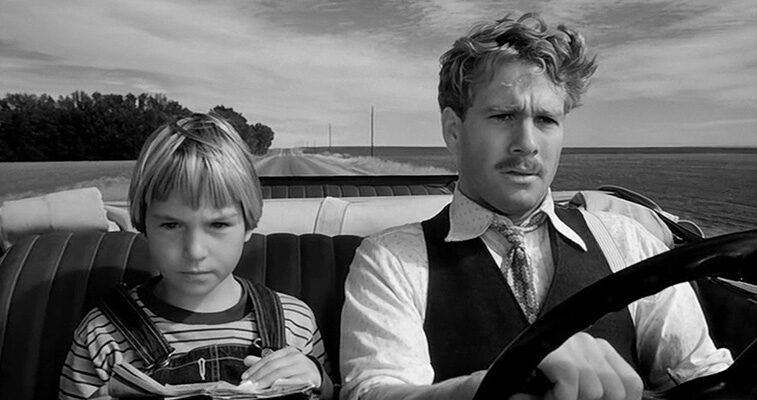
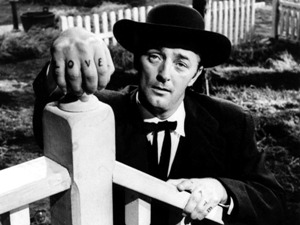
Two small children run for their lives from a murderous preacher in the only film actor Charles Laughton ever directed. The Night of the Hunter is a unique blend — part fable and part thriller, both pastoral and horrific, a beguiling mixture of qualities that usually mark the work of an amateur… or a genius. Laughton is as precise and purposeful as Orson Wells (even using Well’s cinematographer from The Magnificent Ambersons), but there’s also a naive, experimental quality to the film, in the way he mixes realism with German expressionism, and solemnity with odd moments of Tex Avery-style comedy.
All About Eve (1950)
Mrs. Miniver (1942)
The Devil and Daniel Webster (1941)
[10]
William Dieterle’s adaptation of Stephen Vincent Benet’s The Devil and Daniel Webster is a winning combination of rustic Americana and dark fantasy. A cautionary tale of greed and power, the narrative centers around the character of Jabez Stone (James Craig), a down-on-his-luck farmer who is barely able to support his family in 1840s New Hampshire. When the nefarious Mr. Scratch (Walter Houston) appears during a moment of weakness, Jabez agrees to sell his soul in exchange for seven years of good luck. Much to the dismay of his wife (Anne Shirley), mother (Jane Darwell), and beloved politician Daniel Webster (Edward Arnold), Jabez slips into a downward spiral as a result of his newfound wealth and power. When his seven years are up, Jabez learns the error of his ways and wants to make amends. To escape his contract with the Devil, Jabez puts his fate in the hands of the almost mythic Daniel Webster, who represents him in a climactic barn room trial against Mr. Scratch and a jury of the damned. Â