
[9]
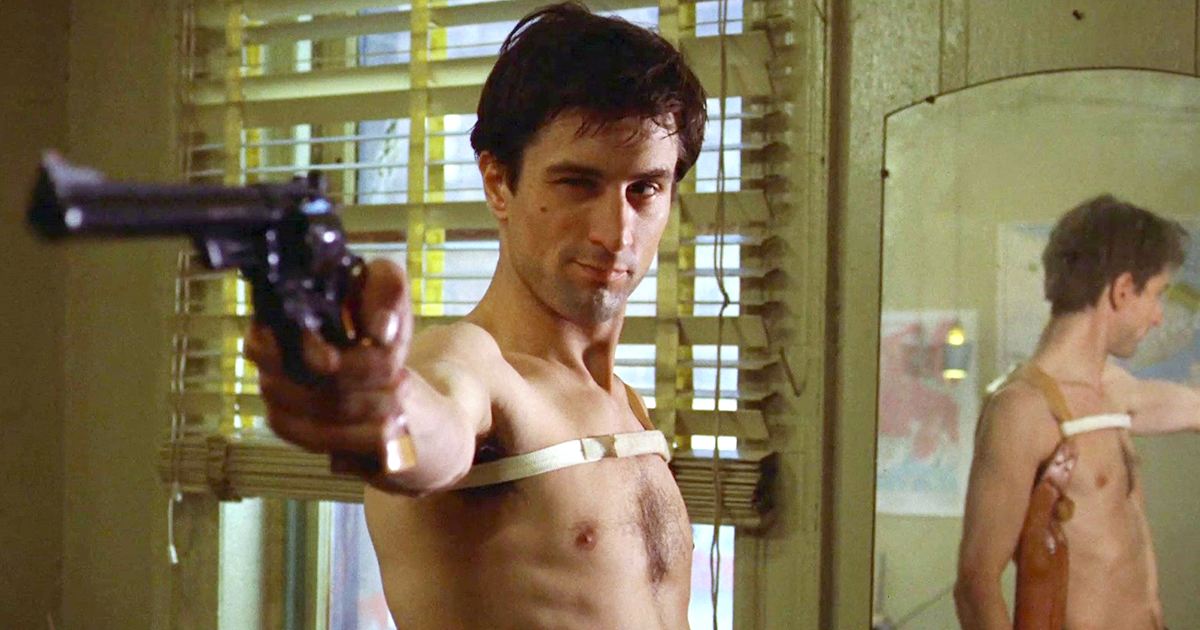
Robert DeNiro stars as Travis Bickle, a New York City taxi cab driver so disgusted with the city’s crime and depravity that he turns to armed vigilantism. After he’s spurned by a beautiful political campaign organizer (The Last Picture Show‘s Cybill Shepherd) he targets the presidential candidate she’s supporting. When that effort is foiled, he switches focus to a pimp (Harvey Keitel) who controls a twelve-year-old prostitute (Jodie Foster) that Bickel feels compelled to rescue — whether she wants it or not.
Taxi Driver is written by Paul Schrader, who seems to relish moral ambiguity in a script that asks us to empathize with a man slowly becoming a monster. It’s an uncomfortable journey, but a revealing one about the restrictive role and expectations forced upon men in the twentieth century. A lot of people say Travis Bickle is mentally ill, but I’m not so sure. He’s sleep-deprived, which always hampers one’s judgment. He’s certainly socially awkward, as evident in his interactions with Shepherd’s character. He’s also without shame, thinking nothing of bringing her to an X-rated porno film and acting surprised when she ends their relationship over it. But are you a monster just because you don’t know how to play coy or navigate the murky waters of courtship?
Bickle tries to open up to a fellow cab driver played by Peter Boyle. It’s the most vulnerable we ever see the character. He tells Boyle he’s disturbed by the world around him and feels an inclination to become violent about it. But Boyle, representing all male friendship here, does what men always do for one another. He pats Bickle on the back and tells him he’ll be fine. Men are great about reassuring one another, but not so great at anything openly deep or meaningful. But Boyle does inspire Bickle with the sentiment that “We are what we do”. So Bickle decides to be the change he wants to see in the world, and he does so by first acquiring an arsenal of weapons.
I’m not saying mental illness isn’t part of Travis Bickle’s problem, but it’s not the whole problem. I see a lot of young men in Travis Bickle. I even see myself in him, to some extent. He’s trying to find a purpose — to be of service, something I think all men seek. But he lacks the grace to get there in any civilized manner. He’s keenly aware of his baser, animal instincts. He boasts to Cybill Shepherd that he felt confident interrupting a conversation she was having with a coworker (Albert Brooks) because he knew he could take Brooks in a fight. We later see Bickle sizing up a secret service agent at a political rally the same way. He’s not ashamed to talk about this alpha male litmus test, just like he’s unashamed to watch porno films or admit he wants to commit violence.
Is he crazy, though? Or is he just uncivilized. Deep down, I bet we all feel like Travis Bickle sometimes. Especially if we have a shitty job like his. Especially if we’re spurned in our romantic efforts. And especially if we have no one else to talk to. Taxi Driver is disturbing not because it’s about a monster, but because it’s about the potential monster in us all. And its ending, which some find ironic or satirical, is actually a corroboration of what we all know is true, no matter how civilized we pretend to be: the primal man wins the girl and the day.
The beauty of Schrader’s screenplay is indeed in its ambiguity, making the film open to interpretation and fun to talk about with other film lovers. Director Martin Scorsese (Goodfellas, The Departed) lends a gritty, slow-motion, smoke-and-neon dream quality, while legendary composer Bernard Herrmann (his final film) delivers a memorable score merging snare drums and distant trumpets with a forlorn saxophone, beautifully capturing Bickle’s military past and his current loneliness. All this, combined with DeNiro’s electrifying performance and creative editing by Marcia Lucas (Star Wars), makes Taxi Driver a dark cinematic delicacy.
Oscar Nominations: Best Picture, Actor (Robert DeNiro), Supporting Actress (Jodie Foster), Score (Bernard Herrmann)