The Hours (2002)
The Iron Giant (1999)
[9]
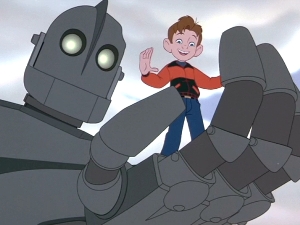
“What if a gun had a soul?” That’s how director Brad Bird pitched The Iron Giant to Warner Bros. Animation. The gun in question is The Iron Giant himself, a robot of unknown origin that crash lands on Earth in 1957, at the height of the atomic scare. He dents his head and can’t remember where he’s from or why he exists. He befriends a boy named Hogarth, a savvy little kid raised by a single mother, whose seen enough science-fiction movies to know how the public will react to his extra-terrestrial friend. With the help of a local beatnik artist, Hogarth keeps the giant hidden from a snooping government official, all while forging a poignant relationship with the impressionable robot.
The Talented Mr. Ripley (1999)
Fly Away Home (1996)
[9]
Angus (1995)
Toy Story (1995)
[9]
A terrific script and loveable characters send Toy Story soaring. At the heart of the simple storyline are two toys with character arcs as compelling as any of their live-action counterparts. Woody (Tom Hanks) is a pull-string cowboy who’s afraid of being replaced as his owner’s favorite, and Buzz (Tim Allen) is the new, gadget-enhanced astronaut who doesn’t accept the fact that he’s a toy. The Oscar-nominated screenplay (co-written by Joss Whedon) deftly blends character, humor, and action. The climax, where Woody and Buzz chase after a moving truck to rejoin their fellow toys, is a particularly thrilling scene. The voice cast is also a triumph, including Wallace Shawn as a neurotic dinosaur, Don Rickles as a bitter Mr. Potato Head, and Jim Varney as a trusty Slinky Dog. Randy Newman’s score makes the plight of plastic playthings nothing less than epic, and his cozy songwriting fits the nature of the film to a tee. “You’ve Got a Friend in Me” is the film’s charming anthem, but it’s Newman’s performance of “I Will Go Sailing No More,” played over Buzz’s realization of his limitations, that works most powerfully.
The Adventures of Priscilla, Queen of the Desert (1994)
The Living End (1992)
Fried Green Tomatoes (1991)
[9]
It may be steeped in sentiment and nostalgia, but Fried Green Tomatoes doesn’t need to use them as a crutch to elicit a powerful emotional response. It’s got bigger guns than that: character and storytelling. It’s one of the rare movies that successfully captures the importance of real, honest-to-God friendship, whether its reflected in the toned-down affection between Mary Stuart Masterson and Mary-Louise Parker (whose characters are lesbians in Fannie Flagg’s novel), or in the budding friendship of Kathy Bates and Jessica Tandy. It’s a marvel that the movie can cut back and forth between the two story lines and keep both equally interesting.